
Neanderthal wooden tools from Spain found preserved in stone
When the world thinks of the Stone Age, the first image that springs to mind is a flint blade or a chipped stone point—tools that have survived the ravages of time because stone resists decay.
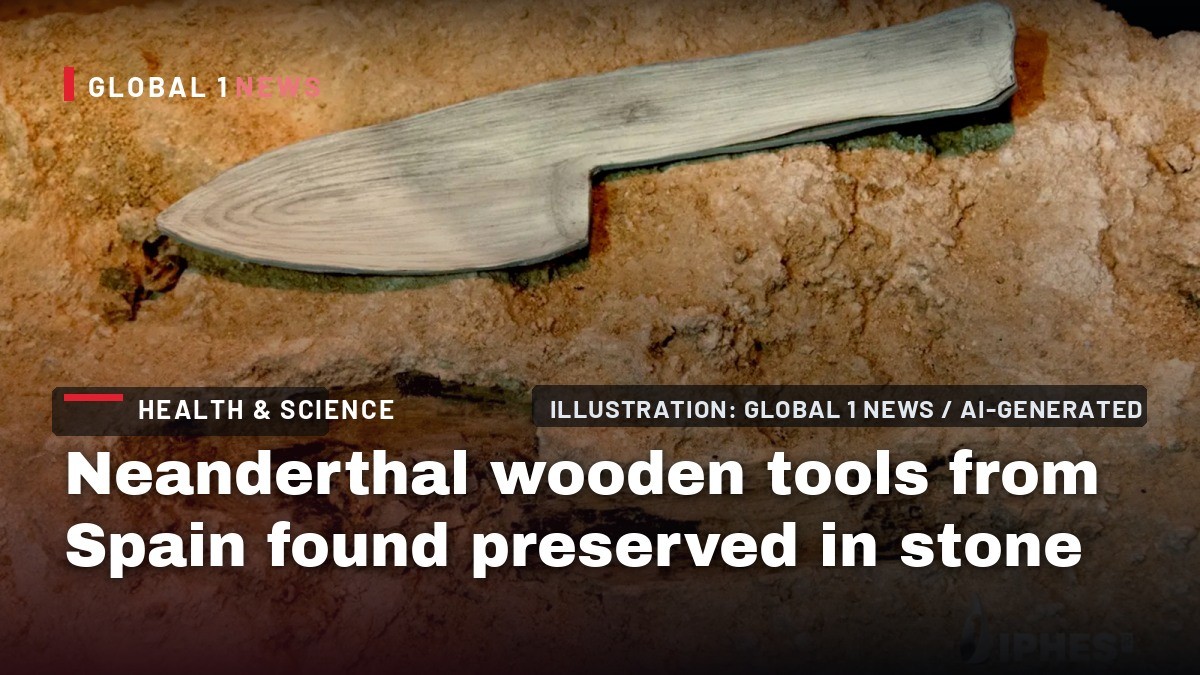
When the world thinks of the Stone Age, the first image that springs to mind is a flint blade or a chipped stone point—tools that have survived the ravages of time because stone resists decay. Yet the raw material that early humans most likely favored was wood, a substance that can be shaped with a fraction of the effort required for stone. The problem? Wood rots, leaving only a thin archaeological footprint. That gap in our record has just been narrowed dramatically by a team of Spanish archaeologists who have uncovered a trove of Neanderthal wooden tools preserved in an unlikely mineral crust at the Abric Romaní rock shelter, west of Barcelona. Their findings, detailed in a new study in Science Advances, force us to rethink the sophistication of Neanderthal daily life and to recognize that their technological repertoire extended far beyond the hunting spear.
From Stone to Wood: Why This Discovery Matters
The classic narrative of Paleolithic technology has long been built on stone because it survives where wood does not. As the Ars Technica article notes, the Stone Age owes its name to the durability of lithic artifacts. However, the same piece points out that wood was “probably… easier to process,” suggesting that the archaeological record has been skewed toward stone simply because of preservation bias. The Abric Romaní site overturns that bias by providing a rare window into the wooden side of Neanderthal life.
What makes the Abric Romaní finds extraordinary is the natural “casting” process that occurred when mineral‑rich spring water deposited a limestone‑like crust over wooden objects. As the wood decayed, it left hollow molds that are exact negatives of the original pieces, even preserving the outlines of wood cells under a microscope. This natural preservation method, combined with modern 3D scanning and printing, has turned what would have been invisible decay into a detailed catalog of 597 wooden remains spanning roughly 20,000 years—from 62,000 to 40,000 years ago.
The Scope of the Find: 597 Remains, 13 Tools
Out of the 597 wooden impressions cataloged, the overwhelming majority are natural elements—fallen branches, trunks, and firewood, primarily Scots pine. Only 13 of the molds display modifications that can be confidently attributed to Neanderthal hands. As lead archaeologist M. Gema Chacón of IPHES‑CERCA emphasizes, “The morphology of these 13 tools is impossible to find in nature.” This tiny subset, however, is enough to illustrate a broad spectrum of activities.
The identified tools include four shallow trays made from juniper bark, a branchless pole over five meters long, a pointed stick, two spears, and a uniquely shaped club. The trays, measuring up to 55 × 20 cm, were recovered near hearths and likely served to carry food or scoop embers—functions reminiscent of the bark dishes used by Aboriginal Australians. The long pole, found leaning against the shelter wall, appears to have been part of a simple windbreak or hut structure, a hypothesis supported by experimental reconstructions that suggest a five‑meter length is ideal for such a shelter.
Hunting Gear Revisited: Spears and a Club
Wooden spears are not new to the archaeological record; the article references well‑known finds from Schöningen (Germany), Clacton‑on‑Sea (England), and Lehringen (Germany), all recovered from waterlogged sediments that slowed decay. Those weapons have primarily informed our understanding of Neanderthal hunting practices. The Abric Romaní spears, however, were discovered in a living area rather than a kill site, offering a different context.
The best‑preserved spear measures 2.45 m in length, and a cast of its tip shows an impact fracture identical to those seen on spears used by Aboriginal Australians—damage that occurs when a point strikes bone. Its proximity to red‑deer antler skulls suggests it was employed in the final stages of a kill or perhaps in butchering. Yet the most striking find is the club, carved from a single piece of wood with a 16‑cm handle and a roughly triangular head about 14 cm tall. The abrupt right‑angle step where the head meets the handle would have prevented slippage, indicating purposeful ergonomic design.
Beyond the Hunt: Everyday Woodworking
What sets Abric Romaní apart from earlier sites is the diversity of wooden implements that extend beyond hunting. The presence of bark trays, a long pole, and a club points to routine woodworking activities embedded in daily life. Chacón notes that because wood appears “level after level” in the stratigraphy, woodworking was a regular, not occasional, practice for Neanderthals.
The choice of raw materials further underscores this routine. Scots pine, which dominates the firewood and tool assemblage, is easy to work and dries quickly, making it ideal for cheap, replaceable implements. Juniper bark, with its fibrous quality, was selected for trays. This selective procurement mirrors the way Neanderthals chose stone—“they knew exactly what they wanted to make,” Chacón says, implying a level of planning and cognitive complexity that challenges the outdated view of Neanderthals as merely “dumber cousins” of Homo sapiens.
Living Spaces: Hearths, Shelters, and Social Organization
The shelter’s layout reveals a sophisticated use of space. Along the back wall, a row of small hearths—about 50 cm across and spaced roughly a meter apart—lacks surrounding debris, leading Chacón to hypothesize they served as “sleeping hearths.” Such hearths would have provided illumination and protection from carnivores, suggesting an organized communal sleeping area.
In the shelter’s “busy end,” large overlapping hearths are surrounded by animal bones, stone‑knapping debris, and firewood, indicating zones for food preparation, tool production, and communal meals. The discovery of a pole leaning against the wall, likely forming a windbreak, further demonstrates an intentional structuring of living space. These spatial patterns, combined with the variety of wooden tools, paint a picture of Neanderthals who managed domestic interiors, organized work zones, and possibly engaged in social rituals around fire.
Implications for Neanderthal Cognition
The Abric Romaní assemblage adds weight to a growing body of evidence that Neanderthals possessed complex cognitive abilities. Prior research has documented their use of cordage, symbolic objects, and interbreeding with modern humans. The new wooden tools extend that narrative by showing deliberate material selection, ergonomic design, and multi‑purpose domestic technology.
Anthropologists studying recent hunter‑gatherer societies note that clubs are employed not only for hunting but also for close‑range combat, work, and as status symbols. While the exact function of the Romaní club remains uncertain, its context—found among hearths, bones, and stone tools—suggests everyday utility rather than ceremonial use. Even so, its sophisticated shape indicates an understanding of leverage and hand safety, hallmarks of purposeful tool design.
Future Directions: From Casts to New Questions
The methodological breakthrough at Abric Romaní—using mineral crusts as natural molds and then digitizing them with 3D scanning and photogrammetry—opens a new avenue for uncovering perishable artifacts at other sites. By creating precise 3D‑printed replicas, researchers can study form and function without risking damage to fragile originals, and museums can display accurate models for public education.
Chacón’s team plans to apply this technique to other rock shelters and caves where mineral deposits may have similarly encased organic materials. Each new find will refine our picture of Neanderthal life, potentially revealing more tools, containers, or even musical instruments that have long been lost to decay. As the study’s authors suggest, the Abric Romaní tools may serve as a comparative benchmark for interpreting wooden remains elsewhere, helping to fill the “missing wood” gap that has long skewed our understanding of Paleolithic technology.
This article was produced with AI-assisted research and editorial support. Reporting is based on the source material cited below. Sources: Ars Technica; arstechnica.com; Global1.News (13 October 2026).
By Jessica Ali, Staff Writer
What's Your Reaction?
 Like
0
Like
0
 Dislike
0
Dislike
0
 Love
0
Love
0
 Funny
0
Funny
0
 Wow
0
Wow
0
 Sad
0
Sad
0
 Angry
0
Angry
0

Editor-in-Chief at Global1.News. Atlanta-based journalist who cuts through the BS and tells it like it is. Lead anchor, host, and the voice you hear when the spin stops and the truth starts.















Comments (0)