
Ukrainian Drone Attack on Volgograd: Refinery and Warehouses Ablaze as Russia's Fuel Crisis Deepens
Folks, explosions ripped through Volgograd overnight as Ukrainian drones slammed into an energy facility and a massive logistics hub, sending flames and thick black smoke into the sky and leaving five people seeking medical care. This was no isolated hit. It capped a furious 72-hour barrage that has now touched refineries, ports, and warehouses deep inside Russia, and the damage is starting to bite hard on Moscow's ability to keep its war machine fueled.
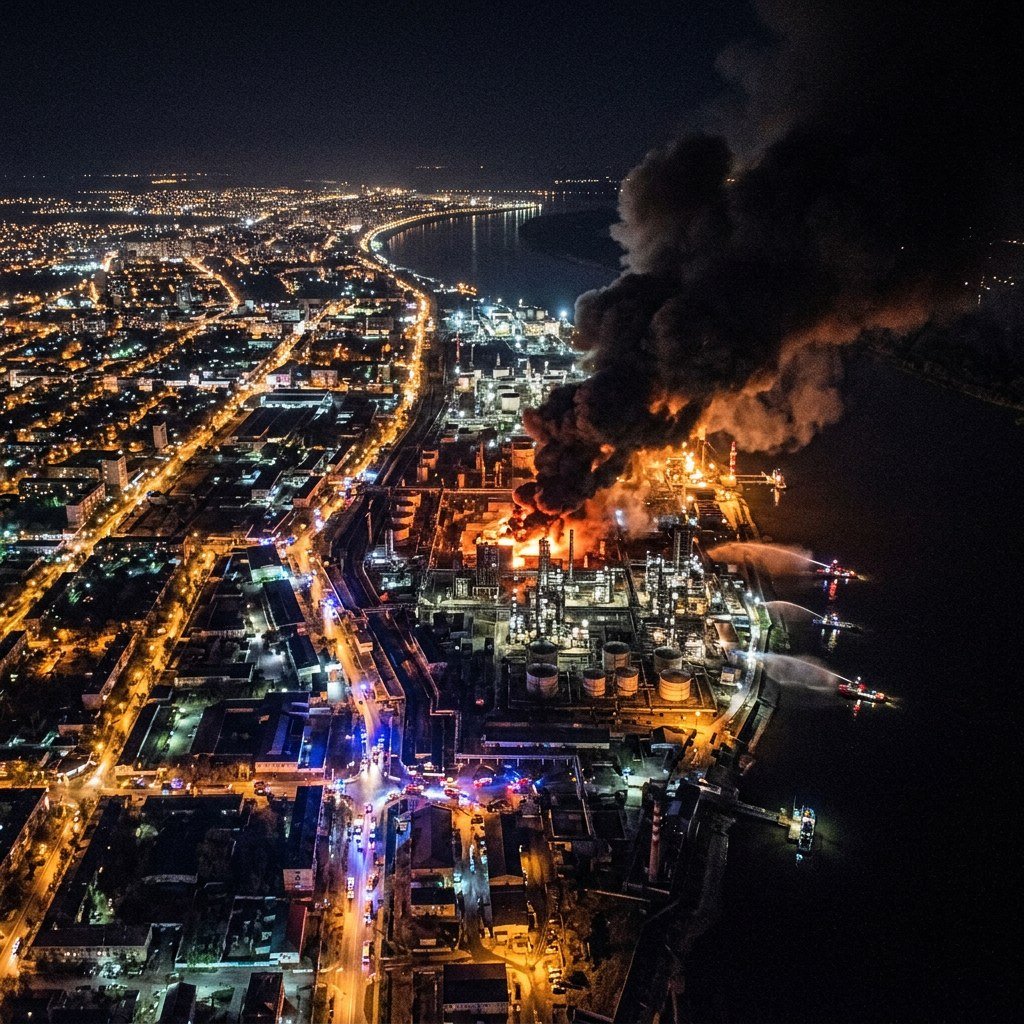
Folks, explosions ripped through Volgograd overnight as Ukrainian drones slammed into an energy facility and a massive logistics hub, sending flames and thick black smoke into the sky and leaving five people seeking medical care. This was no isolated hit. It capped a furious 72-hour barrage that has now touched refineries, ports, and warehouses deep inside Russia, and the damage is starting to bite hard on Moscow's ability to keep its war machine fueled.
Volgograd Under Fire
The strikes landed on the night of July 31, 2026. Regional governor Andrei Bocharov reported that drones hit an energy facility and warehouses, touching off fires that were still burning into Friday morning. Reuters confirmed the blaze at the energy site and said five people were seeking medical help. Earlier accounts from Caliber.Az had put the injured at three, including a child, but Bocharov updated the toll on Telegram.
Moscow said its air defenses were repelling what TASS quoted the Defense Ministry calling a "massive terrorist attack" on energy and civilian infrastructure. Yet several drones got through. One crashed on the grounds of the Yagodka kindergarten. Another damaged an apartment in the nearby city of Volzhsky. A factory in southern Volgograd also caught fire, and emergency crews spent the night hunting for drone debris.
Charter97 and open-source monitoring channels reported direct hits on the Wildberries distribution center, a 44,000-square-meter logistics complex that serves Volgograd, Astrakhan, and surrounding regions, plus the Lukoil-Volgogradneftepererabotka oil refinery. That refinery processes more than 15 million metric tons of crude a year, roughly 5.6 percent of Russia's total refining volume, and is the biggest supplier of fuels and lubricants in the Southern Federal District. The scale of the complex means any sustained outage ripples quickly through fuel distribution networks that support both civilian transport and military logistics in the south.
A City of Symbolic Weight
Volgograd was formerly known as Stalingrad, the site of one of World War II's bloodiest battles. The city holds deep symbolic importance to Russia, and strikes there carry added weight for Russian morale beyond the immediate physical damage to infrastructure.
The Human Cost
Five people sought medical help in Volgograd following the strikes, and the pain stretched beyond the city limits. In the neighboring Rostov region, a woman was injured in the town of Gukovo after a drone strike, according to governor Yuri Slyusar. Local emergency services worked through the early hours to contain secondary fires, underscoring how quickly one successful strike can stretch response resources thin.
The human toll of this campaign has been building for weeks. Earlier strikes on Wildberries sites in Tambov and Elektrostal killed eight people and injured 62, according to Russian officials. Tambov governor Evgeniy Pervyshov said seven workers on the night shift "died on the spot," calling it the "largest and most inhumane" attack on the region in terms of drones used and casualties. Most of the 25 injured there suffered shrapnel wounds, he said, with seven in serious condition. In the Moscow region, governor Andrei Vorobyov said eight of the injured at Elektrostal were in serious condition and that 48 drones were shot down overnight, while a falling drone also struck a Russian oil depot in what he called the incident with "the most serious consequences." Wildberries CEO Tatyana Kim, one of Russia's first female billionaires, described it as a "terrible night" for Russia and the company. In Ryazan, six people were hospitalized with non-life-threatening injuries, governor Pavel Malkov confirmed.
Seventy-Two Hours of Escalation
This Volgograd strike fits a clear week-long surge. On July 28, roughly 400 drones reportedly struck Moscow. On July 29, Ukraine hit the Ryazan Oil Refinery, which processes over 17.1 million tonnes of oil annually and accounts for about 5 percent of Russia's refining capacity, along with a Wildberries warehouse there. The same day, Ukrainian forces struck the Lukoil-Permnefteorgsintez refinery in Perm, a facility that handles about 13 million metric tons of crude per year, with Ukraine's General Staff confirming the hit.
On July 30, drones attacked the key port of Taman in Krasnodar Krai, damaging infrastructure and causing casualties. NASA's FIRMS satellite picked up at least ten large fire hotspots inside the port area. Taman is a crucial hub that moves petroleum products and goods to Crimea. Also on July 30, FP-1 drones struck the Wildberries logistics hub in Penza.
Folks, the tempo left little room for Russian repair crews to catch their breath. Moscow absorbed hundreds of drone incursions, Ryazan and Perm saw major refineries knocked offline, Taman's port lit up with multiple fire signatures, and Penza's logistics hub joined the list of damaged sites. Each location feeds the same supply chain that moves fuel and components southward and westward. When several points in that chain go dark at once, the knock-on effects compound faster than any single strike would suggest.
Refining Capacity Crushed
The cumulative effect on Russia's oil sector is severe. Ukrainian strikes have knocked out roughly one-fifth of refining capacity, dropping output from 5.2 million barrels a day before the war to about 3.8 million now, the lowest level in 21 years, per the Oxford Institute for Energy Studies. After the July 29 strikes alone, crude processing fell to a 21-year low of 3.91 million barrels per day. Kyiv claims nearly 43 percent of Russia's oil refining capacity has been disabled, though that figure has not been independently verified.
Every barrel that cannot be processed at home tightens the domestic market and forces harder choices about where remaining fuel goes, civilian pumps or military depots. Russia's refining throughput has not sat this low since the early 2000s, and the latest drop came in a single week of strikes.
Fuel Shortages at Home
The refining losses hit ordinary Russians where they live. Diesel is critical for agriculture and freight, while jet fuel powers domestic aviation, so shortages squeeze consumers, farmers, and industry, not just the military. President Vladimir Putin made a rare admission in June 2026 that Ukrainian attacks had caused the fuel shortages, and signed into law a bill in early July aimed at boosting supplies to the domestic fuel market. Russia has also extended its fuel export ban until 2027 to protect domestic availability, according to officials. The hits on Taman further threaten the flow of petroleum products to Crimea and other southern markets.
Why Wildberries Keeps Getting Hit
Wildberries, often called Russia's Amazon, merged into the RWB group valued at about $12.6 billion by Forbes Russia in 2026 and controls nearly half the country's e-commerce sector, handling millions of products daily. President Volodymyr Zelensky has said the facilities struck were used to supply sanctioned components for drone production and navigation equipment to the Russian army, and that the warehouse strikes were a response to "Russian strikes on our civilian infrastructure and on our cities and communities."
Serhii Kuzan of the Ukrainian Security and Cooperation Centre told the BBC that Wildberries serves as a vital logistics node. Its website has been used by Russian volunteers to buy walkie-talkies, body armour, and drone components. The primary goal of the strikes, he said, is to disrupt Russian logistics and the supply of dual-use goods to the military, with secondary effects on the broader economy and public support for the war. The repeated targeting of these hubs shows Kyiv views them as choke points where civilian and military supply lines intersect. Russia has targeted similar facilities in Ukraine since the start of the war, including Ukraine's postal service and electronics distributors, the BBC reported.
The company itself has felt the pressure. After the Ryazan strike, Wildberries said access to its warehouse there was "temporarily restricted" while operations were assessed. The Express reported that the retailer also launched a promotional campaign encouraging Russians to support vendors affected by the warehouse strikes, a sign of how central these hubs have become to everyday commerce in Russia.
Legitimate Targets or Not
Ukraine maintains that Russian oil and gas facilities are fair game because Moscow depends on fossil fuel exports to finance the full-scale invasion that began in February 2022. The string of refinery and port strikes this week shows Kyiv is willing to keep pressing that advantage even as Russian air defenses claim partial success. Each successful hit reduces the revenue stream that funds the war while also complicating the movement of goods inside Russia itself.
Bottom-Line Assessment
Folks, the numbers tell the story. Russia has lost a fifth of its refining capacity in months, fuel shortages are real enough for Putin to acknowledge them publicly, and key logistics hubs that move both civilian goods and military components are burning. The Volgograd attack overnight fits the same playbook used in Ryazan, Perm, Taman, and Penza. Ukrainian forces are systematically targeting the infrastructure that keeps Russia's war economy running. How long Moscow can absorb these losses without deeper domestic pain remains the open question.
By Jessica Ali, Staff Writer
This article was produced with AI-assisted research and editorial support. Reporting is based on sources cited in the article.
What's Your Reaction?
 Like
0
Like
0
 Dislike
0
Dislike
0
 Love
0
Love
0
 Funny
0
Funny
0
 Wow
0
Wow
0
 Sad
0
Sad
0
 Angry
0
Angry
0

Editor-in-Chief at Global1.News. Atlanta-based journalist who cuts through the BS and tells it like it is. Lead anchor, host, and the voice you hear when the spin stops and the truth starts.















Comments (0)