
Türkiye, Egypt and Qatar Condemn Israeli Attacks in Gaza as Ceasefire Frays
The fragile ceasefire in Gaza faced its most serious test yet on Thursday as Türkiye, Egypt and Qatar issued a joint condemnation of recent Israeli attacks that killed civilians, including women and children, and warned that the escalation threatens to unravel the painstakingly negotiated truce.
The fragile ceasefire in Gaza faced its most serious test yet on Thursday as Türkiye, Egypt and Qatar issued a joint condemnation of recent Israeli attacks that killed civilians, including women and children, and warned that the escalation threatens to unravel the painstakingly negotiated truce. The three mediating countries, in a sharply worded statement carried by Anadolu Agency, expressed "deep concern" over what they described as continued violations of the agreement and said the intensification of Israeli military operations was undermining regional and international efforts at a critical stage of implementation.
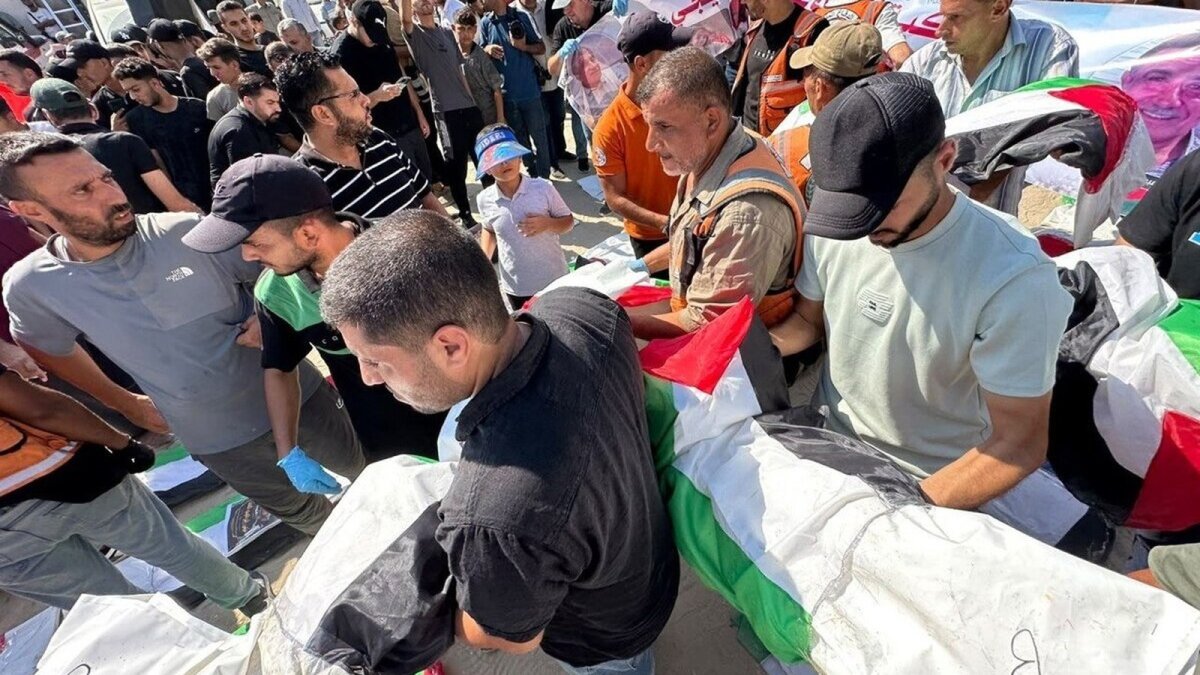
The joint statement comes amid mounting evidence that the ceasefire, brokered after months of intense diplomacy and endorsed by the United Nations Security Council, is buckling under the weight of repeated violations. Palestinian medical sources reported that funerals were held at the Al-Shifa Medical Complex in Gaza City for 50 Palestinians whose bodies were recovered from the rubble of buildings destroyed in recent strikes, a grim accounting of the human cost of the escalation. The dead included civilians, among them women and children, according to the mediators' statement, though figures were not immediately available for the total number of casualties across the enclave since the latest round of attacks began.
Mediators Demand Full Israeli Compliance
In their joint statement, the foreign ministries of Türkiye, Egypt and Qatar stressed "the imperative for Israel to fully comply with all its obligations under the ceasefire agreement and to refrain from actions that could further undermine the ceasefire and escalate tensions." The three countries, which have served as the primary mediators throughout the negotiation process, said intensive efforts were underway to implement what they called the Comprehensive Plan to End the Gaza Conflict, citing a recent meeting between the Board of Peace and Israeli officials as well as "constructive steps" in the negotiation process.
The statement pointed to the "devastating consequences of the continued Israeli aggression" in the region and renewed the mediators' call on the international community and the Board of Peace, under the leadership of President Donald Trump and as endorsed by UN Security Council Resolution 2803, to take the necessary steps to ensure compliance with the ceasefire and to exert effective pressure to prevent further escalation. The reference to the Board of Peace, a mechanism established as part of the broader diplomatic framework, signals that the mediators view the current crisis as a direct challenge to the entire architecture of the agreement.
The timing of the joint condemnation is significant. It comes just days after a meeting between the Board of Peace and Israeli officials, which the mediators had described as constructive, and amid reports of renewed diplomatic engagement involving US envoy Jared Kushner. The mediators' decision to issue a public statement rather than pursue quiet diplomacy appears to signal growing frustration with Israel's conduct and a calculation that public pressure is now necessary to preserve the agreement.
Hamas Rejects Israeli Account of Police Station Strike
At the center of the current crisis is a strike on a police headquarters in Gaza City on Wednesday afternoon that killed nine people and wounded several others, according to Palestinian sources. The Israeli military described the strike as a targeted operation against Hamas field commanders and identified the head of Gaza's women's police force among those targeted. But Hamas rejected the Israeli account, saying those killed were predominantly police officers and personnel, and accused the Israeli government of seeking to obstruct the implementation of the ceasefire.
In a statement issued Wednesday evening, Hamas said Israeli assertions that the strike targeted resistance leaders were "baseless," arguing that the claims were being used to justify attacks on Gaza's police force and civilians. The group linked the timing of the strike to recent diplomatic efforts involving mediators and guarantors of the Gaza agreement, including the meetings with Kushner, and accused Prime Minister Benjamin Netanyahu's government of deliberately undermining those efforts. Hamas warned that continued strikes could derail negotiations over completing the roadmap and implementing subsequent phases of the ceasefire.
The dispute over the police station strike encapsulates the broader challenge facing the ceasefire. Israel maintains that it retains the right to target what it describes as military infrastructure and personnel, even during a truce. Hamas and the mediators counter that the agreement requires a complete cessation of hostilities and that attacks on police forces, which are responsible for maintaining civil order in Gaza, constitute a fundamental violation of the terms. The police force in Gaza operates under the de facto administration of Hamas but is widely seen as a civilian institution responsible for public safety, a distinction that appears to have been lost in the Israeli targeting calculus.
Human Cost Mounts as Bodies Recovered From Rubble
The human toll of the recent escalation was visible at the Al-Shifa Medical Complex in Gaza City, where families gathered to bury 50 Palestinians whose bodies were recovered from the rubble of destroyed buildings. Palestinian medical sources described scenes of grief and anger as bodies wrapped in white shrouds were carried through the hospital courtyard, with women and children among the dead. Medical staff at the complex, already stretched thin by months of conflict and blockade, said they were struggling to cope with the influx of casualties.
The recovery of bodies from the rubble is a particularly painful reminder of the war's toll. For weeks, families have waited for news of relatives missing under collapsed buildings, hoping against hope that they might be found alive. The recovery operations, conducted by Palestinian civil defense teams working without adequate equipment, have been slow and dangerous, with the constant threat of further collapse. Each body recovered brings closure for one family but opens wounds for the community as a whole, as the scale of the destruction becomes ever more apparent.
Local officials said the recent strikes have targeted not only police facilities but also residential areas, markets and infrastructure, compounding an already dire humanitarian situation. The Gaza Strip, which has been under a blockade for nearly two decades, was already facing catastrophic conditions before the latest escalation, with widespread unemployment, food insecurity and a collapsing health system. The renewed violence has set back even the limited reconstruction efforts that had begun under the ceasefire, and residents say they are losing faith in the ability of the agreement to deliver the relief they were promised.
Ceasefire at a Crossroads
The current crisis raises fundamental questions about the viability of the ceasefire and the willingness of the parties to honor their commitments. The mediators, who invested enormous political capital in brokering the agreement, now find themselves in the difficult position of trying to salvage a process that appears to be unraveling. Their joint statement, with its pointed language about Israeli obligations and its reference to "continued Israeli aggression," suggests that they hold Israel primarily responsible for the current deterioration.
But the challenges are not one-sided. Hamas, for its part, has yet to fully implement its own obligations under the agreement, including the release of hostages and the demobilization of its armed wing. The group's warning that the ceasefire could collapse and its decision to hold the mediators responsible for restraining Israel reflect a deep mistrust of Israeli intentions and a calculation that public pressure is its most effective tool. The mediators, caught between the parties, are walking a tightrope, trying to keep both sides engaged while preventing a return to full-scale war.
The reference to UN Security Council Resolution 2803 in the joint statement is a reminder that the ceasefire has international legal backing and that the parties are bound by its terms. But resolutions and statements, however strongly worded, have limited power to compel compliance on the ground. The mediators' call for the international community to "exert effective pressure" on Israel is an acknowledgment that diplomatic language alone will not be sufficient to preserve the agreement. What that pressure might look like, and whether it will materialize, remains to be seen.
Regional Implications and the Path Forward
The stakes extend far beyond Gaza. The ceasefire agreement was seen as a cornerstone of a broader regional realignment, with the Board of Peace process intended to pave the way for normalization agreements and a new security architecture in the Middle East. The collapse of the ceasefire would not only return Gaza to war but would also deal a severe blow to these wider efforts, undermining the credibility of the mediators and the international framework they have constructed.
For the people of Gaza, the immediate concern is more basic: survival. The ceasefire brought a measure of relief, allowing families to emerge from shelters, markets to reopen and children to return to what passes for normal life in the enclave. The recent strikes have shattered that fragile sense of security, and residents are bracing for the possibility that the truce will not hold.
The mediators have said they remain committed to the implementation of the Comprehensive Plan to End the Gaza Conflict and are continuing their intensive efforts to bring the parties back into compliance. But their statement also carried an implicit warning: that the current trajectory is unsustainable and that the international community must act decisively to prevent a return to full-scale hostilities. Whether that warning will be heeded, and whether the ceasefire can be salvaged, will become clearer in the coming days as the parties weigh their options and the mediators press their case.
For now, the ceasefire hangs in the balance, and with it the hopes of two million Palestinians in Gaza who have endured years of war and displacement. The funerals at Al-Shifa Medical Complex are a stark reminder of what is at stake, and of the cost of failure. The mediators have spoken; the question is whether anyone is listening.
This article was produced with AI-assisted research and editorial support. Sources: Middle East Monitor, Anadolu Agency.
By Fatima Al-Rashid, Staff Writer
What's Your Reaction?
 Like
0
Like
0
 Dislike
0
Dislike
0
 Love
0
Love
0
 Funny
0
Funny
0
 Wow
0
Wow
0
 Sad
0
Sad
0
 Angry
0
Angry
0

Gulf/MENA Correspondent at Global1.News. Based in Doha, covering Gulf politics, energy markets, diplomacy, and development across the Middle East and North Africa. Tracks the economic transformation of the Gulf states.














Comments (0)