
Putin's Visit to Disputed Island Exacerbates Japan-Russia Tensions
A Provocative Landing on Iturup Russian President Vladimir Putin visited Iturup Island on August 13, 2026, marking the first time he has personally set foot on the disputed Southern Kurils. Known in Japan as Etorofu, Iturup is the largest of the four islands that constitute the Northern Territories, a chain occupied by Soviet forces in the final days of World War II and claimed by Tokyo ever since. The visit, which included a stop at a secondary school honoring a Russian soldier killed in Ukrai
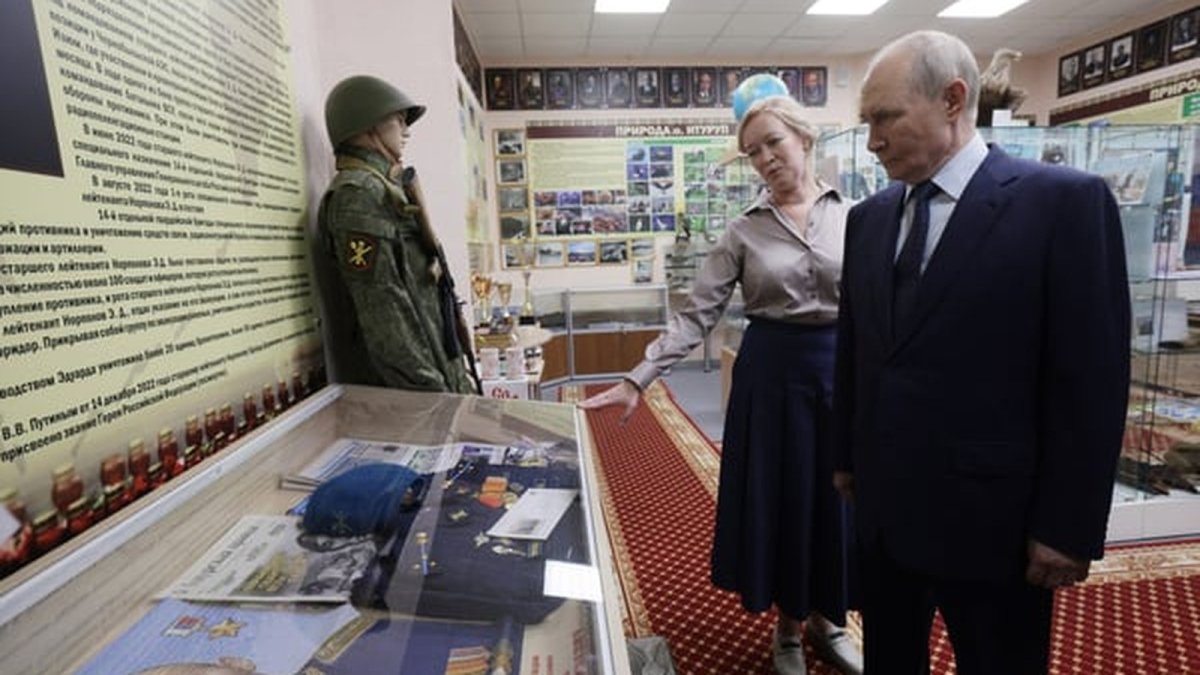
A Provocative Landing on Iturup
Russian President Vladimir Putin visited Iturup Island on August 13, 2026, marking the first time he has personally set foot on the disputed Southern Kurils. Known in Japan as Etorofu, Iturup is the largest of the four islands that constitute the Northern Territories, a chain occupied by Soviet forces in the final days of World War II and claimed by Tokyo ever since. The visit, which included a stop at a secondary school honoring a Russian soldier killed in Ukraine, has injected fresh volatility into an already frozen bilateral relationship.
The timing was deliberate. Putin arrived on the island two days before the 81st anniversary of Japan's announcement of its intent to surrender in World War II, a period of heightened sensitivity in Tokyo regarding territorial conquest and historical grievances. The visit also comes as Russia prepares for its first lower house election since the 2022 invasion of Ukraine, scheduled for September. Domestic political considerations in Moscow, combined with a strategic calculation about Japan's current diplomatic constraints, appear to have driven the decision.
This is not the first time a Russian leader has visited the disputed territory. Then-President Dmitry Medvedev traveled to the islands in 2010, a move that triggered a sharp diplomatic rebuke from Tokyo. However, Putin's personal visit elevates the provocation to a new level, signaling that Moscow is no longer willing to maintain even the pretense of negotiating over the islands' status.
Tokyo's Escalated Response
Prime Minister Takaichi Sanae responded on the same day as Putin's visit with a televised statement that was notably more forceful than standard Foreign Ministry protests. She declared that the trip "hurts the feelings of the Japanese people and is absolutely unacceptable," adding that the Russian side must "take the seriousness of the matter fully to heart." In remarks to reporters, she acknowledged that the visit "has further hardened public sentiment toward Russia in Japan, making it difficult to restore relations over the medium to long term."
The decision to have the prime minister personally deliver the protest, rather than delegating it to the Ministry of Foreign Affairs, is significant. According to reporting in The Japan News, Takaichi believes the prime minister must take a strong personal stance on territorial issues. This reflects a broader shift in Japanese political culture, where territorial sovereignty has become a matter of prime ministerial prerogative rather than bureaucratic routine. The escalation to the highest political level, however, cuts both ways: it signals resolve to domestic audiences but also makes quiet de-escalation considerably more difficult for future administrations.
Russia's response was swift. Deputy Foreign Minister Mikhail Galuzin summoned Japan's ambassador in Moscow, Muto Akira, to lodge a formal protest over what he characterized as Takaichi's "anti-Russia" statements. According to a press release from the Russian Foreign Ministry, Galuzin told Muto that "Russia's sovereignty and jurisdiction over the southern Kuril Islands are inviolable" and that any Japanese attempts to "call this obvious reality into question are categorically unacceptable and illegitimate."
The Historical Weight of the Northern Territories
The Kuril Islands dispute is not merely a diplomatic irritant; it is the principal reason Japan and Russia have never signed a peace treaty concluding World War II. The islands—Iturup, Kunashir, Shikotan, and the Habomai islet group—were seized by Soviet forces in August 1945, in the final days of the Pacific War. Japan has maintained a consistent claim to them ever since, arguing that they are inherent Japanese territory and not part of the Kuril chain that Tokyo renounced in the 1951 San Francisco Peace Treaty.
The issue held particular significance for former Prime Minister Abe Shinzo, who made rapprochement with Russia a centerpiece of his foreign policy. Abe's commitment was deeply personal, rooted in the diplomatic efforts of his father, Abe Shintaro, during the elder Abe's tenure as Japan's foreign minister in the 1980s. The younger Abe pursued a strategy of economic engagement with Russia, hoping that deepened interdependence would eventually create the conditions for a territorial settlement. That approach yielded little concrete progress, and the 2022 Russian invasion of Ukraine effectively buried it.
Since Japan joined the United States and European states in condemning the invasion and imposing sanctions on Moscow, Russia has formally suspended peace treaty negotiations and canceled visa-free travel for Japanese nationals wishing to visit ancestral graves on the disputed islands. Putin's visit now compounds those measures, making any near-term revival of the Abe-era approach virtually impossible.
Strategic Calculations Behind the Visit
Why would Putin choose this particular moment to visit the Northern Territories? The decision appears to rest on three distinct levels of calculation. In the long term, Japan's predictable protest provides Russia, China, and North Korea with an opportunity to rally together against what they can frame as Japan's "aggressive" response—a provocation that Moscow itself engineered. This aligns with a broader pattern of trilateral coordination among the three states, who have increasingly positioned themselves as a counterweight to the Japan-ROK-US trilateral security architecture.
In the medium term, Japan's energy vulnerability severely constrains any substantive response. The ongoing Iran war and the closure of the Strait of Hormuz have exposed the fragility of Japan's energy supply chains. Japan currently imports 9 percent of its total LNG from Russia and has received an extension from the United States for its continued exemption to import LNG from the Sakhalin-2 project, running from June to December 2026. In May, Japan also began importing Russian petroleum. Critically, 90 percent of Japan's petroleum imports and 6 percent of its LNG imports transit the Strait of Hormuz. As long as that chokepoint remains closed, Tokyo's leverage over Moscow is severely limited.
In the short term, the domestic political calendar in Russia cannot be ignored. The September lower house election, the first since the invasion of Ukraine, creates incentives for Putin to project strength on the international stage. The visit to Iturup, timed to coincide with sensitive war anniversaries in Japan, ensures maximum coverage in Russian domestic media while simultaneously embarrassing Tokyo on the world stage.
Regional Implications for Northeast Asia
The timing of Putin's visit also carries significant implications for the broader Northeast Asian security environment. On the same day as the visit, the Chinese and Russian ambassadors to Japan issued a joint statement declaring that "the contribution of our people to the victory [in World War II] laid a solid foundation for the postwar world order." They pledged to oppose attempts to revise the results of World War II and warned against remilitarization in the region—language clearly directed at Japan and its growing defense cooperation with the United States and South Korea.
For South Korea, these developments carry uncomfortable parallels. Seoul maintains its own territorial dispute with Japan over the Dokdo/Takeshima islets, and the trilateral alignment of Russia, China, and North Korea against Japan creates a complex diplomatic environment. The Japan-ROK-US trilateral security cooperation, revitalized in recent years, now faces a coordinated challenge from the opposing bloc. The joint statement from the Chinese and Russian ambassadors suggests that Moscow and Beijing are actively seeking to delegitimize Japan's security posture, framing Tokyo's defensive modernization as a threat to the postwar order.
The energy dimension also resonates in Seoul. South Korea, like Japan, is heavily dependent on energy imports and has historically sought to balance its security alignment with the United States against its economic relationships with Russia and China. The closure of the Strait of Hormuz has demonstrated how quickly energy security concerns can override other foreign policy priorities, a lesson that both Tokyo and Seoul are now confronting simultaneously.
Prospects for the Bilateral Relationship
The immediate outlook for Japan-Russia relations is bleak. Putin's visit has hardened Japanese public sentiment, elevated the dispute to the prime ministerial level, and provided Moscow with a pretext to further consolidate its position on the islands. The Russian Foreign Ministry's insistence that its sovereignty over the Southern Kurils is "inviolable" leaves little room for diplomatic maneuvering.
Japan's options are constrained by its energy dependence on Russian supplies, at least until the Strait of Hormuz reopens and alternative sources become available. The United States' extension of the Sakhalin-2 exemption through December 2026 provides temporary relief but also underscores Tokyo's vulnerability. Any Japanese attempt to impose additional sanctions on Russia would risk its energy security at a time when the Middle East remains unstable.
The medium-term trajectory will depend on several factors: the duration of the Iran war and the reopening of the Strait of Hormuz, the outcome of Russia's September elections, and the evolution of the China-Russia-North Korea alignment. For now, the Northern Territories dispute remains what it has been for eight decades: a frozen conflict that periodically thaws just enough to remind both sides of its intractability. Putin's visit has ensured that the thaw will not come anytime soon.
This article was produced with AI-assisted research and editorial support. Sources: The Diplomat
By Prof. David Park, Staff Writer
What's Your Reaction?
 Like
0
Like
0
 Dislike
0
Dislike
0
 Love
0
Love
0
 Funny
0
Funny
0
 Wow
0
Wow
0
 Sad
0
Sad
0
 Angry
0
Angry
0

East Asia/Technology Correspondent at Global1.News. Seoul-based voice covering Korean politics, technology, business, and culture. Analyzes how technology and geopolitics intersect across East Asia.













Comments (0)