
TypeSafe AI Releases Jev 1.14 With Images, Box Type and 262k Context
TypeSafe AI just dropped Jev 1.14, the newest iteration of its System One “typed decision” model. Why a typed decision model matters for real‑world ops Jev isn’t a chatty text generator; it spits out typed answers—Choice, Score, or Noul—along with probabilities and a confidence score.
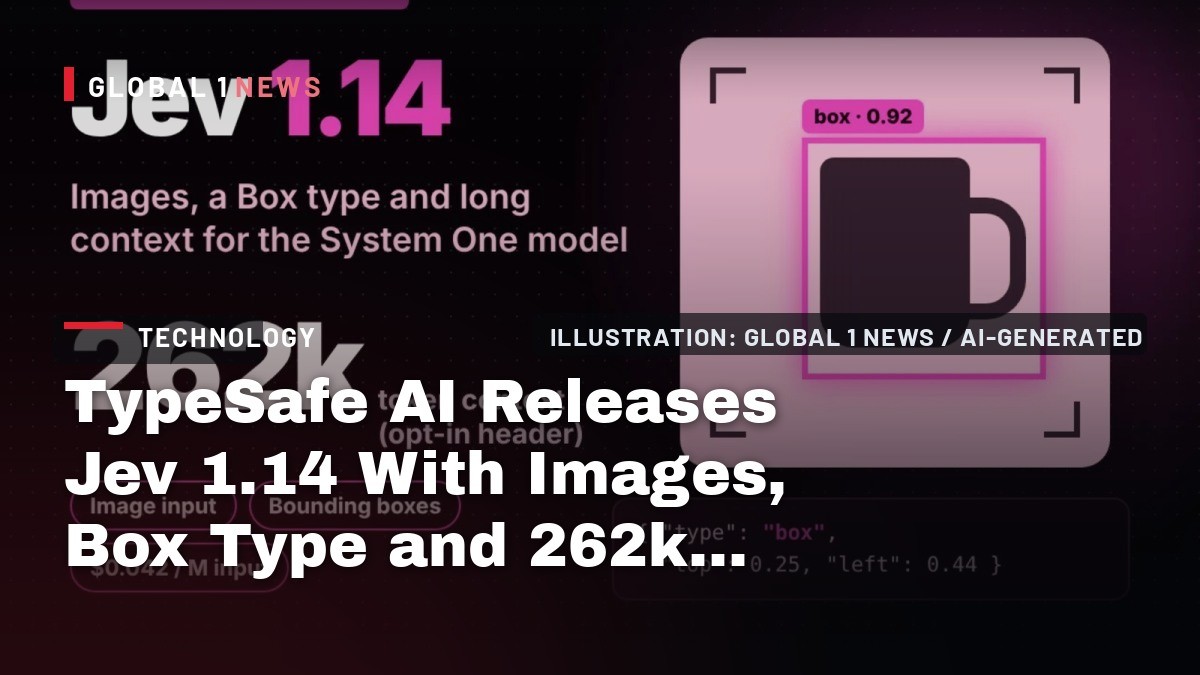
TypeSafe AI just dropped Jev 1.14, the newest iteration of its System One “typed decision” model. The upgrade is being rolled out under the jev-preview alias and comes with three so‑called “danger‑zone” experiments: image input, a native bounding‑box question type, and an optional 262 k token context window. The company is blunt about the fact that none of these features are production‑ready, but the very fact they’re exposing vision‑oriented capabilities in a decision‑oriented model is worth a hard look from any founder who’s ever had to stitch together separate LLM and CV pipelines.
Why a typed decision model matters for real‑world ops
Jev isn’t a chatty text generator; it spits out typed answers—Choice, Score, or Noul—along with probabilities and a confidence score. That structure is a breath of fresh air for production teams that need deterministic outputs for downstream automation. In my own shop, we’ve spent countless hours wrapping LLMs in custom parsers just to get a yes/no or a numeric score we can trust. The RLCD (Reinforcement Learning for Calibrated Decisions) training that TypeSafe touts promises tighter calibration, which, if it lives up to the claim, could shave minutes off our validation loops.
From a risk perspective, a model that returns a structured decision rather than a free‑form paragraph reduces the surface area for hallucinations. That’s a tangible advantage when you’re feeding the model into a compliance pipeline or a real‑time inspection system. The downside? The model’s internals are still a black box, and the pricing—$0.042 per million input tokens with free output—means you still need to budget for token consumption, especially when you start feeding images.
Images: a half‑baked multimodal experiment
TypeSafe says Jev 1.13 was already multimodal, and both 1.13 and 1.14 now accept images when you flip the TypeSafe-Danger-Zone-Images: true header. Images are passed as references in a top‑level assets map, then swapped in before the model reads the request. The limits are modest: PNG or JPEG only, up to 16 MiB per file, and dimensions between 256 and 1 568 pixels per side. The whole request can be up to 32 MiB.
Crucially, the company warns that “all models, Jev included, perform worse on images than on pure text.” In practice that means you’ll see higher latency and lower accuracy when you try to use Jev for visual inspection tasks. For a founder who’s already wrestling with the latency of pure LLM calls, adding image payloads could push you over the edge of acceptable response times. If you need vision now, you’re still better off with a dedicated CV service or a proven open‑source model that can run on your own GPUs.
Box type: a native bounding‑box output, but with caveats
The new Box question type returns a single normalized bounding box per query—edges expressed as fractions from 0 to 1, plus a confidence score. It works only with 1.14 (or the preview alias) and requires the same image header. The box is always returned, even if the target object isn’t present; you’ll get a set of edges that may not correspond to anything useful. TypeSafe recommends pairing a Box query with a Noul (existence) question to verify the object is actually there.
In their internal test on 36 painting crops, four per‑edge Noul questions caught 30 of the cuts, while a single “is all of it inside” question caught 26, and a box‑outline query caught 20. The numbers show that Box alone is a weak detector; you still need a verification step. For an independent hosting provider, that translates to extra API calls, extra token usage, and more complexity in your orchestration layer. If you’re building a quality‑control line that needs reliable localization, you’ll have to treat Box as a hint rather than a final answer.
Long‑context mode: a double‑edged sword
By default Jev keeps 64 k tokens per request and 32 k per question. Flip the TypeSafe-Danger-Zone-Long-Context: true header and both limits jump to 262 k tokens. TypeSafe admits that the model was always capable of longer context internally but was capped deliberately because reliability degrades with length. The dev team still urges short contexts.
From a business‑risk angle, the longer window is tempting for use‑cases that need to feed large documents or logs into a single decision call. However, the degradation in reliability means you’ll get more “I don’t know” or low‑confidence answers the longer you go. In a production line, that could translate to higher false‑negative rates or the need for fallback logic. The extra token consumption also inflates costs—though the price per million tokens stays the same, the sheer volume can add up quickly.
Pricing and migration: stay aware of the token tax
TypeSafe keeps the input price at $42 per billion tokens, or $0.042 per million, with output tokens free. That’s a familiar “pay for input only” model that many hyperscalers use. The upside is predictable cost per request; the downside is that you still pay for every pixel you upload as input tokens, even though images are billed at the same rate as text. For a startup on a shoestring budget, that can bite you if you start feeding high‑resolution images at scale.
The migration path is straightforward: jev-preview points to 1.14 now, jev-latest will switch in a week, and the older 1.13 will stay alive for 60 days before deprecation. Each new version gets a 30‑day deprecation notice. That gives you a narrow window to test and either roll back or commit. In my experience, a 30‑day notice is not enough to re‑architect a critical workflow if the new version introduces breaking changes.
Risk‑focused takeaways for independent providers
First, the “typed decision” approach is a solid concept for reducing hallucination risk, but the model’s internals remain opaque. Second, the image and Box features are experimental and come with performance warnings; they’re not ready for mission‑critical inspection tasks. Third, the long‑context mode can be useful for batch‑style decisions but brings reliability trade‑offs and higher token consumption. Fourth, the pricing model is simple but can become costly when you start adding image payloads at scale.
Bottom line: if you’re a founder looking to add a quick vision layer to an existing decision pipeline, Jev 1.14 gives you a sandbox to play in, but you’ll need to build robust fallbacks, monitor token usage, and keep an eye on deprecation notices. For most production workloads, a dedicated CV stack or an open‑weight multimodal model that you can run on your own hardware will still be the safer bet.
Actionable steps for your next move
1. **Run a controlled pilot**: Use the jev-preview endpoint with a limited set of image queries. Track latency, confidence scores, and token consumption. Compare the results against a baseline CV service you already trust.
2. **Instrument verification logic**: Pair every Box query with a Noul existence check. Log cases where the box is returned but the Noul says “no,” and set a threshold on confidence to trigger a fallback.
3. **Cap context length**: Even though you can request 262 k tokens, enforce a stricter limit (e.g., 32 k) in your API gateway to keep reliability high and costs predictable.
4. **Budget for image tokens**: Remember that each image counts as input tokens at the same $0.042 per million rate. Estimate your monthly image payloads and factor that into your cost model.
5. **Plan for deprecation**: Mark the 30‑day notice window on your roadmap. Set up alerts for the jev-latest switch and the eventual retirement of 1.13, so you’re not caught off‑guard.
By treating Jev 1.14 as a sandbox rather than a production cornerstone, you can extract value from its typed decision framework while sidestepping the pitfalls of its half‑baked multimodal features. That’s the pragmatic play for any independent hosting provider that refuses to be sold a one‑size‑fits‑all hype package.
— Allan Ali, Founder
This article was produced with AI-assisted research and editorial support. Reporting is based on the source material cited below. Sources: MarkTechPost; marktechpost.com; Global1.News (16 October 2026).
By Allan Ali, Global1.News
What's Your Reaction?
 Like
0
Like
0
 Dislike
0
Dislike
0
 Love
0
Love
0
 Funny
0
Funny
0
 Wow
0
Wow
0
 Sad
0
Sad
0
 Angry
0
Angry
0

Publisher of Global1.News. Automation architect, systems builder, and the guy making sure the truth gets published.















Comments (0)