
The "Middle of Nowhere" Data Center Is a Myth — 97.5% of Them Are in Cities
A new Nature Cities study finds 97.5% of US data centers sit in cities, drawn by existing electricity capacity. The rural buildout narrative is a myth reshaping grid politics, ratepayer fights, and hosting economics.
The "Middle of Nowhere" Data Center Is a Myth — 97.5% of Them Are in Cities
Let me tell you something that's been bugging me for years. Every time a data center gets announced, the same story comes out. The press release talks about "thousands of acres of open land." The local politician talks about bringing jobs to "rural communities." The developer talks about building "in the middle of nowhere" where nobody will complain. And I've been sitting here running hosting infrastructure for over a decade thinking: that is not what I see. That has never been what I see.
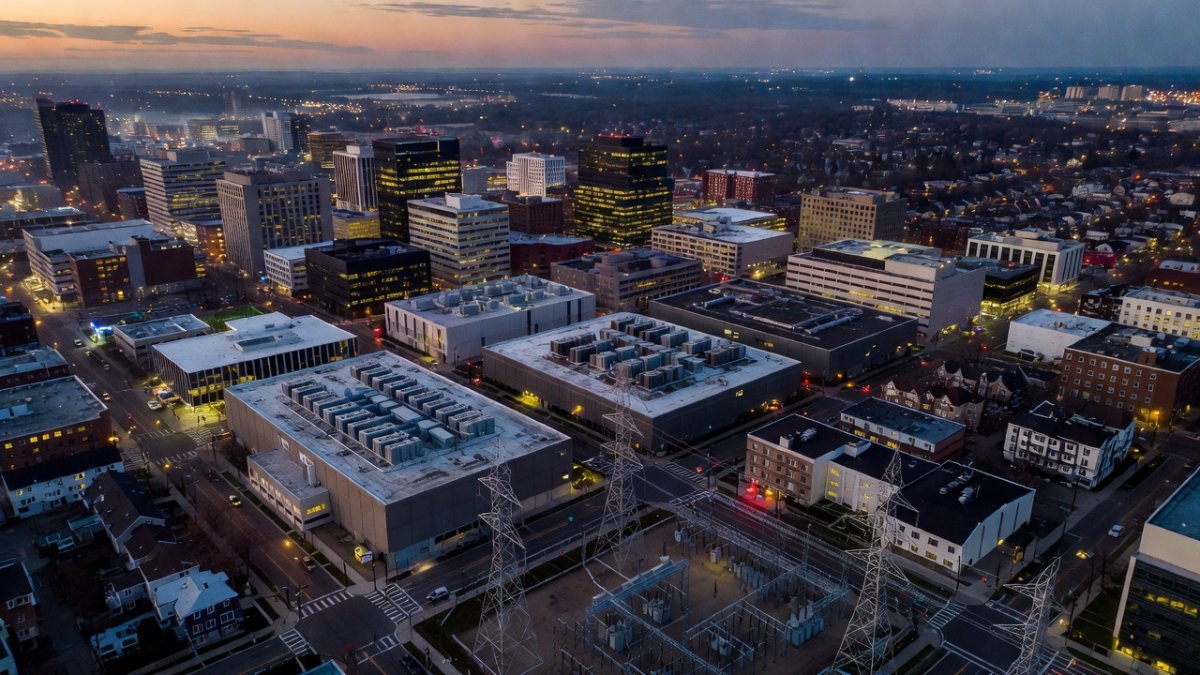
Now I've got receipts. A study just dropped in Nature Cities — the peer-reviewed journal, not some industry puff piece — that analyzed 4,283 data centers across the contiguous United States and found that 97.5% of them sit inside metropolitan or micropolitan statistical areas. Urban cores and their immediate suburbs. Not cornfields. Cities.
The Study That Killed the Rural Narrative
The research team, led by Maurizio Porfiri at NYU Tandon's Center for Urban Science + Progress, went through every data center they could find in the country and mapped it. The result is brutal for the industry's favorite story. 97.5% of American data centers are within metropolitan or micropolitan areas. Of the 2.5% that technically sit outside city limits, the average distance to the nearest urban edge is 8.5 miles. That's not "the middle of nowhere." That's a suburb with a longer commute.
And here's the kicker — the clustering is absurdly concentrated. Five metro areas alone account for nearly a third of all US data centers: Washington–Arlington–Alexandria, Chicago, Dallas–Fort Worth, New York–Newark–Jersey City, and Phoenix. The Washington region by itself hosts 610 facilities. Six hundred and ten. In and around the nation's capital, not in the Shenandoah farmland the press releases keep telling you about.
Porfiri put it better than I ever could: "There is a prevailing narrative of these data centers being somewhere in the middle of nowhere, in rural areas, being a positive force for employment, and being the future of rural communities. We dramatically challenged this view." Dramatically is the right word. He demolished it.
Why Cities Win — It Was Never About the Land
Here's the part that matters for anyone running actual infrastructure. The single strongest predictor of where a data center gets built isn't land cost, isn't tax breaks, isn't even the fiber. It's electricity capacity. How much power the local generators can produce. Full stop.
Think about what that means. A closed coal plant near a city is now prime data center real estate, because the transmission lines, the substations, and the grid interconnection rights are already sitting there. The study found facilities under development are twice as likely to be in cities that overlap with "Energy Communities" — the 2022 federal designation for areas that lost fossil fuel jobs. The industry is literally moving into old power towns. Data centers cluster where IT workers and high-speed internet are concentrated, and here's a surprise for the environmental lobby: water shortages had less impact on placement than you'd think. Power is the whole game.
This shouldn't shock anyone who's ever tried to get a 100-megawatt connection approved. You can buy cheap land in rural Kansas for $5,000 an acre, but if the nearest substation can feed you 20 megawatts, you're building a warehouse, not a data center. Land was never the constraint. Electrons are the constraint. And electrons live in cities.
The Grid Is the Whole Game Now
Which brings me to why this study matters right now, this week, not in some academic abstract. The grid data coming out of Texas is genuinely insane. ERCOT is tracking more than 438 gigawatts of large-load interconnection requests — and nearly 90% of that is data centers. For perspective, ERCOT's all-time historical peak demand record is 85.5 gigawatts. These companies are asking for five times the entire historical peak of the Texas grid, in new connections, most of it from data centers.
Energy research firm Enverus says strained grids and long hookup waits will push about 40% of all new data center capacity entirely off the main grid through 2030. Hyperscalers are going to spend roughly $5 trillion to add 62 gigawatts of off-grid, natural gas-fired power, clustered mostly in Texas, Pennsylvania, and Ohio. That's not a hedge. That's a structural shift. Amazon and Google are quietly pushing back their short-term net-zero pledges because they can't get grid power fast enough. As Enverus researcher Thomas Mulvihill put it: "Tech companies aren't concerned with how quickly it takes them to build the data center shell; they are entirely constrained by time-to-power."
Meanwhile, PJM — the grid operator serving 67 million people across 13 states and DC — said in July that demand keeps growing faster than supply. Its independent market monitor attributed about $6.3 billion of $16.4 billion in capacity charges to data-center-driven demand. That's the bill hitting every ratepayer on the system. BloombergNEF projects data centers will draw 194 gigawatts by 2035 — roughly the output of 200 nuclear reactors — and could consume about one-fifth of all US power generation. One in five. That's not a niche industry anymore. That's the whole grid.
The Off-Grid Escape Hatch Is Leaking
And before anyone tells me the off-grid play solves the politics — it doesn't. It creates a whole new set of them. A coalition including the Sierra Club and the Environmental Integrity Project just threatened to sue Vantage Data Centers and VoltaGrid over behind-the-meter gas-fired generation in San Antonio, alleging they're exploiting a legal loophole to bypass federal Clean Air Act reviews. The EIP's April report counted 74 planned off-grid data center gas plants under consideration that could emit 662 million tons of greenhouse gases annually — a climate footprint matching the nation of Australia.
So here's the trap. Build on the grid, and you get $6.3 billion capacity charges, seven-year interconnection queues, and community lawsuits. Build off the grid, and you get Clean Air Act lawsuits, emissions scandals, and — as Mulvihill points out — the question every hyperscaler will face after four or five years behind the meter: when you need 99.995% uptime and your private gas plant hiccups, aren't you going to want an "insurance connection" to the public grid anyway? And when that happens, who pays for it? Hint: it's not going to be the data center.
The Counter-Argument — "But What About All the Rural Projects?"
Now, the counter-argument I hear constantly: "Allan, what about Meta's Louisiana site? What about the massive campuses in Ohio and Indiana? Those are rural." And sure, they exist. But look at the math. They're the 2.5%. And even that 2.5% averages 8.5 miles from an urban edge — close enough to tap metro transmission corridors. The headline-grabbing rural projects are the exceptions, and the industry loves them precisely because they're rare enough to photograph.
The other thing the rural crowd gets wrong: the politics. The backlash that's stalling $130 billion in projects isn't coming from rural communities grateful for jobs — it's coming from suburbs and exurbs where the 97.5% actually landed. The 300+ bans and moratoriums across the country, the 142 protests in 42 states, the midterm candidates running against data centers — that's urban and suburban anger. The study confirms it: data centers aren't a rural phenomenon, so the resistance isn't rural either. It's happening in your county, next to your substation, under the transmission lines you can already see.
What This Actually Means for Independent Hosting Providers
First — stop trusting the rural narrative when you plan capacity. If a colo provider tells you they're "away from it all" with cheap power, ask to see the interconnection agreement and the substation capacity, not the drone footage of the pasture. The study proves the real asset is existing electrical infrastructure.
Second — watch the former coal plant sites. Every closed coal plant near a city is a future data center or colo campus. If you're in a region with retiring coal capacity, that's where the power will flow and where pricing will move. Position your own capacity planning around those zones before the hyperscalers lock them up.
Third — price in the ratepayer fight. $6.3 billion of capacity charges in PJM, Texas SB6 requiring disclosure of duplicate interconnection requests, New York's 50-megawatt moratorium — the cost-allocation battle is coming to every market. Harvard's Ari Peskoe said it plainly: the industry rules "do not force data centers to pay for new power lines and power plants that are being built for them." Regulators are going to change that. When they do, power prices move — and colocation contracts written today won't have that built in. Negotiate power escalation clauses like your business depends on it, because it does.
Fourth — treat off-grid as a competitive threat, not a curiosity. A hyperscaler that builds its own gas plant doesn't need your grid power. But that same hyperscaler is also going to discover, like every operator before it, that self-generation at 99.995% uptime is brutally hard. The independents who can offer reliable, contractually clean grid-connected capacity are going to be the "insurance connection" they come looking for. Be ready to be that insurance — at a price that reflects what you're actually worth.
The Bottom Line
Here's what this study should do to your mental model. The data center industry has spent a decade selling America a story about remote, rural, invisible infrastructure. The reality is that it's urban, it's concentrated, and it's sitting next to the same substations and power plants that feed your city. The fight over AI infrastructure isn't happening in the middle of nowhere. It's happening in your backyard — because that's where the power already is.
Stop planning around the myth. Plan around the megawatts. The companies that understand where the power actually lives are the ones who'll survive the next five years. The ones still looking at the drone footage of the cornfield are going to be standing in line behind ERCOT's 438 gigawatts — and that line is seven years long. Ent?
— Allan Ali, Founder
This article was produced with AI-assisted research and editorial support. Reporting is based on sources cited in the article.
What's Your Reaction?
 Like
0
Like
0
 Dislike
0
Dislike
0
 Love
0
Love
0
 Funny
0
Funny
0
 Wow
0
Wow
0
 Sad
0
Sad
0
 Angry
0
Angry
0

Publisher of Global1.News. Automation architect, systems builder, and the guy making sure the truth gets published.













Comments (0)