
Thai police arrest four monks in Buriram drug crackdown
In the early hours of 18 September, a joint operation by police, border patrol officers, soldiers and local officials in Buriram province uncovered a startling link between a Buddhist temple and a regional methamphetamine network.
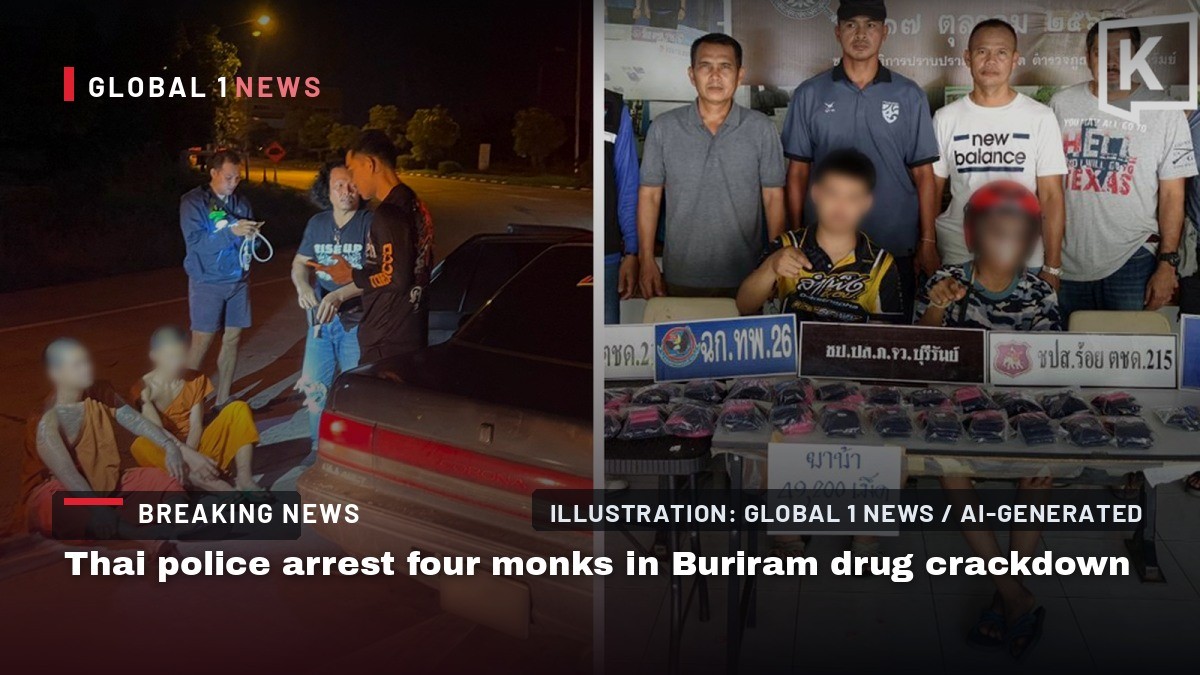
In the early hours of 18 September, a joint operation by police, border patrol officers, soldiers and local officials in Buriram province uncovered a startling link between a Buddhist temple and a regional methamphetamine network. Four monks were arrested after officers discovered 184 meth pills in a black sedan and traced the case to a larger cache of more than 49,000 pills. The incident has sparked a conversation across Thailand about the intersection of religious life, community pressures and the ever‑present challenge of drug trafficking in the northeast.
How the raid unfolded
The investigation began when a team led by Police Lieutenant Colonel Suwat Nammonkol, deputy superintendent and head of the Buriram Provincial Police Narcotics Suppression Unit, spotted a suspicious black sedan running several red lights near the border of Khu Mueang and Phutthaisong districts. Officers followed the vehicle for over 40 kilometres before it stopped at a traffic light in Ban Nong Kung, Mueang Buriram district. When the driver opened the door, ten methamphetamine pills fell onto the road, prompting the police to identify the occupants as two monks.
A second monk, seated in the back, was found with 89 pills hidden inside his robes, while an additional 82 pills were concealed beneath the vehicle’s centre‑console carpet. The combined haul of 184 pills was the immediate evidence that led investigators to suspect a deeper supply chain.
Links within the monastic community
Further examination of the driver’s phone—identified as Kittisak, also known as Tang, a 31‑year‑old monk—revealed messages and money‑transfer records that suggested he had purchased the drugs from another monk in Phutthaisong district. Investigators also uncovered voice recordings and transfer slips that tied the abbot of the temple where Kittisak was staying to the purchase.
Kittisak told police the meth had been bought from a monk known as Plai, or Yutthana, a 27‑year‑old resident of a temple in Ban Pao subdistrict, Phutthaisong district. When officers later located Plai after his alms round, he admitted arranging the purchase of a bag of meth for 3,800 baht and said he had received five pills as payment, sharing three with a fellow monk and keeping two in a phone box inside his quarters.
The abbot’s involvement
Police brought the abbot, identified as Tum or Phiphat, a 32‑year‑old monk of Wat Pa Nong Hin in Prakhon Chai district, to the station for disrobing and testing. A urine test returned positive for methamphetamine. Although he initially denied recent use, he later admitted to using the drug two or three days earlier.
Facebook Messenger conversations presented by investigators showed that Phiphat had instructed Kittisak and the second monk, Phiao (also known as Wachirawit, 22), to purchase meth from Phutthaisong. Phiphat disclosed that the temple housed four monks and that he had been ordained for seven years. He admitted a prior involvement with drugs before his ordination and recounted that a temple worker had re‑introduced meth into his life after he had previously stopped using.
Financial flows and the upcoming ceremony
According to Phiphat, the latest purchase involved a bag containing about 200 pills, for which the monks paid 3,800 baht. They obtained 187 pills, intending to divide them among themselves. Kittisak contributed 1,000 baht, Phiphat transferred another 1,000 baht, and the remaining 1,800 baht was to be paid later. Phiphat said the money came from religious ceremonies and donations made by villagers.
He also expressed concern about a religious event scheduled for 20 September, noting that with three of the four monks now in custody, only an elderly newly ordained monk—who had been ordained only a few days and was still learning chanting—remained to conduct the ceremony. The disruption underscores how drug involvement can ripple through community rituals and local expectations.
Expanding the net: the wider trafficking network
On 19 September, police announced three additional arrests linked to the same network. Anirut, also known as The, a 34‑year‑old man found in a hut in Ban Chan subdistrict, Phutthaisong district, was seized with 23 meth pills and identified as a supplier to the monks.
Investigators traced The’s supplier to two brothers in Ban Pao subdistrict: Theeradon, known as Wave, a 22‑year‑old, and his 17‑year‑old sibling. The brothers were arrested with a total of 49,200 meth pills, alongside a seized car and motorcycle allegedly connected to the drug offenses.
Cross‑border connections and the scale of distribution
Police said Theeradon had received instructions from a person in Laos to distribute meth across Phutthaisong, Mueang Buriram, nearby districts and Song Hong district in Khon Kaen. Records indicated that at least 40,000 pills—more than 20 bundles—had already been distributed before the arrests.
Investigators also traced a delivery of 2,000 pills placed near a signpost close to a bridge over the Mun River on the night the monks were arrested. That cache was seized, adding to the evidence of a coordinated supply chain that extends beyond provincial borders.
Underground caches and the ongoing hunt
Theerthawat, a relative of the arrested brothers, told police he had buried six bags containing about 1,200 pills under his brother’s house. Officers recovered those pills and, following his guidance, uncovered another underground stash: a blue fertilizer sack holding 24 bundles, or roughly 48,000 meth pills.
Further testimony suggested that the brothers repeatedly collected large shipments—about 50 bundles, or 100,000 pills—delivered to Phayakkhaphum Phisai district in Maha Sarakham province, before distributing them to customers. The investigation remains active as police continue to pursue additional individuals believed to be part of the supply chain.
This article was produced with AI-assisted research and editorial support. Reporting is based on the source material cited below. Sources: Khaosod English; khaosodenglish.com; Global1.News (20 September 2026).
By Ann Srisawat, Staff Writer
What's Your Reaction?
 Like
0
Like
0
 Dislike
0
Dislike
0
 Love
0
Love
0
 Funny
0
Funny
0
 Wow
0
Wow
0
 Sad
0
Sad
0
 Angry
0
Angry
0
Southeast Asia Correspondent at Global1.News. Based in Bangkok, covering Thai and Southeast Asian politics, economy, technology, and culture. Deep regional perspective on one of the world's most dynamic regions.













Comments (0)