
Taiwan Rocket Test Fails as Drone Buildup Reshapes Defence
Taiwan's first test of a locally developed satellite launch vehicle failed Wednesday, triggering a missile panic in Pingtung, while the army held its first live-fire FPV drone exercise - a two-front defence shift with dual-use missile implications and Ukraine-style asymmetric tactics watched acro...
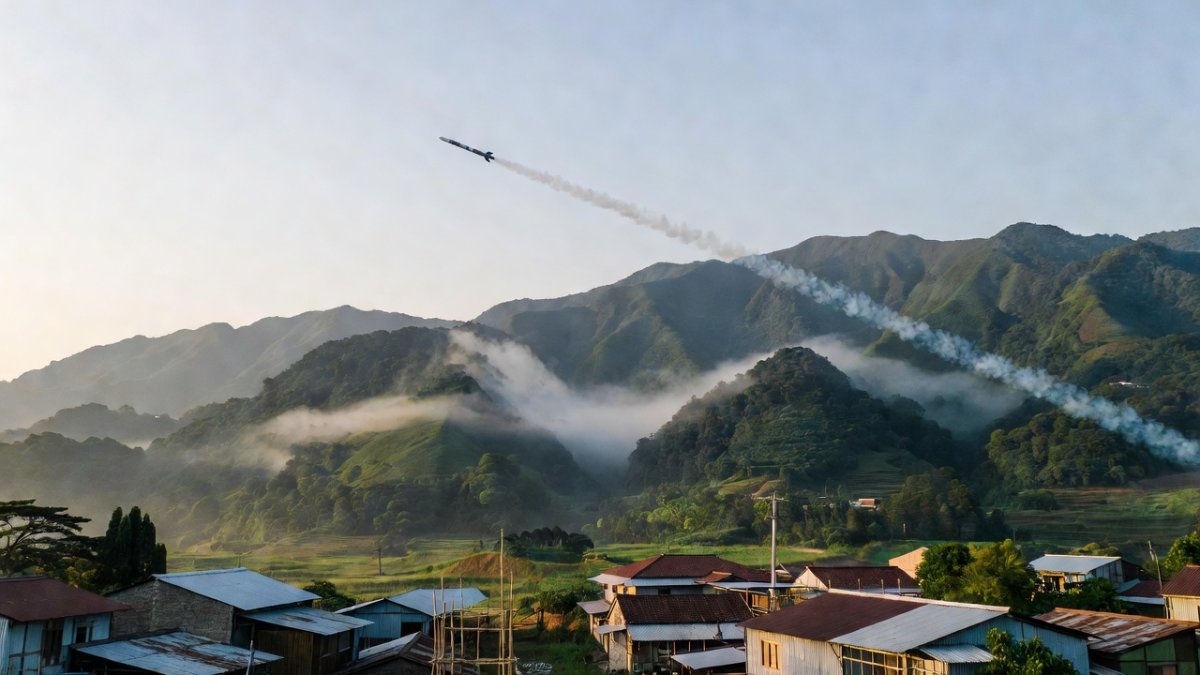
Satellite Launcher Failure Sparks Panic in Southern Taiwan
Taiwan's first test of a locally developed satellite launch vehicle ended in failure on Wednesday morning, when the rocket veered off course and triggered a missile panic among residents of southern Pingtung county. The vehicle lifted off at around 6am from the Jiupeng missile testing base, operated by the government-backed National Chung-Shan Institute of Science and Technology (NCSIST), Taiwan's top weapons developer. Witnesses told the South China Morning Post that the projectile climbed briefly before suddenly changing direction away from the sea and towards the mountains, with video footage circulating online capturing residents shouting: "Something's gone wrong! Oh no! The village!"
The rocket crashed in an uninhabited mountainous area, sending thick smoke over the hillside. No casualties or property damage were reported, but the incident exposed how quickly routine test activity at Taiwan's principal missile facility can unsettle communities that live in its shadow. The launch came just one day after the island's army conducted its first live-fire exercise using first-person view (FPV) drones against armoured vehicles - two developments that, taken together, underline the breadth of Taipei's effort to rebuild its defences around both indigenous technology and Ukraine-war-era tactics.
Tags: Taiwan rocket test, satellite launch vehicle, NCSIST, Jiupeng, missile panic, FPV drones, Taiwan army, cross-strait, PLA, asymmetric warfare, Pingtung, defence buildup
A Morning Launch That Shook Pingtung
The NCSIST later clarified that the test involved its first experimental satellite launch vehicle, not a missile. "An anomaly occurred during the initial trajectory, so the self-destruct mechanism was activated in accordance with the original contingency plan, with the impact point controlled within the planned safety zone," the institute said, adding that the failed vehicle, engine and debris all fell within designated safety areas rather than privately owned land.
A source familiar with the test said ground-based telemetry systems detected an abnormal trajectory and irregular rotation shortly after launch. "Possible causes include a gyroscope or propulsion-system failure, or a weight-distribution problem with the full-up test vehicle," the source said. The NCSIST said telemetry data collected during the flight would be used to modify the vehicle's design and system parameters. The reaction from local government was swift: the Pingtung county government called for an immediate investigation, demanded the institute suspend missile tests until the cause was established, and urged that future trajectories avoid indigenous communities and residential areas. The mayor of Pingtung's Mudan township, Pan Chuang-chih, also demanded a prompt explanation, saying residents had been alarmed by the incident.
A Dual-Use Technology With Missile Potential
Despite the setback, experts said the test marked a significant step forward in Taiwan's development of space-launch technology - capabilities that also hold military potential. The multistage solid-fuel launch vehicle is being developed to carry small payloads into low Earth orbit at altitudes of more than 500km, according to the source, and incorporates technology for launching multiple satellites. The dual-use character of the programme is central to its strategic significance: satellite launch vehicles and ballistic missiles share key technologies, including solid-fuel propulsion, staging, guidance and flight-control systems.
Chang Cheng, former chief engineer of the institute's Hsiung Feng III supersonic anti-ship missile programme, said in Taoyuan on Wednesday that "the necessary technology is already available. If development succeeds, it would demonstrate that the NCSIST has the capability to launch satellites into low Earth orbit." Another missile expert, who declined to be named, told the SCMP that the technologies used in a rocket reaching such an altitude could theoretically be adapted for a medium-range ballistic missile with a range of 1,500km to 2,000km if its flight profile and payload were significantly altered. The programme builds on the Kirin Project, disclosed in 2019, which aimed to develop a solid-fuel launch vehicle capable of placing microsatellites weighing between 50kg and 200kg into orbit at about 500km.
Jiupeng's History of Launch Mishaps
Wednesday's failure was not the first mishap at Jiupeng, Taiwan's main missile research and testing facility. In August 2023, a US-made Patriot II missile exploded seconds after launch during a live-fire exercise, although a second missile was successfully fired and hit its target. Earlier that month, four people were injured in an explosion during the disposal of leftover propellant materials at the base. In June 2022, a propellant anomaly in a locally developed Thunderbolt-2000 multiple-launch rocket system caused an in-tube explosion that damaged the launcher during a live-fire drill, with no injuries reported. In 2017, two US-made Hawk surface-to-air missiles deviated from their planned trajectories due to abnormal propellant combustion, later detonating safely within restricted areas.
The pattern is familiar to any country operating solid-fuel rocket systems: propellant chemistry, guidance electronics and staging mechanisms are unforgiving, and failures are part of the learning curve. For Japan, which operates its own solid-fuel Epsilon launch vehicles and has decades of experience with the H-II family, the episode is a reminder that even mature space programmes endure test anomalies - and that the line between civilian launch capability and missile potential is defined as much by intent as by hardware.
Ukraine-Style Drone Tactics Enter Live-Fire Training
While the failed launch dominated headlines, the island's army was quietly advancing a very different dimension of its defence posture. On Monday, the Army Unmanned Systems Training Command brought together six units from the military's artillery commands, Marine Corps and Military Police for an exercise in which operators flew FPV drones carrying armour-piercing warheads against decommissioned tanks and armoured ammunition carriers. According to the Youth Daily News, a defence ministry-affiliated newspaper, the drones conducted frontal and flanking strikes in both single-drone and coordinated two-drone attacks.
The exercise reflects lessons militaries around the world are drawing from the Ukraine war, where inexpensive FPV drones have become ubiquitous in reconnaissance and precision attacks. Taiwan has increasingly sought to develop similar systems as it prepares its forces for a potential conflict with the People's Liberation Army. The army established its Unmanned Systems Training Command in April, upgrading a training centre set up last year; since the end of last year, the centre has trained more than 800 drone operators for frontline combat units. Army Chief of Staff Chen Chien-yi told lawmakers in May that three corps-level drone battalions covering the island's northern, central and southern operational zones had completed their formation by April.
Units Without Equipment: The Procurement Gap
Organisational expansion, however, has outpaced hardware deliveries. Defence Minister Wellington Koo Li-hsiung acknowledged during the May legislative session that "the military needs to acquire more training drones to avoid ending up with 'units without equipment', as systems including the Altius-600 and Altius-700 have yet to arrive." The Altius line is manufactured by a subsidiary of US arms maker Anduril Industries. Max Lo, executive director of the Taipei-based Taiwan International Strategic Study Society, said establishing the drone battalions was an important response to changes in the nature of cross-strait warfare, but warned that expansion would not automatically translate into combat power.
"Although the new units have been established, the military still has to get through a period in which it could have units without equipment before achieving initial operational capability," Lo said. He also pointed to overloaded frontline units, insufficient specialised training grounds and a shortage of qualified instructors as hurdles. Chieh Chung, a research fellow at the Association of Strategic Foresight, suggested Taiwan look beyond short-range battlefield drones and develop longer-range systems capable of striking PLA logistics and other military targets along the Chinese mainland's southeastern coast. "Such drones could give Taiwan a way to maintain cross-strait strike capabilities even if its conventional assets were severely depleted during a conflict," he said.
What to Watch For: A Region Watching Taiwan's Arsenal
For Japan and other Asia-Pacific capitals, the two developments carry distinct signals. The rocket failure demonstrates that Taiwan's indigenous space-launch programme, whatever its civilian framing, is advancing far enough to warrant attention - and that Beijing will read any eventual success as a missile-capability milestone. The drone build-up, meanwhile, shows Taipei embracing the same asymmetric playbook that has reshaped thinking in Tokyo, Seoul and Washington: cheap, attritable systems that complicate a numerically superior adversary's plans.
Expect Beijing to respond on both fronts. Chinese state media has already framed Taiwan's defence investments as evidence of external interference and separatist intent, and PLA exercises around the island have become routine. The near-term watch points are the NCSIST's post-mortem on the failed launch, the pace of Anduril Altius deliveries, and whether Taiwan's drone programme can close its equipment gap before the next round of Han Kuang exercises. For Japan, the stakes are direct: the Taiwan Strait remains the strategic chokepoint through which most of its energy imports pass, and Tokyo's own defence white paper, released this month, identified cross-strait stability as central to regional security. Taiwan's two-front experiment - rockets and drones, dual-use industry and asymmetric tactics - is being watched closely from Sapporo to Singapore.
By Kenji Tanaka, Staff Writer
This article was produced with AI-assisted research and editorial support. Sources: South China Morning Post, Taipei Times, Focus Taiwan, Taiwan News.
What's Your Reaction?
 Like
0
Like
0
 Dislike
0
Dislike
0
 Love
0
Love
0
 Funny
0
Funny
0
 Wow
0
Wow
0
 Sad
0
Sad
0
 Angry
0
Angry
0

Japan Correspondent at Global1.News. Tokyo-based voice covering Japanese politics, technology, economy, and culture. Tracks the intersection of tradition and innovation in one of the world's most dynamic societies.














Comments (0)