
New Wave of Taiwan Investment Flows Into Thailand, Says TECO Envoy
Taiwan's top envoy in Bangkok says a new wave of Taiwanese investment is flowing into Thailand, driven by AI growth and global supply chain shifts. TECO Representative Peter Lan spoke at a media gathering as bilateral trade hit NT$608.8 billion and foreign direct investment reached record levels.
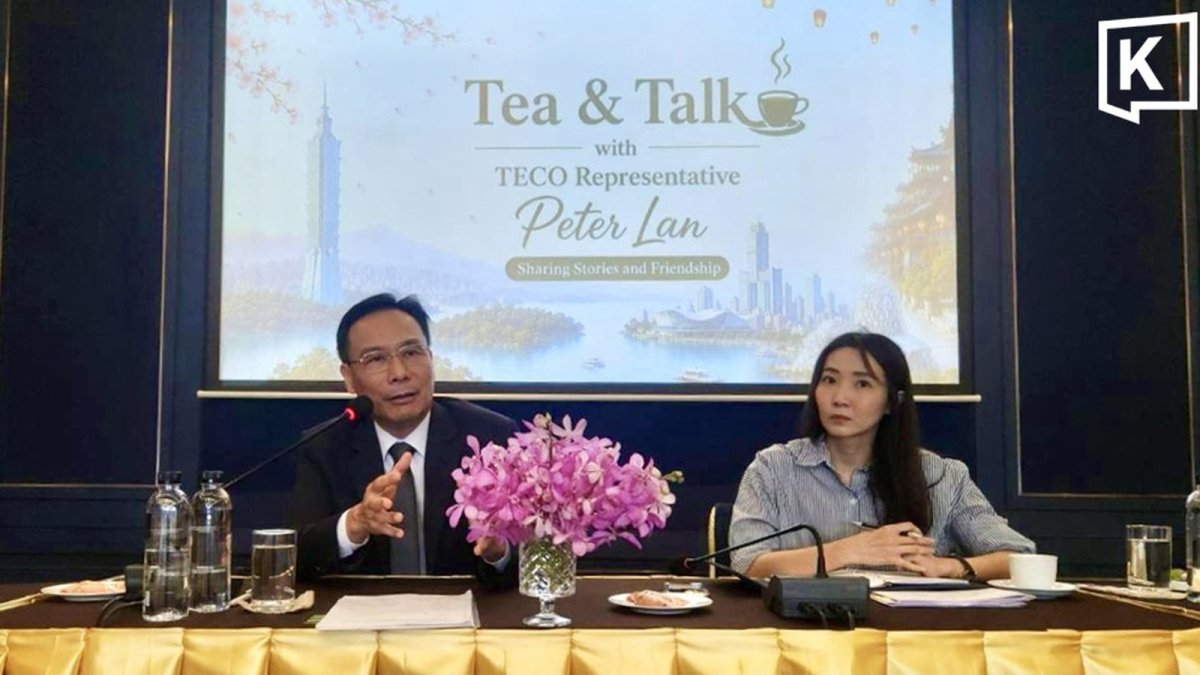
Taiwan's top representative in Thailand highlighted a fresh surge of investment from the island this week, as companies respond to global supply chain shifts and artificial intelligence growth while noting Thailand's stable political environment. Peter Lan, who leads the Taipei Economic and Cultural Office in Bangkok, shared these observations during an informal gathering with Thai media at The Bangkok Club in Sathon on Thursday. The discussion underscored how Thailand's pragmatic approach to international relations aligns with Buddhist principles of balance and hospitality, allowing the kingdom to welcome guests from multiple sides without conflict.
New Taiwanese Investment Flows into Thailand
Peter Lan stated that a new wave of Taiwanese investment is entering Thailand, fueled by geopolitical competition and the rapid expansion of artificial intelligence industries. Companies are applying the China Plus One strategy to diversify operations beyond single locations. Thailand's record foreign direct investment of 1.36 trillion baht in 2025, a 66 percent increase from the prior year, reflects this momentum according to Board of Investment data.
The Eastern Economic Corridor has drawn US$60.23 billion in applications for 2025 alone, accounting for 45 to 55 percent of all Board of Investment projects. Thailand has become the top printed circuit board production base in ASEAN, with output valued at US$3.26 billion and 180 approved projects worth over 200 billion baht between 2022 and mid-2025. These developments create jobs in provinces across the central and eastern regions.
Thai workers in Chonburi and Rayong provinces now see expanded training programs tied to new electronics assembly lines and electric vehicle battery facilities supported by Board of Investment incentives introduced in early 2026. These programs partner with local vocational schools to teach semiconductor packaging skills, allowing families in eastern industrial zones to shift from traditional agriculture toward higher-wage manufacturing roles that align with Buddhist values of steady livelihood and community support.
The Eastern Economic Corridor expansion encourages suppliers in the AI infrastructure sector to locate near existing ports, reducing transport costs for components headed to Singapore and beyond. Local communities in these areas benefit from improved logistics networks, which also support small vendors serving factory workers and create indirect employment in food services and housing construction.
Provincial governments in the central region coordinate with Taiwanese firms on environmental standards for new plants, drawing on Thailand's emphasis on harmonious development. This approach helps preserve agricultural land while generating revenue for schools and health clinics, strengthening the social fabric that underpins the kingdom's reputation for balanced hospitality.
Peter Lan's First Year Leading TECO Bangkok
Peter Lan has served as Taiwan's chief representative in Bangkok since 20 July 2025. In his first year, he described the experience through three words: communication, mutualism and opportunity. He hosted the Tea and Talk event at The Bangkok Club in Sathon on 6 August 2026 to broaden direct dialogue with Thai journalists and the public.
Lan emphasized that TECO operates as an open book, welcoming engagement on practical matters. The office assists roughly 200,000 Taiwanese citizens living and working in Thailand with everyday challenges. Thai media have played a key role in sharing accurate information about Taiwan with local communities.
Drivers of Supply Chain Shifts and AI Growth
Geopolitical competition and the swift development of artificial intelligence industries stand as primary drivers behind the investment increase, according to Lan. Thailand's political stability has boosted investor confidence in long-term projects. The Board of Investment introduced refreshed promotion measures on 15 January 2026, including the Thailand FastPass service for targeted industries and large-scale initiatives.
Investment applications in the first half of 2026 surged 37 percent year-on-year to US$43.6 billion across 1,299 projects. Much of this activity centers on AI infrastructure, positioning Thailand as a reliable partner in Southeast Asian technology networks. These trends support local economies from Bangkok to the Isaan region through expanded manufacturing and related services.
Global electronics firms accelerated moves to Southeast Asia after 2024 tariff adjustments on Chinese exports, prompting Thailand to position itself as a stable alternative within ASEAN networks. Companies now route semiconductor testing and logistics operations through facilities near Bangkok's Suvarnabhumi airport, where streamlined customs procedures introduced in late 2025 have shortened clearance times for regional trade.
Artificial intelligence demand is driving the construction of data centers in eastern provinces such as Chachoengsao, prompting Thai universities to refresh curricula in cloud computing and thermal management. These changes prepare graduates for roles that blend technical expertise with the kingdom's cultural preference for collaborative problem-solving rooted in Buddhist principles of mindfulness and adaptability.
The digital economy gains from government-backed digital infrastructure reaching into Isaan provinces, enabling remote monitoring of supply chain logistics for Taiwanese partners. This infrastructure supports small enterprises that supply components to larger factories, fostering regional balance and reducing urban migration pressures on Bangkok families.
TECO's Approach to Practical Cooperation
Lan noted that recognition of the One China policy does not prevent countries from maintaining practical and substantive relations with Taiwan. Taiwan cannot open embassies in nations that recognize Beijing, so TECO focuses on clarifying what cooperation with Taiwan can achieve. The host country's decisions determine the extent of engagement with both Taiwan and China.
Thailand benefits from parallel and pragmatic relationships rather than triangular dynamics, Lan said. This approach mirrors the Thai cultural value of balanced hospitality, where communities extend welcome to diverse visitors while preserving harmony. TECO continues to dispel misconceptions that might limit such cooperation.
Thailand's foreign policy maintains separate channels with Beijing and Taipei through distinct economic and cultural offices, a practice that dates to the 1975 establishment of relations with the People's Republic while preserving longstanding trade links with Taiwan that began in the 1950s. This dual engagement allows Thai diplomats to negotiate investment terms independently, avoiding entanglement in larger geopolitical disputes.
Parallel relationships also appear in tourism promotion, where Taiwanese visitors are served through dedicated channels at Thai missions, separate from mainland Chinese programs. Such arrangements reflect the kingdom's Buddhist-inspired approach to hospitality, treating each partner with respect while preserving internal harmony and enabling local businesses in Chiang Mai and Phuket to serve diverse markets without friction.
Historical exchanges, including agricultural technology transfers from Taiwan in the 1980s, continue to inform current cooperation on food security projects. Thai officials apply these lessons when coordinating with both sides on supply chain resilience, ensuring that policy decisions prioritize measurable benefits for rural communities over abstract alignments.
Bilateral Trade Growth Between Taiwan and Thailand
Bilateral trade reached NT$608.8 billion, or approximately US$19.37 billion, in 2025, marking a 7.3 percent rise from the previous year. Taiwan's exports to Thailand increased 8.15 percent to NT$401.7 billion during the same period. These figures highlight deepening economic ties that support Thai industries and employment.
The growth aligns with Thailand's broader foreign direct investment surge and positions the kingdom favorably within ASEAN supply chains. Local businesses in electronics and related sectors gain from expanded partnerships, while communities in industrial zones see new opportunities for skilled work.
Implications for Thailand's Regional Position
Thailand's ability to maintain pragmatic ties with both Taiwan and China strengthens its role as a stable hub in Southeast Asia. The kingdom's hospitality and emphasis on mutual benefit create space for technology transfers and infrastructure development that benefit Thai workers and families. Lan's reflections on communication and opportunity point to continued collaboration in areas such as health networks, where Taiwan previously attended an average of only seven technical meetings per year between 2012 and 2025.
These developments matter for Thai readers because they influence daily economic life, from job creation in the Eastern Economic Corridor to tourism and education exchanges. By balancing relations thoughtfully, Thailand can draw investment that supports long-term prosperity across regions while honoring its cultural traditions of welcome and equilibrium.
Within ASEAN, Thailand's measured approach positions it ahead of Vietnam in attracting diversified electronics investment, as investors cite the kingdom's consistent regulatory environment compared with Hanoi's frequent policy adjustments. Malaysia's Penang corridor remains strong in semiconductor design, yet Thailand draws more assembly projects due to lower land costs and established port infrastructure at Laem Chabang.
Regional observers are watching upcoming ASEAN ministerial meetings for signs of coordinated responses to supply chain realignments, where Thailand may advocate for shared standards on AI ethics that incorporate Buddhist perspectives on balance and non-harm. Such leadership could strengthen the kingdom's voice in forums addressing technology governance across member states.
By Ann Srisawat, Staff WriterThis article was produced with AI-assisted research and editorial support. Reporting is based on sources cited in the article.
What's Your Reaction?
 Like
0
Like
0
 Dislike
0
Dislike
0
 Love
0
Love
0
 Funny
0
Funny
0
 Wow
0
Wow
0
 Sad
0
Sad
0
 Angry
0
Angry
0

Southeast Asia Correspondent at Global1.News. Based in Bangkok, covering Thai and Southeast Asian politics, economy, technology, and culture. Deep regional perspective on one of the world's most dynamic regions.













Comments (0)