
AI Capex Is Headed Past a Trillion Dollars — and It's All Turning Into Natural Gas
BofA sees hyperscaler capex topping $1.2 trillion as the AI buildout pivots to natural gas. Chevron signs a 20-year Microsoft deal, Texas freezes its grid queue, and hosting providers face a new power reality.
AI Capex Is Headed Past a Trillion Dollars — and It's All Turning Into Natural Gas
Let me tell you something that's been sitting with me all week. For the last eighteen months, I've been telling anyone who'd listen that the AI buildout stopped being a chip story a long time ago — it's a power story now. This week, the market finally caught up with what I've been watching from the server room. And the numbers are bigger than anything I predicted.
In the last five days, three things happened that all point in the same direction. Bank of America raised its hyperscaler capex call past a trillion dollars. Chevron signed a 20-year natural gas deal to power a Microsoft data center campus in West Texas. And the state of Texas — the second-biggest data center market in the country — froze its entire grid interconnection queue pending an audit. Different headlines, same story: the AI buildout is no longer about how many GPUs you can buy. It's about how much gas you can burn and how much grid you can squeeze.
The Market Just Answered the July Selloff — With a Trillion-Dollar Raise
The July semiconductor selloff was built around one uncomfortable question: what happens when Big Tech finally slows its artificial intelligence spending? Bank of America's semiconductor analyst Vivek Arya answered it this week — the opposite of what the sellers feared. BofA now expects hyperscaler capital expenditures to top $1.2 trillion over the next twelve months.
Let me put that number in context. Earlier this summer, the five largest U.S. hyperscalers were projected to spend roughly $700 billion during calendar 2026. Morgan Stanley recently projected hyperscaler capex at roughly $800 billion in 2026 and $1.2 trillion in 2027 — up from around $450 billion estimates a year earlier. "Hyperscale appetite to investing remains strong," Arya said Monday. That's not a cycle slowing down. That's a cycle putting on weight.
The redistribution is brutal for the people paying the bills. Microsoft's capital spending rose 63% year over year earlier this year while its free cash flow fell 10%. Hyperscaler capex has climbed toward 100% of operating cash flow. The suppliers, meanwhile, sit on the other side of that equation — BofA sees nine Buy-rated semiconductor stocks with at least 30% upside, led by Marvell at 95%, Micron at 88%, Intel at 77%, and Nvidia at 74%. In BofA's words, the bottleneck is increasingly supply rather than demand. When Wall Street says the constraint is supply, not demand, that's a specific kind of warning — it means the money isn't the problem. The physical world is.
Where the Money Actually Lands — Gas Turbines and Dedicated Plants
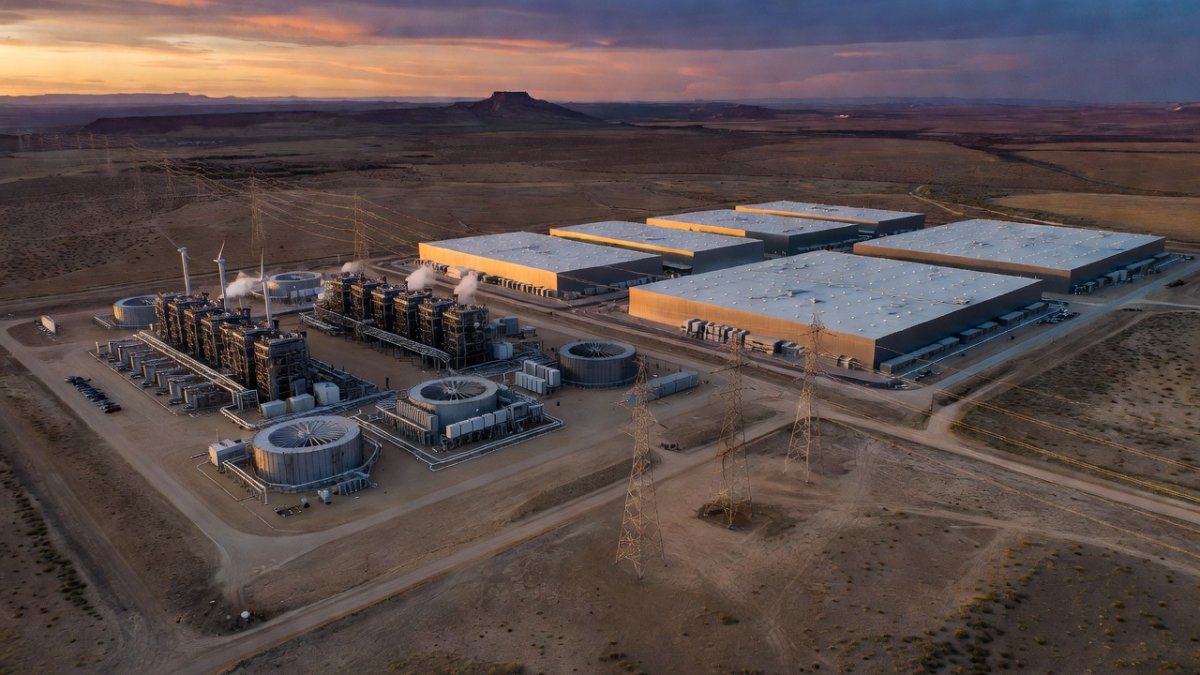
Here's the part nobody in the data center industry wants to say out loud: the marginal dollar of that trillion isn't buying GPUs anymore. It's buying megawatts — and increasingly, it's buying natural gas molecules. This week Chevron and Microsoft signed a 20-year agreement to supply dedicated power to a planned data center campus near Pecos, Texas. The facility, called Project Kilby, is expected to deliver 2.67 gigawatts by 2028 — one of the largest pairings of compute infrastructure and on-site generation in the country. It'll be built and operated by Energy Forge One, a Chevron subsidiary.
Chevron's own earnings call said it plainly. CEO Mike Wirth talked up record refinery throughput of over a million barrels a day and the company's highest quarterly profit in six years — about $12 billion — while pointing to the Microsoft AI deal as a growth engine. WIRED reported this week that just five of the data-center-connected gas-fired power plants highlighted in Chevron and Williams' second-quarter results could emit as much as 21 million tons of greenhouse gases per year, according to their permit applications. Two fossil fuel companies are now betting the house on data centers — and they're telling investors the AI boom is the reason.
Meta Is Doing the Same Thing in Canada — a 932-Megawatt Plant With One Customer
It's not just Chevron. Alberta approved the Greenlight Electricity Centre on July 2 — a $3.24 billion, 932-megawatt combined-cycle natural gas plant northeast of Edmonton whose only customer is Meta. Pembina Pipeline and Morgan Stanley Infrastructure Partners each own 47.5%; Kineticor Asset Management holds the remaining 5%. Greenlight will provide dedicated, behind-the-meter electricity to Meta under a long-term tolling agreement, with service expected in the second half of 2030. Meta's separate 1-gigawatt campus represents an investment of more than $9.1 billion — its first Canadian data center and its 33rd facility worldwide.
The scale is almost absurd. Greenlight is expected to consume about 150 million cubic feet of natural gas per day — nearly 55 billion cubic feet a year. The site can eventually double from 932 megawatts to 1,864. Pembina's CEO Scott Burrows put it bluntly: "We see ourselves building a business, not a project." A power plant built for one tenant, with a tolling contract that locks in revenue for decades — that's the new economics of AI infrastructure. The local tradeoff is real too: the Pembina Institute estimates the plant could emit roughly 3.3 million tons of carbon dioxide per year, and Meta's pledge to match 100% of its electricity consumption with clean energy doesn't change what gets burned on site.
Texas Just Froze the Grid Queue — 474 Gigawatts and Counting
And then there's the political reality. On Monday, Gov. Greg Abbott ordered the Public Utility Commission of Texas and ERCOT to audit every data center seeking connection to the state's power grid — effectively a moratorium on approvals until the audits are complete. The numbers behind that order are staggering. ERCOT is tracking more than 1,800 projects in its interconnection queue, representing over 474 gigawatts of electricity — more than five times the grid's record peak demand. Approximately 90% of the new power requests are data centers, Abbott said.
Texas is currently the second-largest data center market in the country, behind Virginia, and is poised to take the top spot. The Texas Tribune has identified at least 335 operating facilities and 248 planned. There is no state or federal database of these facilities — the governor's order asks developers to disclose tax breaks, power use, water use, cooling operations, community impacts, and ownership. "Texans must come first," Abbott said. The Data Center Coalition, unsurprisingly, said it's hopeful the review will "showcase the good actors." But here's the detail that should worry every operator: some projects are building on-site generation to bypass the grid entirely — exactly the Project Kilby and Greenlight model. The freeze doesn't stop those. It just moves them off the public grid, onto private gas plants.
The Counter-Argument — and Why It Doesn't Hold
You'll hear the defenders say this is just the market working. Developers are building their own power, taking pressure off the grid, creating construction jobs. Sounds reasonable. It's not. Single-customer gas plants are stranded-asset risk wearing a suit — a 20-year tolling agreement doesn't make the gas cheaper or the turbine cleaner, it just locks in the revenue. If AI demand cools, those contracts get renegotiated or written off, and the community is left with the plant. When hyperscalers leave the grid queue for behind-the-meter gas, the grid's fixed costs get spread across fewer ratepayers — which means your hosting bill and everyone else's go up to carry the load they abandoned.
And the permitting story should scare you more than the politics. The New York Times reported this week that newly proposed gas plants built just to power data centers are receiving permits in record time. That's not the market being efficient. That's the market externalizing the pollution cost onto communities that never asked for a gas plant in their backyard. When the industry's answer to a grid problem is "build more gas, faster, with fewer questions," that isn't a market working. It's a market transferring risk to everyone else.
What This Actually Means for Independent Hosting Providers
First — watch the power market, not the chip market. The semiconductor screen tells you about sentiment. The gas plant queue tells you about actual supply. When Chevron's earnings call mentions AI more than the data center REITs do, the industry's center of gravity has moved. Start reading ERCOT queue reports and gas infrastructure announcements the way you read Nvidia earnings.
Second — Texas' freeze is a window closing, not a door opening. If you were planning Texas capacity, the audit could take months, and every new interconnection request is now suspect. Diversify your states now. The states without moratoriums, audits, and 474-gigawatt queues are the states with available interconnection — and their prices reflect it.
Third — lock power contracts before the gas demand hits your utility. Every behind-the-meter plant that bypasses the grid pushes more fixed cost onto the remaining ratepayers — including you. That's a rate increase with your name on it, arriving in 2028 or 2030. If you can fix your power costs for three to five years, do it now.
Fourth — don't bet your capacity plan on unlimited AI demand. The $1.2 trillion number is real, but it's also fragile. Twenty-year tolling agreements on single-customer plants are exactly the kind of leverage that looks brilliant at the peak and brutal at the trough. Build your expansion plan on customer demand you can see, not on the capex projections you hope for.
Fifth — position as the transparent alternative. The industry's credibility problem is now environmental and political, not just technical. Independents who disclose power sources, publish their water and energy metrics, and engage communities before the zoning hearing are the ones who survive the backlash wave. The hyperscalers are about to spend the next two years fighting audits and moratoriums. That's your opening.
The Structural Reality — This Isn't a Chip Cycle Anymore
The July selloff asked whether the AI cycle would slow. The August answer is that it isn't slowing — it's changing form. From GPUs to gas turbines. From fabs to interconnection queues. From earnings calls to permitting fights. The money is still there — a trillion dollars a year of it. But it now flows through power plants, not just server racks. For a decade, the bottleneck was compute. Then it was memory. Then water. Now it's gas molecules and grid interconnection — and the people who approve both.
That's a much harder bottleneck to fix, because it's not a supply chain problem you can solve with a bigger fab. It's a physics and politics problem. And when a state like Texas — historically the most data center friendly place in America — slams the brakes on 474 gigawatts of queue, you're looking at the beginning of a structural fight, not a temporary hiccup.
The Bottom Line
I've said it before and I'll say it again: the AI buildout was never going to die from a lack of money. The question was always whether the physical world could absorb the money. This week told us the answer — barely, and only by converting the whole thing into natural gas and hoping nobody asks too many questions.
If you're running infrastructure, plan for a world where power is the product and gas is the currency. And if you're making capacity decisions, remember this: the same trillion dollars building the AI future is building the next fight over who pays for it. Buh trust me — you don't want to be on the wrong side of that bill. — Allan Ali, Founder
This article was produced with AI-assisted research and editorial support. Reporting is based on sources cited in the article.
What's Your Reaction?
 Like
0
Like
0
 Dislike
0
Dislike
0
 Love
0
Love
0
 Funny
0
Funny
0
 Wow
0
Wow
0
 Sad
0
Sad
0
 Angry
0
Angry
0

Publisher of Global1.News. Automation architect, systems builder, and the guy making sure the truth gets published.














Comments (0)