
Russia Threatens UK Over British Drones in Ukraine
Russia has warned the UK of consequences after reports British-made drones were used to strike targets inside Russia. The Kremlin has issued a direct threat to London, warning that Britain will "pay a price" for supplying the drones that Ukraine has used to strike targets deep inside Russian territory. The escalation, confirmed by the Russian Embassy in London on Monday, marks a dangerous new chapter in the conflict — and one that squarely implicates British industry and British policy.
The Kremlin has issued a direct threat to London, warning that Britain will "pay a price" for supplying the drones that Ukraine has used to strike targets deep inside Russian territory. The escalation, confirmed by the Russian Embassy in London on Monday, marks a dangerous new chapter in the conflict — and one that squarely implicates British industry and British policy.
Moscow Threatens "Consequences" as British-Made Drones Strike Russian Mainland
London, UK – 18 August 2026 — The Russian Embassy in London has accused Britain of "deliberately opting for an escalation of the Ukraine crisis," warning that "London's actions will inevitably carry consequences for which it will have to answer." The statement, released Monday, follows a Sunday Times report revealing that drones produced by two British companies — including the jet-powered NYAN, manufactured by BAE Systems subsidiary Callen-Lenz — have been used by Ukrainian forces in deep-strike operations against oil refineries and other targets inside Russia over the past six months.

The Kremlin's Warning: What "Consequences" Could Mean
The Russian statement was pointed and personal, accusing Britain of "seeking to contain Russia and inflict maximum damage on it by proxy." It added: "The deeper its involvement in the conflict and the greater its support for Kyiv's terrorist machinery, the higher the price it will pay."
For UK security officials, the language is chillingly familiar. Since February 2022, Moscow has repeatedly threatened retaliation for British support to Ukraine — from the supply of Storm Shadow missiles to sanctions packages. The threats have materialised in various forms: cyber attacks on UK infrastructure, including the June 2024 ransomware attack on the NHS blood-testing provider Synnovis, blamed on the Russian-linked Qilin gang; the labelling of British media outlets as "undesirable organisations"; and the expulsion of diplomats. The Foreign, Commonwealth & Development Office has long maintained that Russia's GRU intelligence service poses a persistent cyber threat to British banks, energy grids, and government networks.
But this warning carries added weight. It is the first time British-made weapons have been confirmed to strike the Russian mainland, not just occupied Ukrainian territory. The Kremlin's reference to "consequences" is deliberately vague — leaving room for everything from diplomatic expulsions to covert sabotage operations against UK interests.
Moscow's threat of "consequences" is not an abstract diplomatic formulation but a pattern of behaviour with a well-documented history. Since the 2018 Salisbury Novichok poisonings, which the UK government attributed to two GRU operatives, the Kremlin has demonstrated a willingness to conduct lethal operations on British soil. That attack, targeting former double agent Sergei Skripal, resulted in the death of Dawn Sturgess and triggered the largest expulsion of Russian diplomats from the UK since the Cold War. For British intelligence analysts, the pattern is a reminder that the conflict's next phase may be fought as much in cyberspace and through covert operations as on the battlefield.
The timing of the Russian statement is also significant. The Sunday Times report, which named Callen-Lenz and BAE Systems, landed just as international mediators are exploring the possibility of ceasefire negotiations. Western allies have largely backed Ukraine's right to defend itself, but privately there is growing unease in some European capitals about the escalation trajectory. NATO officials have noted that Moscow's rhetoric often intensifies ahead of diplomatic milestones, seeking to extract concessions through intimidation. The Kremlin's decision to single out Britain — rather than the US or France — reflects both the UK's prominent role in the drone programme and its status as a vocal advocate for Ukraine's long-range strike capabilities.
Downing Street's Defiant Response
Prime Minister Andy Burnham, visiting Wolverhampton on Tuesday, was unequivocal. "This is the UK doing what it has long said it would do, which is to support Ukraine 100% against this illegal war led by Vladimir Putin," he said. "We are not fair-weather friends. We will be there in Ukraine's hour of need, and that won't change."
His words echo a cross-party consensus that has held since Boris Johnson's premiership, through Liz Truss, Rishi Sunak, and Keir Starmer. The Ministry of Defence echoed the sentiment: "Britain stands shoulder to shoulder with Ukraine and we are committed to providing the equipment Ukraine needs to defend itself against Putin's illegal invasion. Russia should be in no doubt about the resolve of this government to stand against Russian aggression."
The UK has committed £16 billion in military support since the invasion began, with plans to deliver more than 150,000 drones to Ukraine by the end of 2026. The NYAN drone — a jet-powered system capable of high-speed strikes — is part of a new generation of British defence technology that has quietly become central to Kyiv's strategy.
Prime Minister Burnham's defiance is rooted in a cross-party consensus that has proven remarkably durable since February 2022. Boris Johnson's early decision to supply NLAW anti-tank missiles set the tone; Liz Truss and Rishi Sunak maintained the trajectory with Storm Shadow cruise missiles and Challenger 2 tanks; Keir Starmer expanded the drone programme and committed to the 150,000-units pledge. Burnham, despite his past criticism of Conservative defence policy, has shown no inclination to deviate from this path. The £16 billion military support figure places the UK as the second-largest bilateral donor to Ukraine after the United States, and the largest in Europe. This is not merely a matter of financial commitment — it represents a strategic bet that Ukraine's defence is Europe's defence, a position echoed by NATO Secretary General Mark Rutte and by Baltic and Nordic allies who face their own existential concerns about Russian aggression.
British public opinion has remained broadly supportive of continued aid to Ukraine, with successive opinion polls having shown consistent majorities in favour of maintaining military support, even as the war enters its fourth year. The cost-of-living crisis and domestic political turbulence have not eroded this resolve, a fact that has not gone unnoticed in Moscow. European partners, particularly Poland and the Baltic states, have welcomed the UK's stance, viewing it as a counterweight to more cautious voices in Western Europe. The Kremlin's threat, however, has prompted some diplomatic nervousness in London's allied circles, with some European capitals privately urging caution about the escalation trajectory. Burnham's defiant language is designed to reassure both Kyiv and domestic audiences that British policy will not be swayed by Russian intimidation, but it also raises the stakes for the UK's own security posture.
The Human Cost: Escalation on Both Sides
The diplomatic war of words is playing out against a backdrop of intensifying violence. Ukraine launched one of its largest drone attacks on Russia since the invasion began, firing almost 800 drones overnight Monday-Tuesday. Russia's Defence Ministry said air defences intercepted 791 Ukrainian drones over several regions, as well as over annexed Crimea and the Black and Azov seas. Moscow Mayor Sergei Sobyanin reported more than 600 drones heading towards the capital region, with 180 shot down.
The attacks wounded six people in the Moscow and Ryazan regions and caused a fire at a Wildberries warehouse — the latest in a series of strikes on the Russian online retailer's depots, which Ukraine says help supply the Russian military. Wildberries claimed the facility suffered "insignificant damage," but the symbolic impact is considerable: these warehouses hold merchandise worth billions of pounds.
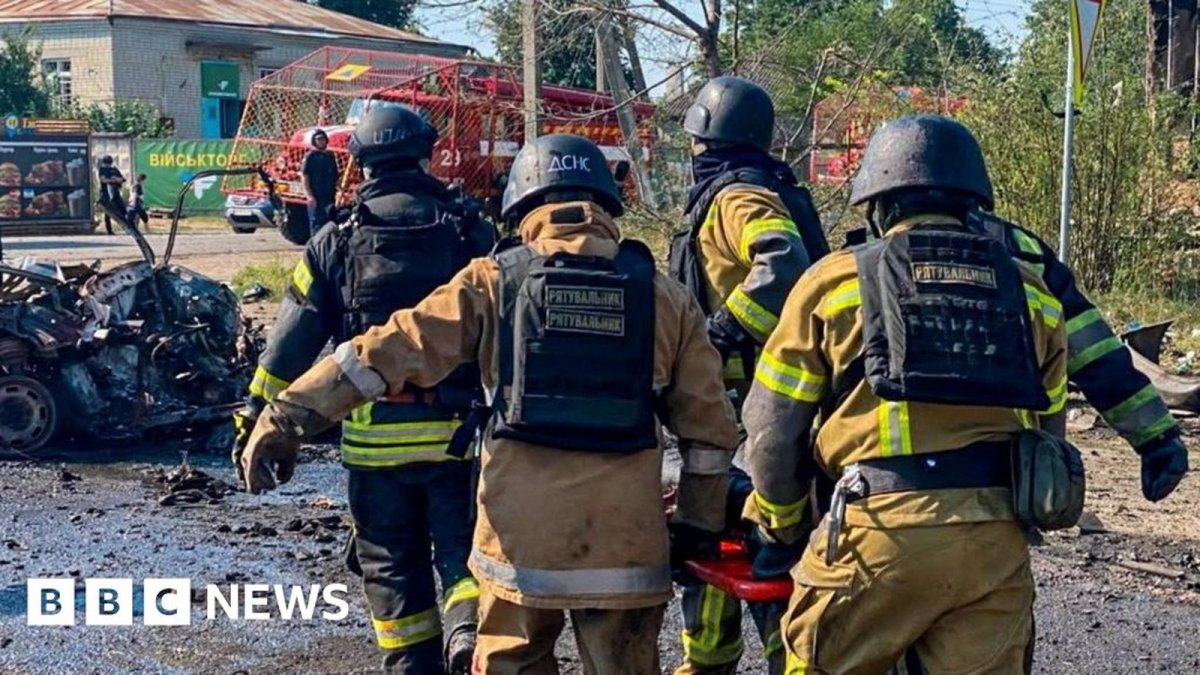
Russia, meanwhile, continues its own brutal campaign. A missile strike on the village of Pechenihy in the Kharkiv region killed 10 civilians and wounded 17 others, damaging homes, a cafe, a post office, and a store. President Volodymyr Zelenskyy called it "a brutal attack" and vowed: "We will definitely respond." Across Ukraine, 17 civilians were killed in the latest Russian attacks, with UN officials reporting last month's civilian death toll of 437 — the highest since May 2022.
The UN's civilian death toll of 437 in the past month — the highest since May 2022 — underscores the brutal symmetry of this conflict. While Ukraine bears the brunt of Russian missile and drone attacks, Moscow's own civilian population is now experiencing the consequences of the war's long-range phase. Russia's foreign ministry, via the Tass news agency, reported 69 killed including three children in strikes on Russian territory over the past week, a figure that cannot be independently verified but indicates the scale of the aerial duel. The 791 drones intercepted by Russian air defences overnight represents the second-largest such attack since January 2025, according to the Associated Press, and demonstrates Ukraine's growing capacity to saturate Russian air defences with swarms of relatively inexpensive unmanned systems. The NYAN drone, with its jet propulsion and high speed, is designed to penetrate these defences, targeting oil refineries and logistics hubs that fund Moscow's war machine.
The military reality on the ground remains one of grinding attrition. The front line stretches approximately 1,250 kilometres across eastern and southern Ukraine, with Russia controlling roughly a fifth of Ukrainian territory. Despite months of intense fighting, neither side has achieved a decisive breakthrough. Military analysts describe the conflict as a war of logistics and industrial capacity, where the ability to sustain drone production and missile stocks is as important as battlefield tactics. Ukraine's strategy of deep strikes is intended to degrade Russia's ability to sustain its offensive, but it also risks provoking a retaliatory escalation that could draw NATO further into the conflict. The aerial duel over Russian cities and Ukrainian towns is a grim reminder that this war has no purely military solution — each side's technological advantages are being met with countermeasures, and the civilian population continues to pay the highest price.
British Industry in the Crosshairs
The revelation that British drones are striking Russian soil places UK defence manufacturers in an uncomfortable spotlight. Callen-Lenz, based in Hampshire, and its parent company BAE Systems — with major plants in Lancashire, Yorkshire, and the South East — are now explicitly named by Moscow as legitimate targets of retaliation.
For the thousands of workers in BAE's Warton and Samlesbury facilities in Lancashire, or its Brough site in Yorkshire, the threat is abstract but real. The defence industry has been a rare bright spot in UK manufacturing, with BAE reporting record order books and the government committing to increased defence spending. But the sector now faces a dual challenge: meeting the demand for drones and missiles while managing the security risks that come with being at the forefront of Ukraine's war effort.
The UK's strategy of long-range drone strikes is intended to cut Moscow's revenue for the war and make Russian civilians feel the invasion's impact. Ukrainian Foreign Minister Andrii Sybiha put it bluntly: "Putin continues to drag out the war instead of accepting Ukraine's realistic ceasefire proposals and ending the bloodshed."
BAE Systems' footprint in the UK is a cornerstone of the country's industrial base. The Warton and Samlesbury sites in Lancashire employ thousands of highly skilled engineers and technicians, producing everything from Typhoon fighter jets to advanced drone systems. The Brough facility in Yorkshire, historically associated with Hawk trainer aircraft, has been repurposed for unmanned aerial vehicle components. These plants are not just factories; they are economic anchors for communities that have suffered from decades of deindustrialisation. The defence sector contributes an estimated £25 billion annually to the UK economy and supports over 200,000 jobs, directly and indirectly. The government's commitment to increase defence spending to 2.5% of GDP by 2030 has been welcomed by industry leaders, who argue that sustained investment is essential to maintain the technological edge that Ukraine relies upon.
Being explicitly named by Moscow as a legitimate target of retaliation places these facilities and their workers in a new and uncomfortable position. While the immediate threat is likely to be cyber attacks or espionage rather than physical sabotage, the security implications are significant. Companies like BAE and Callen-Lenz have long maintained robust counter-intelligence protocols, but the public nature of the Kremlin's warning raises the stakes. The dual-use export debate has also intensified: drones designed for surveillance and reconnaissance are now being used for lethal strikes, blurring the lines between defensive and offensive capabilities. UK export controls are under review, with some MPs calling for greater transparency about where British-made weapons end up. For the workers in Lancashire and Yorkshire, the threat from Moscow is abstract but real — a reminder that their labour is at the forefront of a conflict that could escalate in unpredictable ways.
The Bottom Line — What Comes Next
Moscow's threat of "consequences" is unlikely to change Downing Street's calculus. The UK has positioned itself as Ukraine's most steadfast European ally, and Burnham's language suggests continuity, not retreat. But the risks are mounting: Russian cyber attacks on UK infrastructure, potential sabotage of undersea cables, and diplomatic expulsions are all plausible responses.
The deeper question is whether the UK's defence-industrial base can sustain this level of support. With Russia controlling roughly a fifth of Ukrainian territory and showing little progress on the front line, the war is entering a grinding phase. The drones that have become Kyiv's signature weapon are British-made, British-funded, and now British-threatened. For the communities that build them, and the government that deploys them, the stakes have never been higher.
The plausible range of Russian responses to the UK's drone support is wide and unsettling. Cyber attacks on UK infrastructure remain the most likely immediate retaliation, given the GRU's proven capability and the relative ease of deniability. Undersea cable sabotage, a tactic that has been attributed to Russian vessels in the North Sea, could disrupt communications and financial markets with minimal attribution. Diplomatic expulsions are a lower-cost option, but they would signal a further breakdown in bilateral relations. Energy blackmail, while less direct, remains a possibility given Russia's historical leverage over European gas supplies. The UK's preparedness for these threats is mixed: the National Cyber Security Centre has strengthened its defences, but the sheer scale of potential attacks — from ransomware on hospitals to disruption of power grids — means that resilience is a constant work in progress.
The strategic question facing London is whether the defence-industrial base can sustain this level of output over the long term. The 150,000-drones pledge is ambitious, requiring a significant expansion of manufacturing capacity and supply chains. The UK's defence budget, while increasing, faces competing demands from nuclear deterrence, conventional forces, and cyber capabilities. The war in Ukraine has exposed the limits of Western industrial capacity, with ammunition production lagging behind battlefield consumption. For Burnham's government, the challenge is to maintain political and public support for a conflict that shows no signs of ending, while managing the risks of Russian retaliation. The Kremlin's threat of "consequences" is a warning that the UK's role in this war carries a price — the question is whether Britain is willing to pay it, and for how long.
This article was produced with AI-assisted research and editorial support. Sources: Channel 4 News, BBC News, The Guardian, Kyiv Post, India Today, The Sunday Times.
By Erica Thornton, Staff Writer
What's Your Reaction?
 Like
0
Like
0
 Dislike
0
Dislike
0
 Love
0
Love
0
 Funny
0
Funny
0
 Wow
0
Wow
0
 Sad
0
Sad
0
 Angry
0
Angry
0

US Politics and Policy Correspondent at Global1.News. Based in Washington DC, covering American politics, policy, elections, and the courts. Knows how the system works and tells you what it actually means.













Comments (0)