
Russia Denies Secret Baku Peace Talks Even as Aliyev Produces Flight Data and New Tracks Emerge in Vienna
Russia's Foreign Ministry denies official talks with Germany on Ukraine, but President Aliyev says flight data prove a secret July 12-14 Baku meeting involving former German officials and Kremlin insiders, as new Vienna backchannels emerge.

Moscow this week denied that official Russian-German talks on Ukraine took place in Azerbaijan last month — but the categorical rejection by Deputy Foreign Minister Mikhail Galuzin collides with a detailed account from Azerbaijani President Ilham Aliyev, who produced flight data to prove the secret meeting occurred. The episode has laid bare a widening gap between the Kremlin's public rhetoric and its quiet pursuit of backchannels to the West.
Russia Denies Secret Baku Peace Talks Even as Aliyev Produces Flight Data and New Tracks Emerge in Vienna
Moscow, Russia — Russia's Foreign Ministry has denied that Russian and German officials held talks in Azerbaijan last month to discuss the ongoing war in Ukraine, calling such contacts "hardly possible" given Berlin's hostility toward Moscow. But the denial, issued this week by Deputy Foreign Minister Mikhail Galuzin to state news agency TASS, stands in direct conflict with Aliyev's public account of a secret July 12-14 meeting in Baku — a meeting the Azerbaijani leader says his own border service confirmed.
Moscow's Flat Denial
"There have been no official contacts with Germany regarding a settlement in Ukraine, nor are there any now," Galuzin told TASS. "And they are hardly possible given the extremely aggressive anti-Russian rhetoric and actions of Germany's leadership."
The remarks reflect the Kremlin's hardening line toward German Chancellor Friedrich Merz, who has positioned Berlin as one of Europe's most resolute supporters of Kyiv. German military aid to Ukraine has expanded significantly under Merz, and Berlin has repeatedly ruled out negotiations on terms favorable to Moscow.
Yet even in the same statement, Galuzin conceded that backchannel discussions have taken place between individuals from Germany and Russia who are not affiliated with either country's government. He provided no further details — and pointedly did not address reports this month that former British, French and German diplomats met secretly with a former Russian official in Vienna as part of a Swiss-mediated initiative.
Aliyev's Bombshell in Berlin
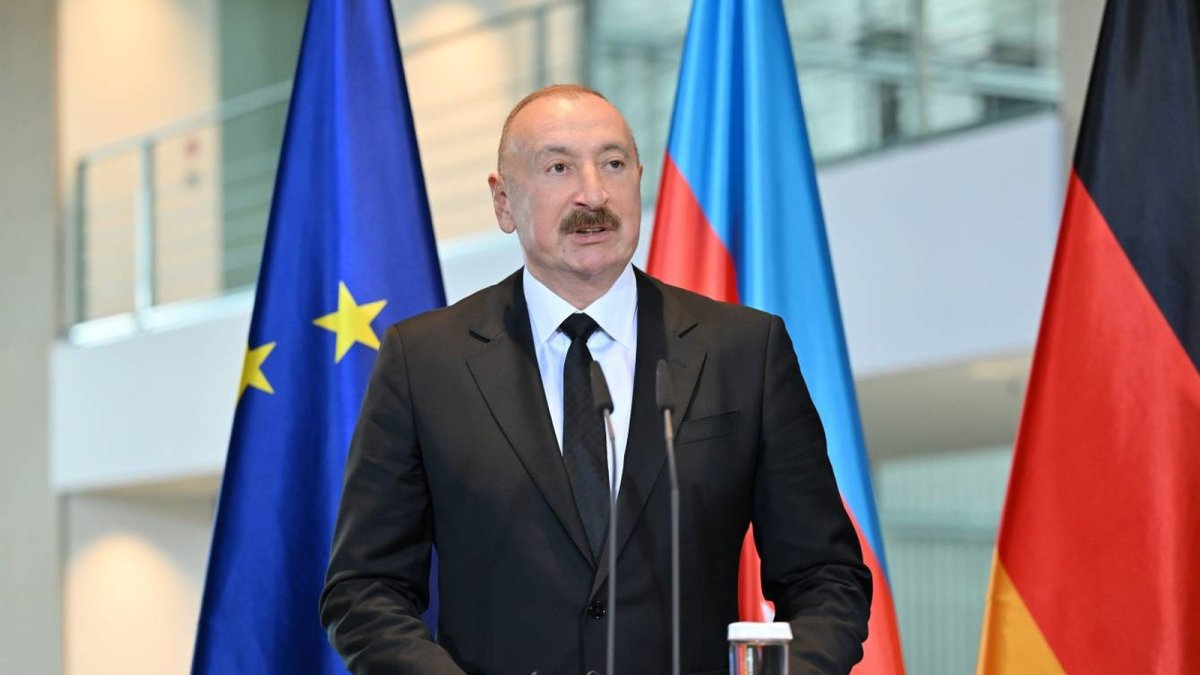
The denial came three weeks after Aliyev dropped a diplomatic bombshell at a July 21 Berlin press conference alongside a visibly startled Merz. Aliyev declared that Russian and German officials had held a "secret meeting" in the Azerbaijani capital earlier that month, and challenged both governments to deny it.
"On July 12, two well-known figures — Mr Ronald Pofalla, the head of Merkel's Administration, and Mr Matthias Platzeck — arrived in Baku on the Berlin-Baku flight and returned on 14 July," Aliyev told reporters. "At the same time, on 12 July, former Russian Prime Minister Mr Viktor Zubkov and Mr Valery Fadeyev, the head of the Presidential Council for Civil Society and Human Rights under the President of Russia, arrived in Baku from Moscow."
Aliyev stressed that neither side informed Baku of the meeting. "We were not informed about this by either Germany or Russia. In other words, our territory was simply used without our knowledge," he said, noting that he requested information from Azerbaijan's border service, which confirmed the arrivals and departures.
Merz, standing beside Aliyev, issued an awkward denial. The Azerbaijani leader made clear he was not accusing anyone of wrongdoing: "If this meeting was aimed at helping end the war between Russia and Ukraine, we can only welcome it."
A Cast of Kremlin Insiders and German Emissaries
The names Aliyev cited give the meeting unusual political weight, even if all participants now insist they acted in a private capacity.
Ronald Pofalla served as chief of staff of the German chancellery under Chancellor Angela Merkel from 2009 to 2013, one of the most powerful positions in German governance. Matthias Platzeck, the former minister-president of Brandenburg, has spent years cultivating contacts with Russian officials, often defending dialogue with Moscow in the face of domestic criticism.
On the Russian side, Viktor Zubkov is a former prime minister who currently chairs the board of directors of Gazprom, the state-controlled energy giant whose export revenues long underwrote the Russian budget. Zubkov is under Western sanctions and is considered close to President Vladimir Putin — a man whose inner circle has narrowed considerably since the full-scale invasion of Ukraine.
Valery Fadeyev, who heads the Presidential Council for Civil Society and Human Rights, is a Kremlin loyalist whose formal portfolio — human rights advocacy — makes for an awkward pairing with covert negotiations. His presence, analysts suggest, was designed to give the Russian delegation political cover while maintaining a direct line to the presidential administration.
A Pattern of Quiet Channels
This is not the first time this exact cast has surfaced in Baku. In 2025, revelations that Pofalla and Platzeck held secret meetings with Russian officials in Azerbaijan — joined then by German MP Ralf Stegner — provoked outrage in Germany, where lawmakers demanded to know who had authorized freelance diplomacy conducted under the country's political shadow.
Nor is the Kremlin's use of deniable intermediaries new. In 2023, former senior U.S. national security officials and high-ranking Kremlin officials held similar secret talks, sources previously told The Moscow Times. Each new disclosure reveals a consistent Russian method: when official channels freeze, Moscow deploys trusted emissaries with ties to power but no formal mandate, preserving plausible deniability at the highest levels.
Galuzin's careful wording this week fits that template precisely. By acknowledging that private discussions exist while denying they carry official character, the Foreign Ministry preserves maximum flexibility — insisting publicly that nothing is happening while privately keeping lines open.
Vienna: The Other Track
The Baku meeting is only one of several apparent tracks. According to a Bloomberg report published this month, former senior officials from Britain, France, Germany and Russia met secretly in Vienna last month to explore potential terms for holding peace talks on Ukraine.
Western participants included Tim Barrow, the former UK national security adviser; Markus Ederer, the former German state secretary; and Pierre Vimont, a veteran French diplomat. The identity of the Russian official in Vienna was not disclosed.
Ederer and Vimont sit on the board of the Center for Humanitarian Dialogue, a Swiss-based organization specializing in conflict resolution. The center said it often operates discreetly to protect dialogue initiatives conducted independently and without official involvement.
Western official responses were carefully hedged. The German Foreign Ministry said it was unaware of the talks and that they were not conducted on its behalf or in coordination with the ministry. The French Foreign Ministry declined to comment. The UK government said only that London supports efforts to achieve a just and lasting peace in Ukraine.
Yet sources close to the talks told Bloomberg that some European governments were aware of the Vienna meetings and welcomed them. A senior advisor to European Council President Antonio Costa has also attempted to create a separate channel with Moscow, though according to Bloomberg's interlocutors it has not yet produced results.
What Moscow's Denial Conceals
The contrast between Galuzin's categorical rejection and the accumulating evidence of quiet contact suggests the Kremlin is running a deliberate dual-track policy.
On the surface, Russian officials persistently dismiss European mediation. The Kremlin has rejected the idea of the EU as a possible mediator in Ukraine peace negotiations, and Foreign Ministry statements routinely characterize European leaders as Russophobic. Galuzin's own remarks this week echoed that line, citing "extremely aggressive anti-Russian rhetoric and actions" as the reason official talks are impossible.
Beneath the surface, however, the presence of Zubkov — a Gazprom chairman with decades of state service and direct access to Putin — signals that the Baku meeting carried Kremlin approval, whatever the Foreign Ministry now claims. Zubkov is not a private citizen wandering the halls of power; he is a sanctioned insider whose movements would be known to the presidential administration.
Analysts suggest this duality is intentional. Public rejection of mediation burnishes the Kremlin's image at home, where Putin faces pressure from war hawks who oppose any concessions. Private backchannels allow Moscow to test the waters, probe Western red lines, and keep options open without committing to anything.
The choice of Baku as a venue also reflects post-Soviet dynamics. Azerbaijan, a former Soviet republic, has carefully balanced its relations between Moscow and the West, maintaining warm ties with the Kremlin while selling natural gas to Europe. Aliyev's decision to go public with the July meeting was a pointed message to both sides: Azerbaijan is a sovereign state and a host — not a silent accomplice.
Energy and Leverage in Baku
Aliyev's Berlin visit was about more than exposing secret diplomacy. Germany has become one of Baku's newest gas customers since Azerbaijani gas began flowing to Germany in 2024 via the Southern Gas Corridor and onward connections. Aliyev said he expects annual deliveries to reach 2 billion cubic metres by next year — a modest volume in a market that once imported vastly more from Russia, but a symbolically important diversification for Berlin.
That commercial relationship gives Azerbaijan unique leverage. Baku can host talks, supply energy to Europe, and present itself as a constructive force for regional peace — while ensuring its own strategic relevance in the shifting European energy architecture.
For the Kremlin, each new revelation of backchannel diplomacy is a double-edged sword. The channels provide intelligence and a route to Western interlocutors outside official structures. But exposure — whether by Aliyev in Berlin or Bloomberg in Vienna — erodes the fiction that Moscow is isolated and unbending, and hands the Kremlin's opponents evidence that it seeks talks while publicly rejecting them.
For now, Moscow is betting that denial will outrun disclosure. But with flight records, border service confirmations, and a growing stack of leaked meeting reports from Baku, Vienna and beyond, the gap between what the Kremlin says and what it does is narrowing. Each new track carries the risk that the denial itself becomes the story.
By Irina Volkov, Staff Writer
This article was produced with AI-assisted research and editorial support. Reporting is based on sources cited in the article.
What's Your Reaction?
 Like
0
Like
0
 Dislike
0
Dislike
0
 Love
0
Love
0
 Funny
0
Funny
0
 Wow
0
Wow
0
 Sad
0
Sad
0
 Angry
0
Angry
0
Russia/Eastern Europe Correspondent at Global1.News. Covering Russian politics, energy, security, and the shifting dynamics of the post-Soviet space. Provides clear-eyed analysis on one of the world's most opaque regions.











Comments (0)