
Route 60 Expansion: Israel Seizes West Bank Land for Settlers
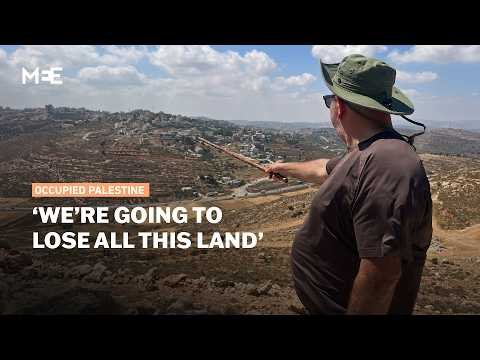
In a recent Middle East Eye report, the video shows residents in Al-Mazra'a Al-Sharqiya discovering confiscation orders scattered on their land for the expansion of Route 60, one of the main settler roads linking areas near Ramallah and Nablus. The Route 60 Expansion: A Road Through Palestinian Land Israel issued orders to confiscate large tracts of Palestinian land in the occupied West Bank for the expansion of Route 60. The project targets priv
The Route 60 Expansion: A Road Through Palestinian Land
Israel issued orders to confiscate large tracts of Palestinian land in the occupied West Bank for the expansion of Route 60. The project targets privately owned paved agricultural land to add new lanes and strengthen connections between illegal settlements. Farmers in affected areas received no formal delivery of the orders and instead found them discarded on their fields. The expansion would cut through established agricultural plots that families have cultivated for generations.
Route 60 itself traces its origins to the 1970s, when Israeli planners repurposed an older Ottoman-era path into a strategic artery connecting Jerusalem with northern settlements. Over decades, successive governments widened sections of the highway to accommodate growing settler populations, often at the direct expense of Palestinian villages whose lands were declared “state land” under military orders. The current expansion revives this pattern on a larger scale, incorporating bypass segments designed to insulate settlers from Palestinian traffic while carving deeper into terraced olive groves and rain-fed fields.
Taysir Salem, a landowner whose family holds documents proving decades of ownership, described how his grandfather once held 180 dunams. The family inherited the land and planted trees across it. Salem stated that Route 60 will be extended through their land, and at their expense the authorities will take it by force and bulldoze half of a hill that belongs to them. He noted that all the neighbouring towns will also face land theft because of the road.
Historical records show that Route 60’s alignment was deliberately chosen to link the Etzion bloc with settlements north of Ramallah, a configuration that fragments Palestinian contiguity. The latest orders, issued without public hearings, echo earlier seizures justified under the 1950 Absentee Property Law and subsequent military regulations that treat Palestinian title deeds as subordinate to security needs. Families like Salem’s now confront the prospect of losing not only soil but also the irrigation networks and stone terraces maintained since the British Mandate period.
The confiscation forms part of a wider pattern of seizures along the same route. Exact figures for the total area remain unknown because landowners received no official notification. The orders affect hundreds of dunams of productive agricultural land that supports local livelihoods.
International observers have noted that such infrastructure projects frequently precede formal annexation declarations. The 2024 International Court of Justice advisory opinion, which declared the occupation unlawful and called for its termination, explicitly referenced road networks that entrench settlement blocs as evidence of permanent control. UN General Assembly resolutions dating back to 2016 have repeatedly condemned similar expansions as violations of the Fourth Geneva Convention’s prohibition on transferring civilian populations into occupied territory.
Al-Mazra'a Al-Sharqiya: A Community Under Siege
Al-Mazra'a Al-Sharqiya, east of Ramallah, ranks among the towns most threatened by the Route 60 project. Residents there found the seizure orders on their land rather than through formal channels. The community relies on these plots for olive groves and other crops that sustain families across multiple generations.
The village’s location along the historic route has exposed it to incremental encroachment since the 1980s, when nearby settlements such as Ofra and Beit El received approval. Each widening phase reduced available grazing land and forced farmers to reroute donkey paths around newly erected barriers. Today’s expansion threatens to complete the encirclement, leaving only narrow corridors for movement between remaining fields.
Salem explained the personal stakes: the land has supported his family since his grandfather's time, and the planned road would destroy established trees and terrain. He warned that the entire area faces ongoing danger because the authorities intend to take the land by force. Palestinian landowners continue to hold legal documents that establish their ownership over many decades.
Community elders recall how earlier confiscations in the 1990s were accompanied by promises of compensation that never materialized. The current orders arrive amid a documented surge in settler violence, with UN OCHA recording over 1,200 incidents in the first half of 2024 alone. Residents fear that once bulldozers arrive, access to water springs and harvest routes will be permanently severed.
Daily life in the town already contends with movement restrictions tied to the existing road. The proposed widening would further fragment fields and limit access for farmers who must tend their crops. Community members describe the uncertainty as a constant pressure on their ability to plan for the future.
Local women’s cooperatives that process olive oil and za’atar have begun stockpiling supplies, anticipating that the new lanes will cut through processing sheds built on family plots. Schoolchildren already navigate checkpoints along Route 60; further expansion risks turning routine commutes into multi-hour detours through settler-only segments.
Systematic Land Theft: A Coordinated Campaign
The confiscations coincide with a settler campaign of intimidation directed at local residents. Settlers arrived on tractors and expelled Palestinians from their land at gunpoint. Salem stated that the community is in great danger because the goal is to seize the land by force.
These actions form part of Israel's broader policy under its most right-wing government to expand settlements and pursue annexation. In July the security cabinet approved 1.3 billion shekels for 34 new settlements. The Route 60 project fits within this pattern of infrastructure that links and enlarges settlement blocs while removing Palestinian access to land.
Landowners across multiple towns report similar experiences of finding orders left on their fields. The absence of direct notification leaves families without clear avenues to challenge the seizures in a timely manner. The combination of official orders and settler pressure creates a coordinated effort to clear land for the road expansion.
Reports from human-rights monitors describe coordinated settler incursions timed with the posting of military orders, creating a climate in which Palestinian farmers hesitate to approach their own fields. In several documented cases, masked individuals on all-terrain vehicles have fired warning shots near olive pickers, forcing families to abandon harvests mid-season. Such tactics mirror earlier campaigns that preceded the construction of the separation barrier and the expansion of the Ariel bloc.
Finance Minister Bezalel Smotrich has publicly framed these infrastructure initiatives as steps toward “applying sovereignty” over Area C, aligning with coalition agreements that pledge to legalize outposts and accelerate road linkages. The Route 60 works therefore serve both practical settlement growth and a political message that Palestinian land claims will not impede the emerging map of Greater Israel.
International Law and the Settler Enterprise
More than 700,000 Israeli settlers live in the occupied West Bank. Settlements remain illegal under international law. The Route 60 expansion would add infrastructure that supports these settlements and further entrenches their presence on Palestinian land.
Salem called on the international community to intervene. He noted that the American government holds the power to stop Israel from taking the land but has not done so. Palestinian documentation of ownership stands in direct contrast to the seizure orders that target the same plots.
The project would also advance the E1 settlement plan, which would divide the West Bank and sever its connection to East Jerusalem. Such fragmentation affects movement, trade, and family ties for Palestinians across the territory.
The ICJ’s July 2024 advisory opinion reinforced earlier UN Security Council resolutions, including 2334, which declared settlement activity a flagrant violation of international law and an obstacle to the two-state solution. Legal scholars argue that new road construction facilitating settler movement constitutes “de facto annexation,” a term used in the ICJ’s findings to describe measures that alter the demographic and territorial status of occupied land.
European Union statements following the opinion urged member states to differentiate between Israel and settlements in trade and labeling policies, yet enforcement remains inconsistent. Palestinian legal teams have begun preparing submissions to the UN Human Rights Council, citing the Route 60 orders as fresh evidence of systematic dispossession that contravenes both the Hague Regulations and the Fourth Geneva Convention.
The Political Context: Elections and Annexation
October 2026 elections approach, and West Bank annexation features as a campaign issue. Finance Minister Smotrich has declared a settlement revolution and continues to push for de facto annexation through infrastructure projects and new construction approvals.
The Route 60 expansion aligns with these political priorities. It strengthens links between settlements while removing Palestinian agricultural land from use. The timing of the confiscation orders places additional pressure on communities already navigating restricted access and economic strain.
Broader seizure activity along the route continues alongside the specific orders issued for Al-Mazra'a Al-Sharqiya. These steps reflect a consistent policy direction that prioritises settlement growth over Palestinian land rights.
Coalition partners have tied continued support for the government to concrete progress on annexation legislation, including retroactive legalization of outposts adjacent to Route 60. Smotrich’s office has circulated maps showing the highway as the backbone of a contiguous settlement corridor stretching from the Jordan Valley to the Green Line, effectively bisecting the northern West Bank.
Palestinian Authority officials warn that the combination of road expansion and settlement funding risks rendering future negotiations moot, as the physical facts on the ground outpace diplomatic timelines. International donors have expressed concern that continued land loss will deepen fiscal strain on the Authority, already facing salary arrears and service disruptions.
Analysis and Implications
The Route 60 project illustrates how road infrastructure serves as a tool for territorial control. By widening an existing settler road through privately owned Palestinian land, the plan removes productive agricultural areas and increases settler connectivity. Families such as Salem's face the loss of land that has supported them for generations, with no formal process to contest the orders they discovered by chance.
Settler intimidation that accompanies the official measures adds immediate physical risk to the legal threat. Residents report being driven from their fields at gunpoint, creating an environment where continued cultivation becomes unsafe. This dual pressure accelerates displacement without requiring large-scale military operations.
Salem's appeal to the international community underscores the limited options available to affected Palestinians. With elections scheduled for October 2026 and annexation rhetoric prominent in Israeli politics, the window for external pressure appears narrow. The human cost falls on communities whose daily routines, economic survival, and generational ties to the land are directly disrupted by the planned expansion.
Figures for the total area confiscated were not immediately available, yet the impact on individual families remains clear through the accounts of landowners who have maintained documents of ownership. The pattern of scattered orders and accompanying settler actions points to a systematic approach that affects multiple towns along the route.
Longer-term demographic projections indicate that completion of the Route 60 corridor would consolidate settlement blocs housing more than 150,000 Israelis, rendering any future Palestinian state territorially non-viable under current parameters. Agricultural economists estimate annual losses in olive and vegetable production exceeding several million dollars for the affected villages alone, compounding food insecurity already heightened by movement restrictions.
By Fatima Al-Rashid, Staff WriterThis article was produced with AI-assisted research and editorial support. Reporting is based on sources cited in the article.
What's Your Reaction?
 Like
0
Like
0
 Dislike
0
Dislike
0
 Love
0
Love
0
 Funny
0
Funny
0
 Wow
0
Wow
0
 Sad
0
Sad
0
 Angry
0
Angry
0

Gulf/MENA Correspondent at Global1.News. Based in Doha, covering Gulf politics, energy markets, diplomacy, and development across the Middle East and North Africa. Tracks the economic transformation of the Gulf states.













Comments (0)