
Rustam Emomali Awarded Order for ‘Selfless Service’ by Uzbek President
Historical Context of Uzbek‑Tajik Relations The bilateral relationship between Uzbekistan and Tajikistan has long been shaped by the legacy of Soviet‑era borders and competing water‑resource claims.
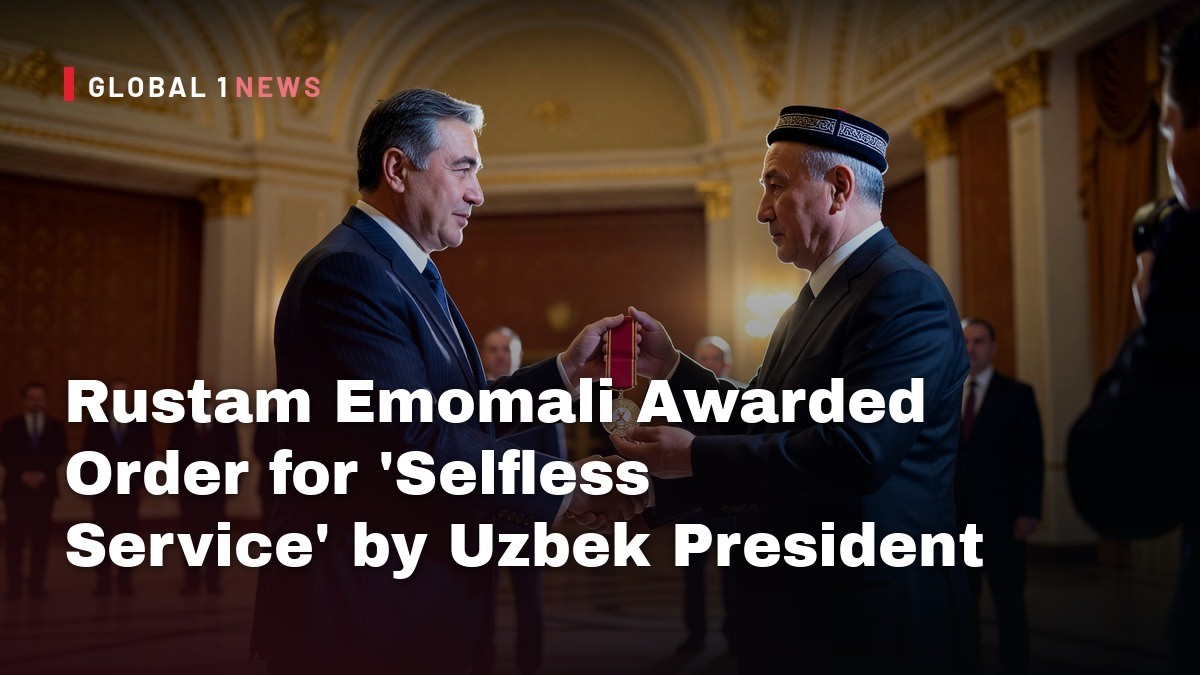
On 4 November 2026 Uzbek President Shavkat Mirziyoyev conferred the Order for Selfless Service (Fidokorona Xizmatlari Uchun) on Rustam Emomali, citing his “significant contributions to strengthening the strategic partnership and alliance between the two countries, as well as his fruitful work in expanding interparliamentary dialogue.” The award, delivered during Emomali’s official visit to Tashkent and a brief stop in Bukhara, underscores a diplomatic moment that is as much about personal prestige as it is about the evolving geopolitics of Central Asia.
Historical Context of Uzbek‑Tajik Relations
The bilateral relationship between Uzbekistan and Tajikistan has long been shaped by the legacy of Soviet‑era borders and competing water‑resource claims. The death of Islam Karimov in 2016 marked a turning point; his tenure was characterized by strained ties with neighboring states, particularly Tajikistan. By contrast, the 2018 visit of Tajik President Emomali Rahmon to Tashkent and Samarkand inaugurated a new era of rapprochement, signaling a shift from entrenched rivalry to a more collaborative stance. This diplomatic thaw set the stage for the 2026 encounter between Mirziyoyev and Rustam Emomali, whose own political ascent is tightly interwoven with Tajikistan’s internal succession dynamics.
Within this broader context, the award ceremony can be read as a symbolic affirmation of the “friendly relations, good‑neighborliness, strategic partnership, and alliance” articulated by both leaders. The Uzbek presidential press service highlighted the meeting’s focus on “key issues concerning the further deepening” of these ties, particularly through interparliamentary cooperation—a domain where Emomali’s dual roles as chair of the National Assembly and appointed mayor of Dushanbe grant him considerable leverage.
Rustam Emomali’s Political Trajectory
Rustam Emomali occupies a uniquely privileged position in Tajik politics. As the son of President Emomali Rahmon, who has ruled since 1994, Rustam has been groomed for leadership through a series of high‑profile appointments. In 2017 he was named mayor of Dushanbe, a move that elevated his public profile. By April 2020, amid the COVID‑19 pandemic, he was appointed chair of the Majlisi Milli (National Assembly), constitutionally placing him second‑in‑line to the presidency. This succession pathway was facilitated by a 2016 constitutional amendment that lowered the presidential age requirement from 35 to 30, aligning the eligibility window with Rustam’s age at the time.
The 2026 Uzbek award therefore functions as both a diplomatic accolade and a tacit endorsement of Rustam’s emerging stature on the regional stage. His participation in interparliamentary initiatives, such as signing a road map for cooperation with Senate chairwoman Tanzila Narbayeva for 2027‑2028, reinforces his role as a conduit for Tajik‑Uzbek dialogue, while simultaneously positioning him as a visible successor to his father’s long‑standing regime.
Strategic Significance of Interparliamentary Cooperation
Interparliamentary dialogue has become a cornerstone of Central Asian diplomacy, offering a platform for legislative bodies to coordinate on cross‑border issues without the direct involvement of executive heads of state. The road map signed between Rustam Emomali and Tanzila Narbayeva outlines a two‑year framework for joint parliamentary activity, reflecting a broader trend toward institutionalized cooperation. Such mechanisms are especially valuable in a region where water allocation, trade corridors, and security cooperation require sustained legislative oversight.
For Tajikistan, deepening parliamentary ties with Uzbekistan serves multiple strategic purposes. It not only consolidates the “strategic partnership” celebrated by Mirziyoyev but also provides Rustam with a tangible portfolio of diplomatic achievements that can be leveraged domestically. By showcasing successful interparliamentary outcomes, he can bolster his credentials as a statesman capable of navigating complex regional issues—an essential narrative as Tajikistan approaches its 2027 presidential election.
The Russian Dimension of Tajik Succession Politics
Russia remains a pivotal external actor in Tajikistan’s security and economic architecture. As noted by analyst Bruce Pannier, Moscow’s support is indispensable for any orderly transfer of power in Dushanbe. The Russian Federation maintains a military base in Tajikistan and ranks among its largest trading partners. In 2025 Rustam Emomali’s first one‑on‑one meeting with President Vladimir Putin in Moscow underscored the Kremlin’s role as a gatekeeper for Tajik succession.
Pannier’s observation that “if Moscow doesn’t approve the process, it could seriously complicate the situation” highlights the delicate balance Tajik leaders must strike. Russian endorsement confers legitimacy, while also ensuring that any transition aligns with Moscow’s strategic interests in the region, particularly concerning security cooperation against extremist threats and the management of the Central Asian energy corridor.
China’s Parallel Influence
China’s engagement with Tajikistan has intensified over the past decade, primarily through infrastructure investment and trade. Rustam Emomali’s 2023 visit to Beijing, though lacking a direct audience with President Xi Jinping, signaled a willingness to cultivate ties with the Chinese capital. The subsequent 2024 state visit by Xi to Dushanbe, during which Rustam stood beside his father in a high‑visibility farewell gesture, further cemented the symbolic importance of the bilateral relationship.
While the source material does not detail specific agreements, the public display of cooperation suggests that Tajikistan seeks to diversify its diplomatic portfolio, balancing Russian security guarantees with Chinese economic outreach. For Rustam, participation in these high‑profile moments enhances his image as a forward‑looking leader capable of managing Tajikistan’s great‑power interactions.
Implications for the 2027 Presidential Election
With Tajikistan’s presidential election scheduled for October 2027, the convergence of regional diplomatic activity around Rustam Emomali is unlikely to be coincidental. The award from Uzbekistan, the parliamentary road map, and the earlier engagements with Russia and China collectively construct a narrative of a seasoned, internationally recognized figure ready to assume higher office. This narrative is reinforced by the absence of “serious political opposition,” as noted in the source, indicating a tightly controlled political environment conducive to a managed succession.
Observers across Central Asia will be monitoring whether the 2027 election becomes a “managed political transition” akin to those observed in neighboring states. The degree to which Rustam can translate his diplomatic capital into domestic legitimacy will be a decisive factor. Should he secure the presidency, the continuity of the Rahmon dynasty would likely be accompanied by a foreign policy that maintains the current balance among Russia, China, and Uzbekistan, while potentially deepening parliamentary cooperation as a hallmark of his administration.
Forward‑Looking Assessment
The conferment of the Order for Selfless Service on Rustam Emomali is emblematic of a broader strategic calculus in Central Asia. It reflects Uzbekistan’s desire to cement a partnership with a Tajik leadership that appears poised for continuity, while simultaneously offering Rustam a platform to demonstrate his diplomatic competence. As the 2027 election approaches, the interplay of internal succession planning and external great‑power dynamics will shape Tajikistan’s trajectory.
From a scholarly perspective, the episode illustrates how personal honors can serve as proxies for deeper geopolitical signaling. The award not only acknowledges Rustam’s “fruitful work in expanding interparliamentary dialogue” but also signals Uzbekistan’s confidence in a stable, cooperative neighbor. If the anticipated transition proceeds without significant disruption, Central Asia may witness a period of incremental integration, anchored by interparliamentary mechanisms and sustained by the patronage of Russia and China. Future research should track the implementation of the 2027‑2028 parliamentary road map, assess the durability of Russian and Chinese support, and evaluate how these factors influence Tajik domestic reforms under a potentially new presidential administration.
This article was produced with AI-assisted research and editorial support. Reporting is based on the source material cited below. Sources: The Diplomat; thediplomat.com; Global1.News (09 November 2026).
By Prof. David Park, Staff Writer
What's Your Reaction?
 Like
0
 Dislike
0
 Love
0
 Funny
0
 Wow
0
 Sad
0
 Angry
0
East Asia/Technology Correspondent at Global1.News. Seoul-based voice covering Korean politics, technology, business, and culture. Analyzes how technology and geopolitics intersect across East Asia.









Comments (0)