
Poland's Top Court Split in Two: A Suspended Chief Justice, Riot Police, and a President Who Turned His Plane Around
A judge the president refuses to recognise suspended Poland's Constitutional Tribunal president and his deputy for a month, prompting riot police to seal the court and President Karol Nawrocki to turn his plane back from Senegal.
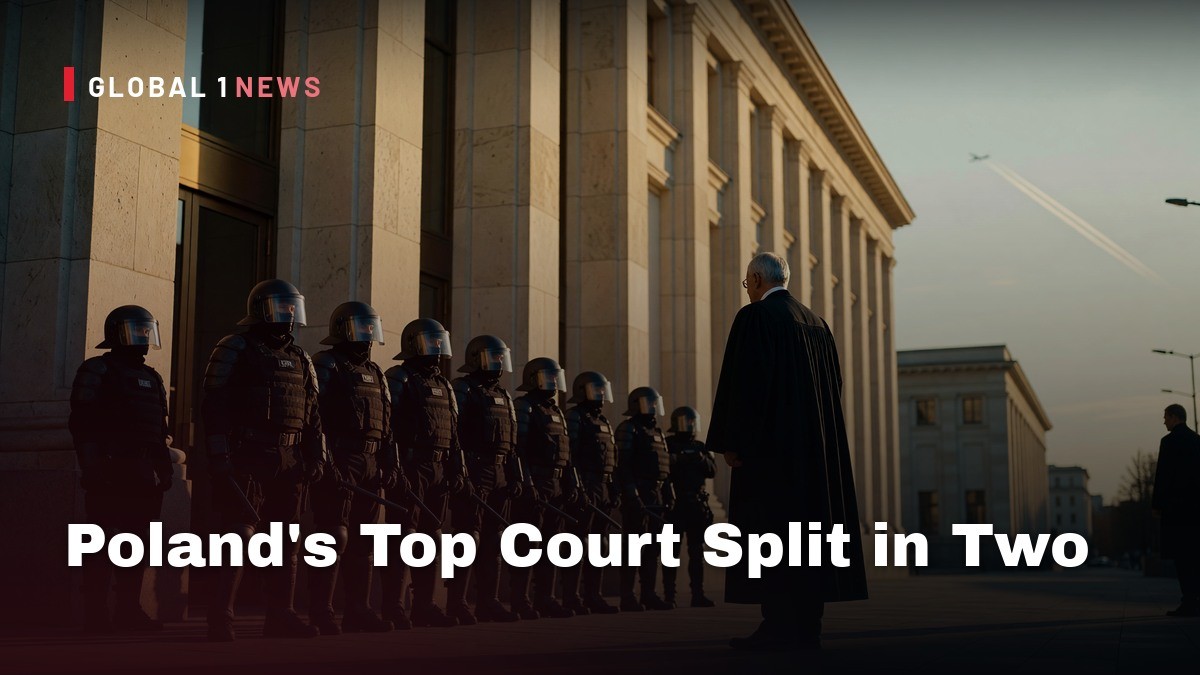
At six o'clock on Friday evening a short notice appeared on the website of Poland's Constitutional Tribunal, and by one o'clock on Saturday morning the President of the Republic was pushing his way through a police cordon to get inside his own country's highest court. Between those seven hours, a judge the president refuses to recognise suspended the court's chief justice, riot police sealed the building, three people were detained, and a head of state ordered his aircraft to turn around over Africa and fly him home.
Poland's Top Court Split in Two: A Suspended Chief Justice, Riot Police, and a President Who Turned His Plane Around
Warsaw, Poland — Poland's constitutional crisis stopped being a legal argument on Friday night and became a physical contest over one building in Warsaw, with two sets of judges, two claims to authority and a president who decided the only place he could be was inside it.
The Order That Appeared at Six O'Clock
The notice published on the tribunal's website on Friday evening said that a break in the activities of its president, Bogdan Święczkowski, and his deputy, Bartłomiej Sochański, had been ordered for one month. It did not name who had issued it. Soon afterwards the site went down, and The Associated Press reported that it could not independently verify the reasons the court had given.
The order was claimed hours later by Anna Korwin-Piotrowska, one of the judges elected by the current parliament whose appointment President Karol Nawrocki has refused to accept. She told state broadcaster TVP that she had issued it because Święczkowski was breaching the rules governing how the tribunal operates, and that she had no other choice. As the longest-serving judge among those in dispute, she said she was now leading the court.
A President Turns His Plane Around
Nawrocki was in the air, bound for a state visit to Senegal, when the news reached him. He had been due at the Summer Youth Olympic Games in Dakar. "At a moment like this, the President must be in Poland. I am cutting short my flight to Senegal. I am returning," he wrote on X. Flight-tracking data showed the government aircraft turning in midair and heading back toward Warsaw, a detail the flight-tracking service Flightradar24 published as it happened.
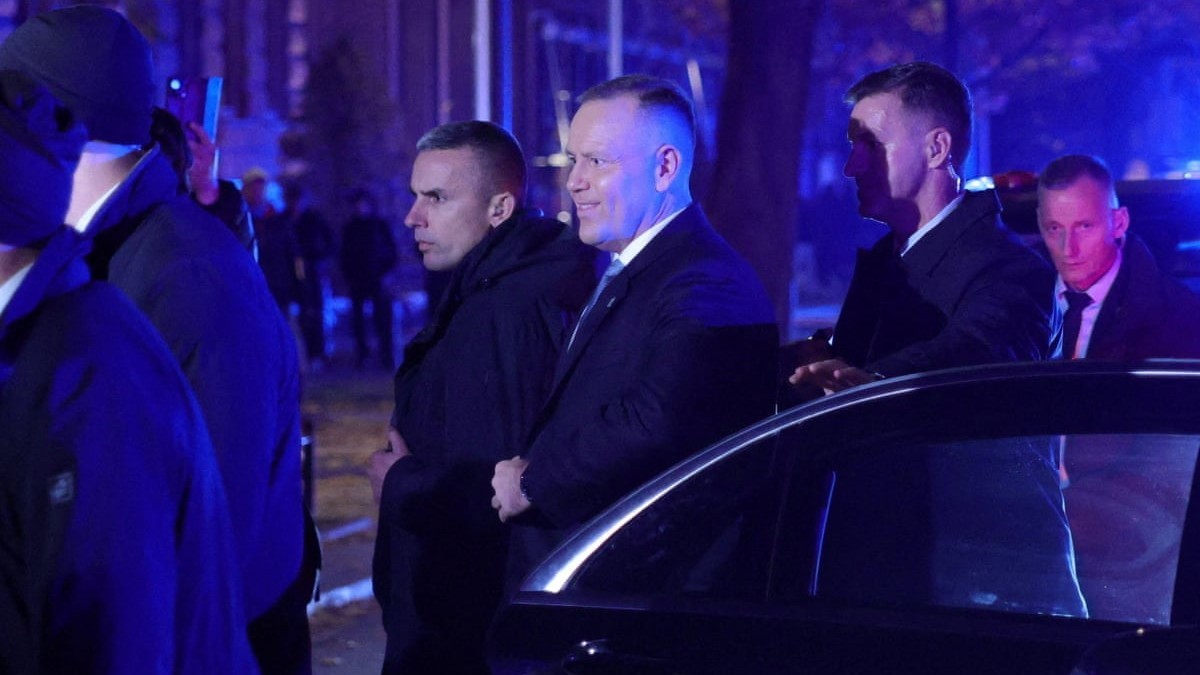
Back in the capital he went first to the presidential palace, where he met Święczkowski and Zbigniew Kapiński, the first president of the Supreme Court — a separate institution from the tribunal. No account was given of what was decided there. Shortly before one o'clock in the morning he appeared outside the court itself and forced his way through the police line, with video circulating online showing him tussling with officers and with judges. Inside, he was heard saying that the judges appointed by the government "were not judges of the constitutional court". He escorted Sochański, whom he called the legally serving vice-president, into the building. Judge Maciej Taborowski told the Polish news agency PAP that the president and his chief of staff, Zbigniew Bogucki, left before five in the morning, and that the judges stayed.
What the Tribunal Says It Is
Święczkowski is not a neutral figure in this fight. He was a deputy justice minister in 2015 and served as national prosecutor from 2016 to 2022 under the previous Law and Justice administration, and he has led the tribunal since December 2024, when President Andrzej Duda appointed him to replace Julia Przyłębska.
The court answered on its own terms. Its official account on X said there had been an unlawful takeover of the tribunal's website, that Święczkowski remains its president and Sochański its vice-president, and that Korwin-Piotrowska is not a judge of the tribunal at all. "All persons participating in these actions are committing the crime of a coup d'état," the post said.
The court's spokeswoman, Weronika Ścibor, gave broadcaster Kanał Zero an account of how the building was entered: seven people elected as tribunal judges this year were escorted inside by officers of the State Protection Service, a body that answers to the interior minister, and they came through a gate connecting the court to the prime minister's chancellery rather than the main entrance where the crowd had gathered. Sochański, she said, was not let in. The picture she painted is of a court whose two halves now use different doors.
The Judges Already Inside
To understand why a single notice could empty a street into a confrontation, you have to follow the arithmetic of the bench. Parliament has chosen eight new tribunal judges this year. Nawrocki has administered the oath to three of them and refused the other five, questioning how they were selected or whether they were qualified.
Those five responded by holding their own swearing-in ceremonies in the lower house, the Sejm, and sending their oaths to the president's office in writing. Święczkowski then refused to admit them to the court, telling reporters he could not recognise them because the president had not informed him they had taken the oath before him, and dismissing the parliamentary ceremony as a performance. He also declined to give effect to an interim measure from the European Court of Human Rights requiring that the judges be allowed to take up their posts, arguing that the Strasbourg court had no authority over the question. Earlier in October the Venice Commission, the Council of Europe's rule-of-law advisory body, said the president's refusal should not prevent the judges from taking office. Korwin-Piotrowska has called a general assembly of the tribunal's judges for 3 November.
The Legal Ground, and the Experts Fighting Over It
The notice on the court's website cited article 130 of the law on common courts, a provision allowing the head of a court or the justice minister to order an immediate break in a judge's duties where the judge is caught in the act of committing an offence. Legal commentators picked at that immediately. Marcin Matczak, a constitutional lawyer and a persistent critic of the previous Law and Justice government, said the route appeared to run through article 19 of the law on the status of tribunal judges, which defers to the rules governing Supreme Court judges, and from there to the Supreme Court's own equivalent of article 130.
He then reached a conclusion that cut against his own politics: he said he never thought he would end up defending Święczkowski, but that the legal basis for the suspension was non-existent. That is the shape of this dispute. It is not a fight between people who agree on the law and differ on the politics. It is a fight in which the lawyers are split, no court has ruled, and each side can point to a defect in the other's position.
Fifty Volumes on the Prosecutor's Desk
Waldemar Żurek, who holds both the justice portfolio and the office of prosecutor general, said on Friday that he had submitted motions to the tribunal to strip Święczkowski and Sochański of their immunity from prosecution. "This court has become private property; we must restore its proper functioning," he told reporters.
The Kyiv Independent reported that the paperwork amounted to five separate requests — four concerning Święczkowski and one concerning Sochański — accompanied by 50 volumes of case files, and it noted a distinction that matters: the requests do not themselves constitute criminal charges. Żurek also made clear he wanted prosecutors to look at the president's own conduct overnight. "It is unacceptable for a person protected by presidential immunity to behave this way, forcing his way in, attacking judges," he told TVN24. Sochański was able to enter the building only at the president's side, by Nawrocki's own account of the night.
Tusk's Argument
Prime Minister Donald Tusk did not hedge. "Restoring the rule of law is our duty," he wrote on X. "After years of PiS-led lawlessness, this is a difficult process, sometimes painful, and it requires decisive action. There is no other way." Earlier this month he had set the expectation plainly, saying the court would begin its work in accordance with the constitution, whether people liked it or not.
Foreign Minister Radosław Sikorski, speaking to reporters on the margins of a G20 meeting in Atlanta, put the case in institutional terms: the tribunal was politicised under the previous government, and what is happening is meant to let the majority of duly elected judges make it function again. Interior Minister Marcin Kierwiński defended the officers on the ground, writing that police outside the tribunal had acted professionally and calmly for many hours and were not escalating. The government's problem is that a legal argument about restoring a court now has to be made from behind a police barrier.
What the Opposition Heard
On the other side of the fence, the language was of a state being taken. Law and Justice leader Jarosław Kaczyński told the crowd that as of today Poland had become a police state, and that from there it is a straight path to authoritarianism and then to totalitarianism. He called the night an assault on the tribunal, urged supporters to win the battle for Poland, and demanded that the president act — a demand that was already being met in the air over Africa. Former prime minister Mateusz Morawiecki stood among the demonstrators.
The crowd's register was religious as much as political. Several protesters held rosaries and religious images and prayed. Others chanted "Tusk traitor". One demonstrator, Tomasz Zaleski, told the AFP news agency that the prime minister was trampling on their constitutional rights. Piotr Duda, head of the Solidarity trade union, addressed the government directly: "Do you want a war? Then you shall have one." Krzysztof Bosak of the far-right Confederation party, who is a deputy speaker of the Sejm, called the president's overnight move a success and predicted the standoff could run for weeks or months.
Washington, Brussels and the Crowd at the Fence
The American ambassador in Warsaw, Tom Rose, posted a carefully balanced assessment. "The events unfolding tonight are very serious," he wrote, adding that both sides offered sharply different accounts of what happened and why. He warned that thousands gathering outside the tribunal made an already dangerous situation more combustible, and that the last thing Poland needed was a confrontation spiralling into something far worse. Washington, he indicated, would not interfere.
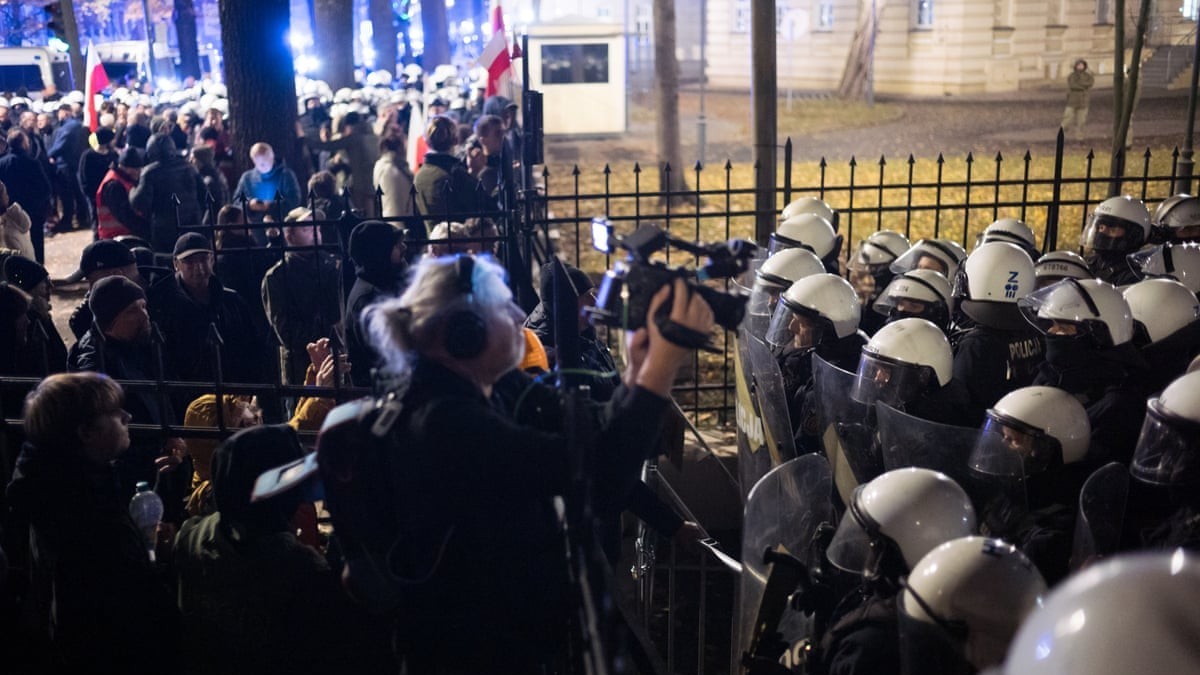
Condemnation also arrived from European far-right figures, including Britain's Nigel Farage and Liz Truss and the Netherlands' Geert Wilders. On the ground, police said three people were detained after some in the crowd breached the tribunal's fence and others threw objects at officers, and that officers had not entered the building itself. Local media reported several people injured. Whatever else is contested, the physical facts of Friday night are not: a fence was cut, a cordon held, and the court's two halves spent the night in the same building refusing to recognise each other.
What Happens Next
At five in the morning the president's office put out a statement read to the crowd by presidential minister Paweł Szefernaker. Nawrocki said there had been a violation of the constitutional order of the Republic of Poland and a forcible takeover of a constitutional body of the state. He called for what he described as the coercive forces sent by the government to leave the tribunal's premises, and said Kapiński also did not recognise as legal the actions of those he called usurpers. Citing a threat to internal security, he convened urgent consultations with representatives of the parliamentary parties for Saturday.
Poland's ambassador to China, Jakub Kumoch, resigned his post, and Sikorski said the diplomat no longer represented the country. A parliamentary election is due in 2027, and polls give the populist right a real chance of returning to power, which is why neither side can afford to look as though it blinked. The question underneath all of it is the one Poland has been unable to answer since 2015: when two groups of people both claim to be the Constitutional Tribunal, who decides what is constitutional?
By Jessica Ali, Staff Writer
This article was produced with AI-assisted research and editorial support, and reviewed before publication. Sources: Anadolu Agency, Reuters, Agence France-Presse, The Associated Press, BBC News, The Guardian, Notes from Poland, Deutsche Welle, Al Jazeera, Türkiye Today, Kyiv Independent, Xinhua, Polish Press Agency (PAP), TVN24 and TVP Info. Photographs: Agata Grzybowska/Anadolu/Getty Images; Dawid Żuchowicz/Agencja Wyborcza.pl/Reuters. Cover: Global 1 News editorial image.
What's Your Reaction?
 Like
0
 Dislike
0
 Love
0
 Funny
0
 Wow
0
 Sad
0
 Angry
0

Editor-in-Chief at Global1.News. Atlanta-based journalist who cuts through the BS and tells it like it is. Lead anchor, host, and the voice you hear when the spin stops and the truth starts.













Comments (0)