
Hackers Poisoned a Trusted Testing Script and Reached Visitors on 178 Websites
Malicious JavaScript was served to visitors of 178 organisations, including Zoom, the BBC, HSBC and CNN, after an attacker wrote code into Optimizely customers' Project JavaScript fields. Report URI found 188 infected snippets out of 1,611 checked.
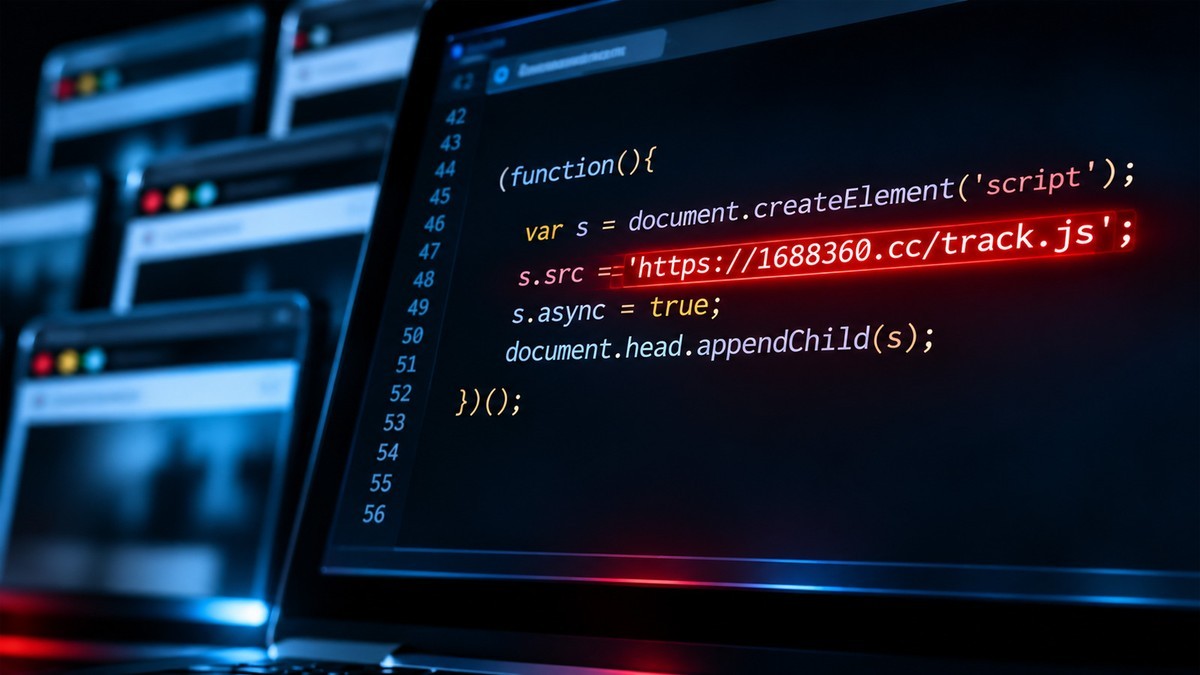
For most of Monday, some of the most-visited websites in the world served their visitors code the sites never wrote. It arrived from a vendor they pay to experiment on their own pages, it came from a domain every one of them already trusted, and it was built to empty cryptocurrency wallets and lift payment cards.
Hackers Poisoned a Trusted Testing Script and Reached Visitors on 178 Websites
London — November 17, 2026 — The malicious JavaScript was served to visitors of 178 organisations through Optimizely's web experimentation platform, according to the security firm Report URI, which published its findings on Monday night. The list of affected sites reads like a cross-section of the corporate internet, and the code was removed from nearly all of them within a single working day.
What Was Served, and to Whom
Report URI's Scott Helme said his team fetched 1,611 distinct Optimizely snippets and found 188 of them carrying the malicious code, belonging to 178 organisations. The named sites include Zoom, the BBC, CNN, Salesforce, GitLab, IKEA, HSBC, Equifax, Air France-KLM, Ledger and Peacock. "The real number is likely higher as we could only check snippets we could find in time," Helme wrote.
Banks and financial firms were the largest single group at 32 organisations, followed by technology and software companies at 23 and retailers at 20. BleepingComputer said it independently confirmed the script loaded or attempted to load on a string of the affected sites, using scans recorded by urlscan.io. Hudson Rock, an infostealer research firm, named 21 web properties and said that evidence set is not an estimate of the incident's full size.
The Trusted Domain Was the Weapon
Optimizely Web lets a company test different layouts and wording on its own pages. Each customer loads a JavaScript snippet from Optimizely's content delivery network, and that snippet carries Optimizely's code, the customer's experiments, and an optional field called Project JavaScript where the customer can write custom code that runs on every page.
The attacker wrote into that field. The rest of each snippet was left alone, and the file continued to be served from Optimizely's own host with Optimizely's own certificate. That is why none of the affected websites had to be broken into for their visitors to receive malware.
Even customers who serve the snippet from their own domain, such as Scheels and Vodafone Australia, were caught, because the content comes from the same Optimizely project. Optimizely's own sites were affected too.
A Single Day, Timestamp by Timestamp
The last clean capture of the BBC's Optimizely snippet in Report URI's records was at 02:21 UTC. The first injection appeared at 04:21, when that snippet began loading a script from webshell.lol, a domain seen in an earlier wave of the same campaign. The infrastructure followed quickly: the domain 1688360.cc was registered at 05:23, and its certificates were issued over the same window.
By 08:28 the payload was live on bbc.com. Zoom's snippet was modified at 11:20. At 13:03 the attacker swept stolen cryptocurrency to exchanges, and at 13:43 the card skimmer was added to the same file. A second iOS delivery host was registered at 16:38 UTC. Report URI's own sweep between 19:24 and 19:59 found 186 of the 1,611 snippets still carrying the code. The clean-up ran from about 20:40 to 21:10, and at 21:52 one snippet, belonging to TalkTalk, still carried the code.
Three Jobs in One Script
The payload arrived through one of three loaders: a plain script tag pointing at the attacker's domain, the same address hidden in base64 and decoded in the browser, or a full copy of the code that ran if the remote file was blocked. It was rebuilt 26 times during the day, and features and wallets were only ever added, never removed.
The first job was address swapping. The script looked for valid wallet addresses on Bitcoin, Ethereum, Tron, Solana, TON, Litecoin, Bitcoin Cash and Dogecoin, checked their checksums so it only swapped real ones, and replaced them in page text, form fields, links and images, in the clipboard, and in outgoing requests. The second was card skimming, which watched form submissions and outgoing form posts for a card number, expiry date and security code. Cards typed into payment forms run by Stripe, Adyen and similar providers were out of its reach.
The third function posted the page address, readable cookies and a rendered screenshot to the attacker whenever the script swapped an address near wallet or payment wording.
The iPhone Branch
On iPhones and iPads the script read the device's iOS version and loaded an exploit chain in a hidden frame. Devices on iOS 13 to 17 were routed to a kit called Coruna; iOS 18 received one labelled DarkSword; iOS 26 got a separate chain that, in Report URI's testing, only fingerprinted the device.
The kits' own comments say the exploits are patched on iOS 18.7.3 or later and on iOS 26.3 or later. Pages opened on iOS 18.6 or earlier reloaded every 60 seconds to retry, something a visitor could have noticed.
Later-stage analysis by the researcher known as Kirk described code built to register a device and upload its keychain database, and a control panel intended to collect seed phrases and private keys. Hudson Rock said it has not independently reproduced those stages or shown that a real person's iPhone was compromised. A request labelled iOS 26.3 did reach one chain, but that chain's own log recorded the weapon as unusable.

What the Wallets Show, and What They Don't
By 19:25 UTC the attacker's wallets had received about $7,040, all within roughly nine hours, according to Report URI. Most of it was Bitcoin. The funds were moved out between 13:03 and 13:05, and the USDC on Ethereum went to a deposit address at the exchange HitBTC. One of the Tron wallets had been in use since March 2026.
That figure is disputed. Galaxy Digital's Alex Thorn put the likely loss at about $2,300, because much of the Bitcoin appeared to be the attacker's own funds, and Bloomberg said it could not independently verify the larger number. Neither total covers cards, cookies or phones, and Report URI said it cannot see how many of those reached the attacker's server.
The Defence That Was Already Available
Report URI crawled 256 of the affected organisations' hosts to test whether a Content Security Policy would have stopped the attack. Sixty-eight published no policy at all. In 50 cases the policy allowed both the payload and the theft. In 17 the payload ran but the policy blocked data leaving the page, which stopped the card and cookie theft but not the address swapping.
Twenty-four organisations, about 15 per cent, blocked the payload outright. Listing Optimizely's domain in a policy offered no protection, because the malicious code arrived from that domain. What separated the protected sites was a restrictive rule on which scripts a page may run.
Two common settings let it through. One, called strict-dynamic, trusts any script the snippet inserts. The other permits the browser's eval function, and Optimizely's own documentation tells customers to allow it. That is how a backup copy of the code still ran on HSBC's site even though its policy blocked the main file.
Four Services, Not One
The campaign reached past Optimizely. Hudson Rock and Kirk traced poisoned scripts to the analytics provider Kissmetrics, the widget provider StorifyMe and the video loader minute-ly, with the earliest records on 13 November. StorifyMe confirmed to iTWire that unauthorised JavaScript reached a subset of its customers' integrations, that it disabled custom JavaScript in its widgets and rotated credentials, and that it had not verified any visitor's device was compromised.
The shared hosting, loader code and a mobile routing marker link the deliveries technically. They do not identify one operator or prove a single way in. Hudson Rock recovered eight poisoned Optimizely files and one minute-ly file directly; Kirk reports 51 traced sites overall, with 15 captures verified at the level of the response body itself.
There is a practical wrinkle. The BBC's and HSBC UAE's files carried a full 24,392-byte copy of the payload, which ran if the remote file failed or did not arrive within about 2.5 seconds. Blocking the attacker's domain alone would not have cleaned the project code.
What Optimizely Has Said
Optimizely's status page, updated at 01:02 UTC on Tuesday and still listed as monitoring, says an unauthorised party "exploited a vulnerability in Experimentation and used it to add malicious JavaScript to some customer projects", and that the vulnerability has been fixed and the injected code removed.
The company told BleepingComputer that the flaw sat in its Experimentation account signup flow. It said it has closed sessions, revoked tokens and reset access for affected accounts, and blocked code delivery through Cloudflare. It has not explained the mechanics of the bug.
In a post on X, Optimizely said the vulnerable path was blocked and customers had been contacted directly. Report URI said it had no response to its outreach. Salesforce said it was investigating and disabled its Optimizely scripts as a precaution. Equifax stopped using the platform and said it found no evidence its own systems were compromised. IKEA said it was working out whether customers were affected. Optimizely, Apple, Zoom, HSBC, CNN and IKEA did not immediately respond to Reuters' requests for comment, and Ledger did not immediately respond to CoinDesk.
What Is Not Established
Nobody has explained how the attacker obtained write access to so many unrelated customer projects. Nobody knows how many card numbers or cookies arrived, or how many devices were infected. None of the firms tracing the attack has linked it to AI tools. And the counts are snippets, not people: a listed subdomain does not prove that a company's entire site, product or checkout was exposed.
For anyone who used an affected site on 16 November, Report URI's advice is narrow and specific. Update an iPhone or iPad to iOS 18.7.3 or later, or 26.3 or later. Check any crypto transfer made that day and confirm the address the funds went to is the one you meant to pay. Watch card statements.
For the companies, the list is longer: open every Optimizely project and look for code nobody on the team wrote, review who and what can write to the account, rotate credentials, treat cards entered that day as potentially exposed, and put a policy in place that restricts where a page is allowed to send data. "Trusted JavaScript doesn't always remain trustworthy," Helme wrote. Monday was the demonstration.
By Jessica Ali, Staff Writer
This article was produced with AI-assisted research and editorial support. Sources: Report URI, Optimizely, BleepingComputer, Reuters, CoinDesk, Hudson Rock, Ohey, iTWire, Help Net Security, Cybernews, Tech Times and ISPreview UK. Photographs: BleepingComputer (lead image); Tima Miroshnichenko/Pexels via Tech Times; Kristin Hardwick via Wikimedia Commons (CC0).
What's Your Reaction?
 Like
0
 Dislike
0
 Love
0
 Funny
0
 Wow
0
 Sad
0
 Angry
0

Editor-in-Chief at Global1.News. Atlanta-based journalist who cuts through the BS and tells it like it is. Lead anchor, host, and the voice you hear when the spin stops and the truth starts.














Comments (0)