
Philippine Court Issues Arrest Warrant for Vice President Sara Duterte in Grave Threats Case
Folks, we are following a major development out of the Philippines tonight. A Quezon City court has issued an arrest warrant for Vice President Sara Duterte on charges of grave threats, stemming from her explosive remarks about President Ferdinand "Bongbong" Marcos Jr. in late 2024. This is a stunning legal escalation that throws the country's political crisis into overdrive.
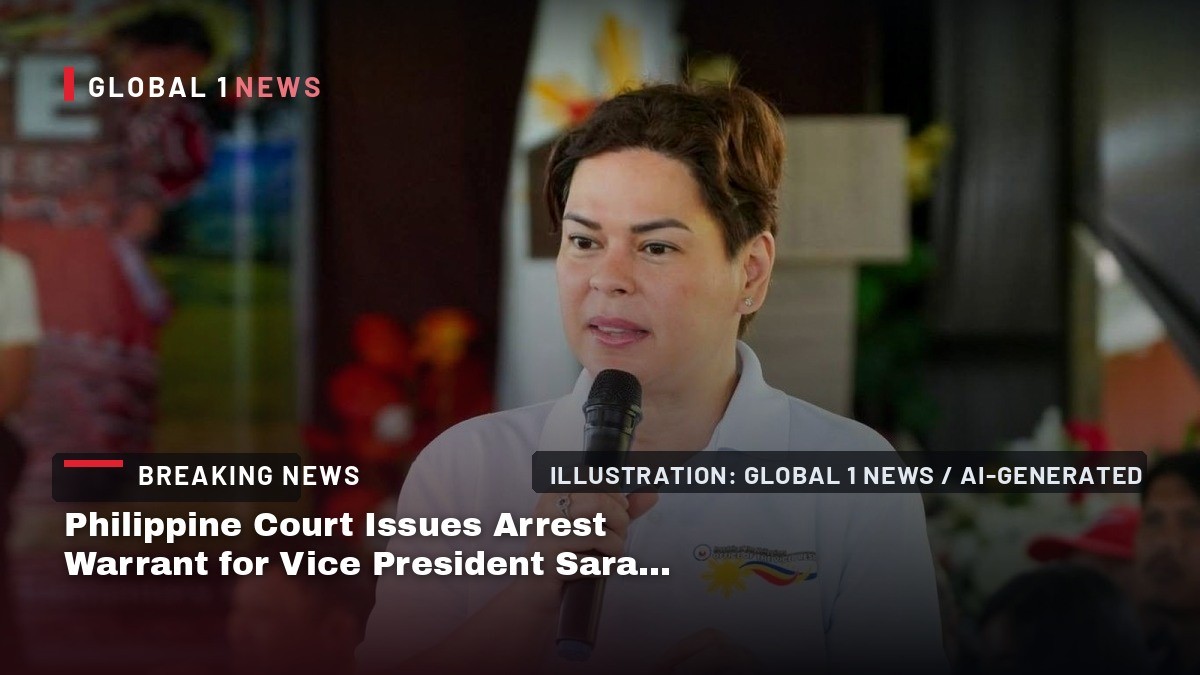
Folks, we are following a major development out of the Philippines tonight. A Quezon City court has issued an arrest warrant for Vice President Sara Duterte on charges of grave threats, stemming from her explosive remarks about President Ferdinand "Bongbong" Marcos Jr. in late 2024. This is a stunning legal escalation that throws the country's political crisis into overdrive.
The Warrant and the Court's Ruling
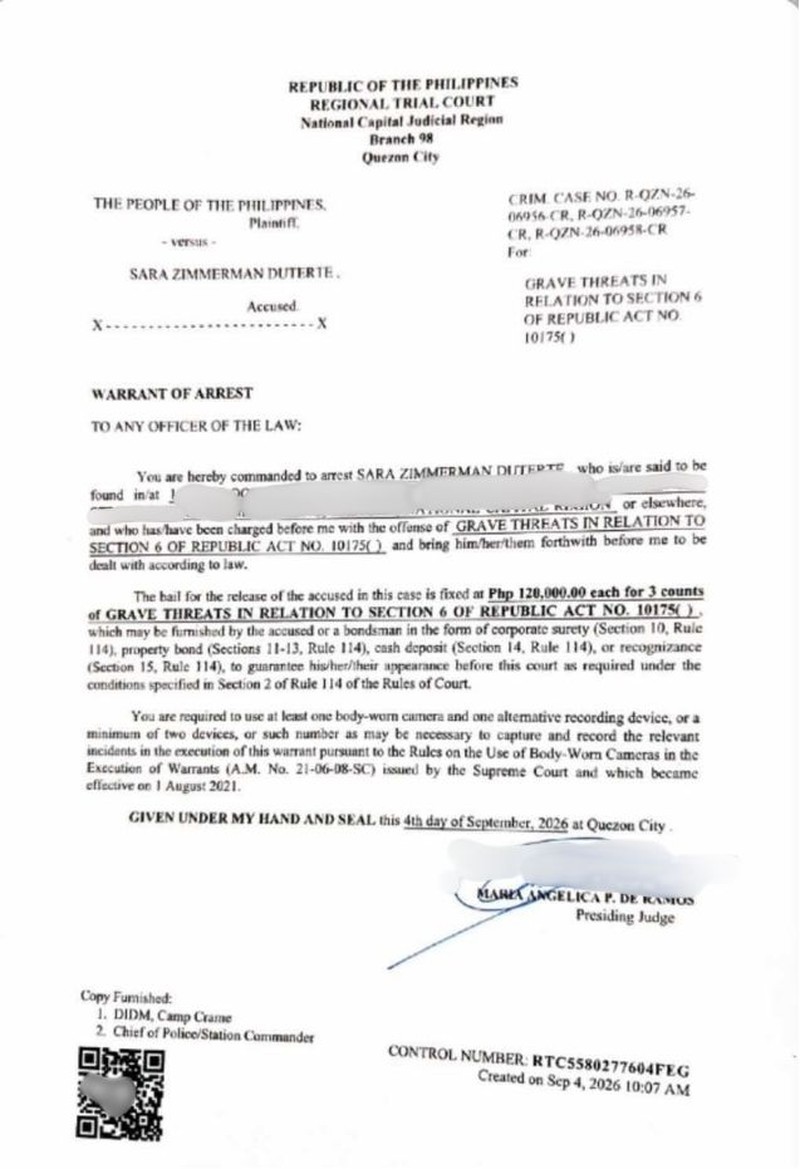
On Friday, September 4, 2026, Branch 98 of the Quezon City Regional Trial Court formally issued the warrant for Duterte's arrest on three counts of grave threats. The order, signed by Presiding Judge Maria Angelica P. De Ramos, sets bail at 120,000 pesos — roughly $1,900 — per count, meaning a total of 360,000 pesos if she posts bail for all three charges.
The court's decision came after it found probable cause to hold the Vice President for trial on charges filed by the Department of Justice (DOJ). In its order, the court wrote: "Together with its supporting evidence, and after due consideration of the arguments raised by both parties in their oral arguments, the Court finds that there is probable cause to hold the accused for trial for the crimes charged in the Informations."
Judge De Ramos also denied Duterte's motion to defer the issuance of, or recall, the arrest warrant, as well as her motion to quash the information. This means the legal process will move forward, and the Vice President must now face the charges in court.
Duterte confirmed in a statement that her office received notice of the warrant, dated September 4, 2026, served by PNP Colonel Christine Tabdi at the Office of the Vice President. She stated that her lawyers, Attorneys Paul Lim and Clifford Chua, "will attend to this matter immediately."
The 2024 Remarks and the Charges
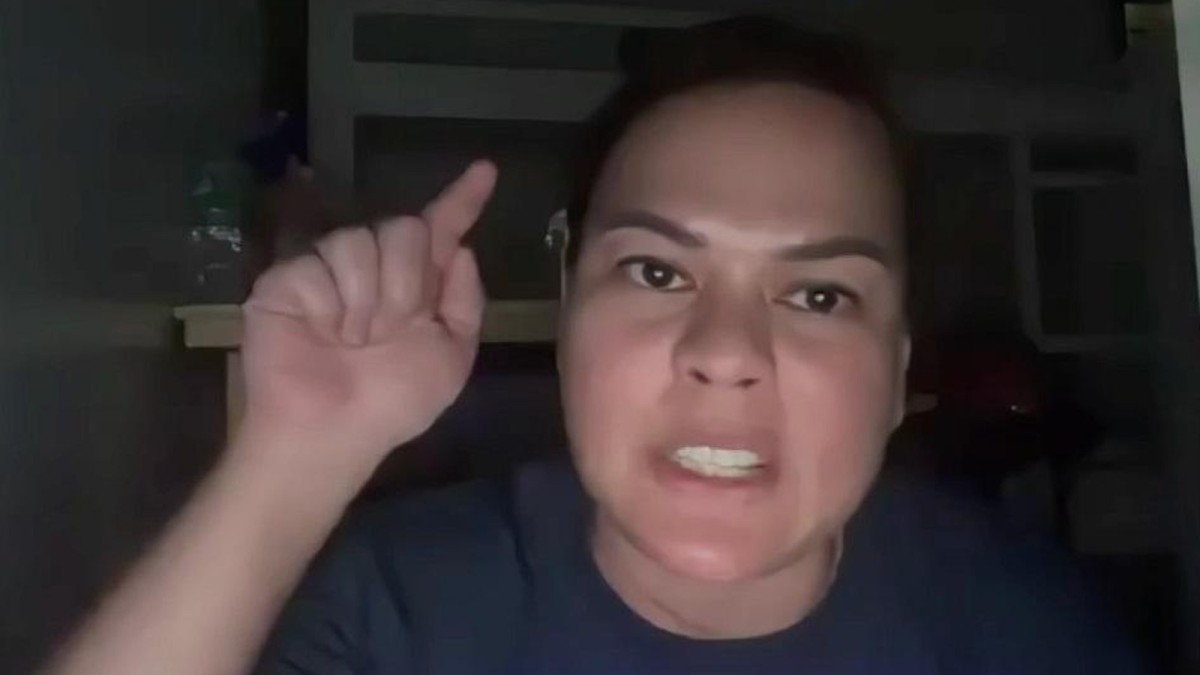
To understand the gravity of this, we have to rewind to late 2024. In a series of online press conferences held in October, November, and December of that year, Duterte made statements that would come to define the bitter feud tearing apart the country's ruling coalition. She claimed she had spoken with an assassin and instructed someone to kill President Marcos, First Lady Liza Araneta Marcos, and then-House Speaker Martin Romualdez — now a Leyte Representative — if she herself were killed.
These were not off-the-cuff remarks made in a quiet setting; they were public declarations made during a period of intense political warfare. Duterte has consistently denied threatening the president and his family, insisting her words were "maliciously taken out of logical context."
Despite her denials, the National Bureau of Investigation (NBI) looked into the matter and forwarded its findings to the DOJ in February 2025. It took time, but on August 11, 2026 — while her Senate impeachment trial was already underway — DOJ prosecutors formally filed the three counts of grave threats against her.
Under the Philippine Revised Penal Code, grave threats can carry a jail term of up to six months, a penalty known as arresto mayor, depending on the circumstances of the case. While that may sound relatively minor compared to other criminal charges, the political weight of this case is anything but light.
Reactions from Duterte's Camp
Duterte's legal team moved quickly to project an image of cooperation and confidence. Her lawyer, Paul Lawrence Lim, made it clear they are not running from this. "Regardless of the question on jurisdiction, she has no intention of evading the law and will continue to exercise all her legal remedies," Lim said.
That statement is key, folks. It signals that while they may challenge the legal basis of the case, they are not going to turn the Vice President into a fugitive. Interior Secretary Jonvic Remulla backed this up, saying Duterte's lawyers received the warrant and intend to post bail as soon as possible. This suggests we are unlikely to see a dramatic arrest scenario play out in the coming days.
Reactions from the DOJ and Malacañang
The Department of Justice, which brought the charges, is taking a measured tone. The DOJ said it respects the court's decision and noted that warrants are transmitted directly by the court to law enforcement agencies for implementation. It is a procedural statement, but it underscores that the executive branch is letting the judiciary do its work — at least publicly.
Malacañang, the presidential palace, also issued a brief statement saying it respects the Quezon City court's decision. That is a carefully worded response, and you can bet there is a lot of political calculation behind those few words. The Marcos administration is walking a tightrope here, trying to appear neutral while the legal system moves against its chief political rival.
Reactions from House Prosecutors
The House of Representatives, which impeached Duterte in May 2026, had its prosecutors weigh in on the development. Rep. Zia Alonto Adiong of Lanao del Sur, one of the House impeachment prosecutors, was direct about what the warrant means. "The issuance of an arrest warrant is not a finding of guilt. Due process must be observed at every stage. A court, however, does not issue a warrant without probable cause. That determination has now been made," Adiong said.
That is a pointed observation. Adiong is drawing a clear line between the court's finding of probable cause and an actual conviction, but he is also reminding the public that a judge looked at the evidence and decided there was enough to move forward.
Fellow House prosecutor Rep. Terry Ridon of the Bicol Saro party-list was quick to separate the criminal case from the impeachment proceedings. "The impeachment proceedings are a separate constitutional accountability process. The Senate Impeachment Court will independently determine the matters properly before it. No one should prejudge either proceeding," Ridon said.
This is a crucial distinction. The criminal case in Quezon City and the impeachment trial in the Senate are two parallel tracks, each with its own rules, standards, and consequences. But make no mistake — they are politically intertwined in ways that will shape the Philippines' immediate future.
Reactions from Sen. Bong Go
Sen. Christopher "Bong" Go, a longtime ally of the Duterte family, did not hold back in questioning the timing of the warrant. Go, who served as former President Rodrigo Duterte's aide, asked why the legal system is moving now, when the alleged remarks date back to 2024 and the impeachment trial is in full swing.
"Why only now? Why is it issued now when the impeachment is ongoing? There was plenty of time before... That happened a long time ago," Go said. He added that he believes Duterte can handle the situation.
Go's comments tap into a narrative that the Duterte camp has been pushing — that this is a coordinated political attack designed to weaken the Vice President while she fights for her political life in the Senate. Whether that is true or not, the timing is undeniably convenient for the administration's critics to point to.
The Senate Impeachment Trial Context
Let's zoom out and look at the bigger picture, because this arrest warrant is just one piece of a much larger puzzle. Sara Duterte was impeached by the House of Representatives in May 2026 on charges including culpable violation of the Constitution, betrayal of public trust, graft and corruption, and the alleged kill threats against Marcos, the first lady, and Romualdez.
Her trial before the Senate, sitting as an impeachment court, recently concluded its ninth week — its third month. This is shaping up to be one of the most consequential political trials in modern Philippine history, and the stakes could not be higher.
If the Senate returns a guilty verdict, Duterte would be removed from office and permanently disqualified from holding public office. That would effectively end any plans she has for a presidential run in 2028. The alleged threats are also among the allegations in the articles of impeachment against her, so the criminal case and the impeachment trial are drawing from the same well of accusations.
Duterte's defense team has been fighting on multiple fronts. They argued in a motion to quash that she and other impeachable officers have limited procedural immunity while in office under the 1987 Constitution. The court heard oral arguments on that motion in late August before ultimately ruling against her and issuing the warrant.
The Legal Road Ahead
So what happens now? University of the Philippines College of Law associate dean Paolo Tamase told AFP that the warrant is unlikely to result in Duterte being taken into custody. He expects her lawyers to file for bail, possibly before the day is out, and noted that the warrant could be challenged at the Court of Appeals or potentially the Supreme Court.
This is standard legal maneuvering, but it buys time. Posting bail would keep Duterte free while the criminal case proceeds through the courts. The appeals process could stretch on for months or even years, potentially outlasting the impeachment trial or at least running parallel to it.
For now, the immediate priority for Duterte's team is to get bail posted and keep her out of jail. The longer-term strategy will likely involve challenging the jurisdiction of the court and arguing that her remarks were protected speech or taken out of context. But the court has already signaled it is not buying those arguments at this stage.
The Broader Political Stakes for 2028
Folks, this is where things get really interesting. The warrant is a major escalation in the Philippines' political crisis, deepening the confrontation between the Marcos administration and the Duterte camp less than two years before the 2028 presidential election.
Let's remember the history here. Sara Duterte, daughter of former President Rodrigo Duterte, was elected vice president in 2022 on a unity ticket with Marcos. The alliance was a political powerhouse, combining the Marcos name and machinery with the Duterte family's massive popularity, particularly in Mindanao.
But that alliance fractured publicly in 2024 and 2025 amid an escalating political feud. The 2024 remarks came during that feud, at a time of intense public speculation about her political future and her father's legal troubles. Rodrigo Duterte was arrested in March 2025 on an International Criminal Court warrant over his deadly drug war and is currently in ICC custody in The Hague.
The grave-threats case is separate from but politically intertwined with the impeachment trial. Legal analysts note that the cases create a two-front legal battle for the Vice President. She is fighting for her political survival on two separate tracks, and each one could be fatal to her ambitions.
If she is convicted in the Senate, she is out of politics for good. If she is convicted in the criminal case, she faces jail time and the political fallout that comes with it. Either outcome would be a massive victory for the Marcos camp and a devastating blow to the Duterte political dynasty.
But here is the thing — this could also backfire. The Duterte name still carries significant weight in the Philippines. There is a real possibility that this legal onslaught could rally her supporters, casting her as a martyr being persecuted by a political rival. The 2028 election is still two years away, and a lot can change between now and then.
Why This Matters Beyond the Philippines
Now, you might be asking yourself, "Jessica, why should I care about a court case in Quezon City?" Fair question. Let me break it down for you.
The Philippines is a critical player in the Indo-Pacific region, a longtime ally of the United States, and a nation of over 110 million people. Its political stability has direct implications for regional security, economic partnerships, and the balance of power in Southeast Asia. When the Vice President of the Philippines is facing arrest and impeachment simultaneously, that is not just a local story — it is a regional story with global consequences.
The Marcos-Duterte feud is also a cautionary tale about political alliances built on convenience rather than shared principles. The 2022 unity ticket was never about ideology; it was about power. And when power is the only glue holding a coalition together, it does not take much for things to fall apart.
There is also the question of democratic institutions. The Philippines is testing whether its courts and its Senate can handle a politically charged case against a sitting vice president without descending into chaos. The world is watching to see if the rule of law holds up under extreme political pressure.
And let's not forget the broader regional context. The Philippines has been navigating a delicate balancing act between its traditional alliance with the United States and its complex relationship with China. A prolonged political crisis in Manila could distract from these larger strategic issues, creating uncertainty in a region where stability is already hard to come by.
For American audiences, this matters because the Philippines is a key security partner in the South China Sea and a vital economic link in the Asia-Pacific supply chain. Political turmoil in Manila could have ripple effects that reach far beyond the archipelago.
What to Watch For
In the coming days, we will be watching several key developments. First, will Duterte post bail quickly, and will she appear in court to face the charges? Second, how will the Senate impeachment trial proceed now that the criminal case is moving forward? Will the two proceedings influence each other, or will they remain separate as the House prosecutors insist they should?
We will also be watching the public reaction. The Duterte family has a passionate base of supporters, and how they respond to this warrant could shape the political landscape in the months ahead. Protests, political rallies, and social media campaigns are all possible.
And finally, we will be watching President Marcos. His administration has maintained a public stance of respecting the judicial process, but the political calculations behind the scenes are far more complex. How he navigates this crisis will define his presidency and set the stage for the 2028 election.
This is a developing story, folks, and we will bring you updates as they come in. For now, the situation is clear: the Vice President of the Philippines is facing arrest, her political future is on the line, and the country is bracing for what comes next.
Stay with Global 1 News for the latest on this unfolding story.
This article was produced with AI-assisted research and editorial support. Sources: Reuters, GMA News Online, Philstar.com, CNA, Philippine Daily Inquirer, Malay Mail.
By Jessica Ali, Staff Writer
What's Your Reaction?
 Like
0
Like
0
 Dislike
0
Dislike
0
 Love
0
Love
0
 Funny
0
Funny
0
 Wow
0
Wow
0
 Sad
0
Sad
0
 Angry
0
Angry
0

Editor-in-Chief at Global1.News. Atlanta-based journalist who cuts through the BS and tells it like it is. Lead anchor, host, and the voice you hear when the spin stops and the truth starts.














Comments (0)