
Pangasinan Declared Under State of Calamity as Monsoon Floods Wreak Havoc
Pangasinan declares state of calamity as monsoon floods and cyclones Luis, Maymay, Neneng devastate the province. NLEX is gridlocked in Pampanga. Experts blame decades of ignoring the 1941 flood plan, while the DPWH faces a corruption scandal amid sluggish fund use. Bayanihan endures.
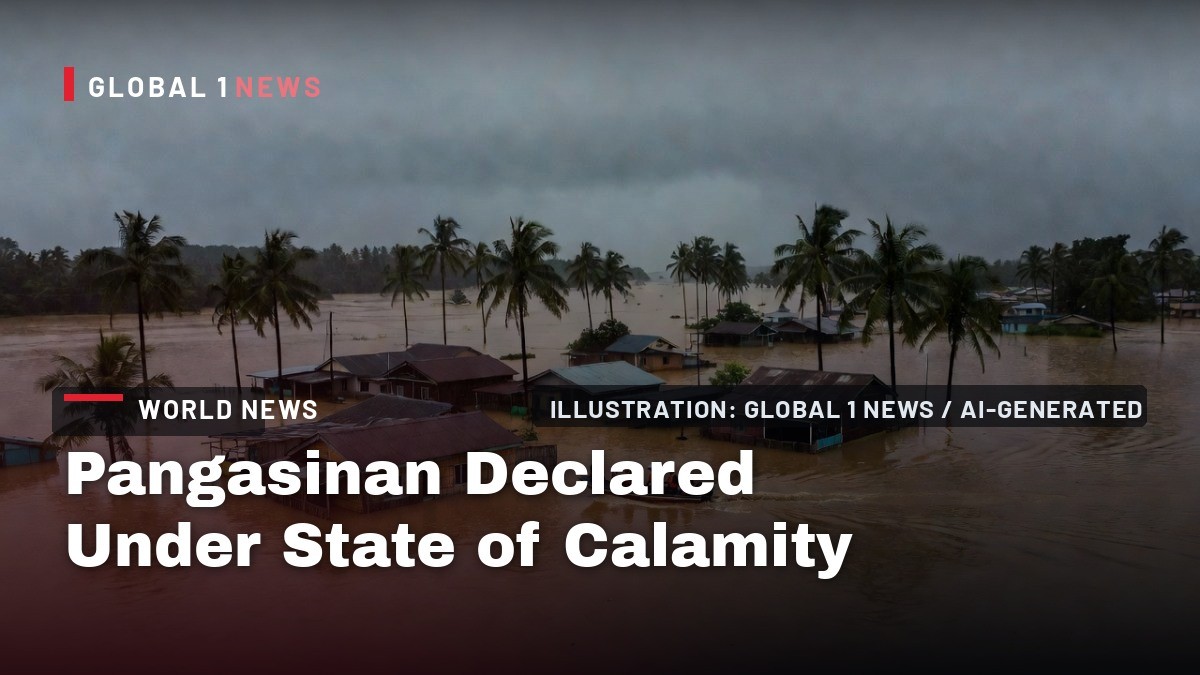
Pangasinan Declared Under State of Calamity as Monsoon Floods Wreak HavocLINGAYEN, Pangasinan — The provincial government of Pangasinan has formally declared a State of Calamity, a move that unlocks critical emergency funds and accelerates relief efforts for hundreds of thousands of residents grappling with the relentless wrath of the enhanced southwest monsoon, locally known as Habagat. The declaration, formalized on Monday, August 31, 2026, comes as the province reels from the compounded effects of three successive tropical cyclones — Luis, Maymay, and Neneng — which have transformed rivers into raging torrents and vast agricultural lands into temporary inland seas.The Sangguniang Panlalawigan, the province's legislative body, unanimously passed Provincial Resolution No. 985-2026 during a special web-based session. The resolution cites the "severe impacts" of the Enhanced Southwest Monsoon and the three cyclones as the basis for the declaration. This is not a mere bureaucratic formality; for the people of Pangasinan, it is a lifeline. The declaration allows the provincial government to dip into its Quick Response Fund (QRF), a dedicated pool of money intended precisely for this kind of disaster, ensuring that food packs, clean drinking water, and medical supplies can reach evacuation centers without the usual procurement delays.
A Province Under Water: The Human Toll in Pangasinan
The scene in Pangasinan is one of profound distress. In the capital town of Lingayen, the municipal government has also issued its own declaration of a state of calamity through Resolution No. 462, Series of 2026. This parallel action at the local level is crucial, as it empowers the municipal chief executive and the local disaster risk reduction and management office (LDRRMO) to mobilize resources with greater flexibility. For the kapitbahay in low-lying barangays, this means the immediate deployment of rescue boats and the opening of more evacuation centers, transforming school gymnasiums and barangay halls into temporary shelters for families who have lost their homes to the floodwaters.The flooding has not discriminated. It has invaded the concrete homes of the middle class in urban centers and the stilt houses of fishing communities along the coast. In many areas, the water has risen to chest level, forcing residents to move their belongings, including precious sari-sari store inventories, to higher shelves or to the roofs of their homes. The agricultural heartland of the province, which supplies much of the nation's rice and vegetables, is now a muddy expanse of ruined crops. Farmers, who had hoped for a bountiful harvest this season, are now counting their losses, their livelihoods literally washed away by the relentless rain. The declaration of a state of calamity is a formal acknowledgment of this widespread suffering, a necessary step to access national government funds for rehabilitation and to provide financial assistance to affected families.NLEX Gridlock: The Floods Reach the Expressway
The disaster is not confined to the provinces. The flooding has also crippled major infrastructure, most notably the North Luzon Expressway (NLEX), a vital artery for commerce and commuters heading to and from Metro Manila and the northern provinces. The operator, Manila North Tollways Corporation (MPTC), has been forced into a defensive battle against the rising waters, particularly in San Simon, Pampanga, where the town has been reported to be 95% submerged. The situation has caused hours-long traffic jams, stranding thousands of motorists, including many Overseas Filipino Workers (OFWs) who had just returned home for a vacation and were eager to reach their families in the provinces.MPTC has deployed a multi-pronged response to the crisis. In a statement, the company detailed its ongoing operations in Tulaoc, San Simon, which include the installation of flood barriers, the operation of siphoning trucks, and intensified pumping efforts. The company has also issued a public apology to motorists for the inconvenience, acknowledging the severe congestion that persists at the Tulaoc and San Simon Interchange. For the long term, MPTC has announced plans to raise the expressway pavement in these flood-prone areas, a significant engineering undertaking that acknowledges the changing climate reality. However, for the thousands of drivers and passengers stuck in traffic on Monday night, the long-term plan offers little comfort. They are the ones bearing the brunt of this infrastructural vulnerability, their travel time stretching from hours to an entire day, their patience worn thin by the heat and the uncertainty.The Limits of Pumping: A Deeper Infrastructure Problem
The flooding on NLEX highlights a critical limitation in current flood mitigation strategies. MPTC has been transparent about this, stating that pumping alone cannot clear the highway while the surrounding areas remain flooded. This is a crucial admission that points to a systemic problem. The expressway, built on a floodplain, is essentially a low point in a landscape that is itself underwater. The company is now installing concrete barriers covering about 300 meters in each direction along the expressway to limit the amount of water entering the road. This is a defensive measure, a temporary dike against an overwhelming force.This situation in Pampanga and Pangasinan is a stark illustration of a national tragedy. The floods are not just a natural phenomenon; they are a man-made disaster exacerbated by decades of poor planning and neglect. The water that inundates our homes and highways is a direct consequence of our collective failure to manage our environment, to preserve our watersheds, and to build infrastructure that can withstand the forces of nature. The sight of siphoning trucks working around the clock is a testament to human ingenuity, but it is also a symbol of our reactive approach to a problem that requires a proactive, long-term solution.Decades of Neglect: The 1941 Master Plan and Project NOAH
The roots of this catastrophe run deep, and experts are pointing to a historical failure of governance. Mahar Lagmay, a prominent University of the Philippines expert and the head of the now-defunct Project NOAH (Nationwide Operational Assessment of Hazards), has stated that the massive flooding in Metro Manila and various areas is the result of decades of failure to follow the 1941 flood control master plan. This plan, conceived during the Commonwealth era, was a comprehensive blueprint for managing the country's waterways. It was ignored, and the consequences are now being felt with devastating clarity.The Philippines, for decades, chose short-term gains over long-term resilience. We allowed informal settlers to build homes along esteros and riverbanks, we allowed watersheds to be denuded by illegal logging, and we failed to invest in the dredging and maintenance of our major river systems. The 1941 plan was not a perfect document, but it was a starting point, a vision for a flood-resilient nation. By abandoning it, we set the stage for the annual tragedy of the rainy season. Project NOAH, which ran daily from 2012 to 2016, was a modern attempt to fill this void, providing detailed, science-based hazard maps that helped the country avoid mass casualties during its operation. Its discontinuation was a significant setback, leaving the country without a centralized, high-resolution early warning system.The Flood Control Scandal: A Crisis of Governance
The current disaster is unfolding against the backdrop of a major political scandal involving the very agency tasked with preventing it. The Department of Public Works and Highways (DPWH) is at the center of a flood control scandal, with allegations of corruption, mismanagement, and irregularities in government-funded projects. This controversy gained national attention in 2025 when President Bongbong Marcos himself highlighted the alleged anomalies. The timing could not be more tragic. As the waters rise, the public is left to wonder if the billions of pesos allocated for flood control were ever properly spent.Adding insult to injury, reports indicate that the DPWH posted sluggish fund utilization in the first seven months of the year, despite receiving bigger cash allocations. This means that even the money that was available was not being spent on the projects that could have mitigated the current disaster. The spending rate was uneven, suggesting a lack of urgency and a possible bottleneck in project implementation. For the ordinary Filipino, this is a profound betrayal. It is the difference between a dry home and a flooded one, between a safe commute and a stranded one. The scandal is not just about corruption; it is about the failure to deliver a basic service — public safety — to the people who need it most. The Senate and the Office of the Ombudsman must pursue this with the full force of the law, not just for accountability, but to ensure that future funds are used effectively to protect our communities.Bayanihan in the Time of Crisis: The Filipino Spirit Endures
Despite the overwhelming despair, the Filipino spirit of bayanihan remains a powerful counterpoint to the tragedy. In evacuation centers across Pangasinan and Pampanga, stories of heroism and selflessness are emerging. Volunteers, many of them students and young professionals, are helping to distribute relief goods, cook meals, and care for the elderly and children. Fishermen are using their bancas to rescue families trapped in their homes. Sari-sari store owners are sharing their limited supplies with their neighbors. This is the essence of the Filipino community — the willingness to help one another in times of greatest need.The local government units (LGUs), from the barangay captains to the provincial governors, are working tirelessly, coordinating rescue operations and managing the logistics of relief distribution. The Department of Social Welfare and Development (DSWD) is mobilizing its resources, while the Department of Health (DOH) is on alert for waterborne diseases. The Philippine National Police (PNP) and the Armed Forces of the Philippines (AFP) have been deployed to assist in rescue and security operations. This is a whole-of-nation response, a testament to our collective resilience. But as we extend our hands to our kapitbahay, we must also look to our leaders and demand accountability. The bayanihan spirit can save lives today, but only good governance can save our nation from this recurring nightmare tomorrow.This article was produced with AI-assisted research and editorial support. Sources: Philstar.com, Manila Times, Philippine Information Agency, GMA News, Manila Bulletin, Context.ph.By Bella Reyes, Staff WriterWhat's Your Reaction?
 Like
0
Like
0
 Dislike
0
Dislike
0
 Love
0
Love
0
 Funny
0
Funny
0
 Wow
0
Wow
0
 Sad
0
Sad
0
 Angry
0
Angry
0

Isabella "Bella" Reyes
Philippines/Southeast Asia Correspondent at Global1.News. Manila-based journalist covering Philippine politics, environment, maritime security, and social issues. Passionate about marine conservation and the communities protecting the Philippines' natural heritage.











Comments (0)