
OpenAI Just Lost the Man in Charge of Its Data Centers — Right Before the Biggest Test of the AI Trade
OpenAI's head of data centers, Chris Malone, left last week — one of 13 executive departures in 2026 as the company heads for a 2027 IPO. A hosting founder on what talent churn in the most execution-critical seat says about the AI buildout.
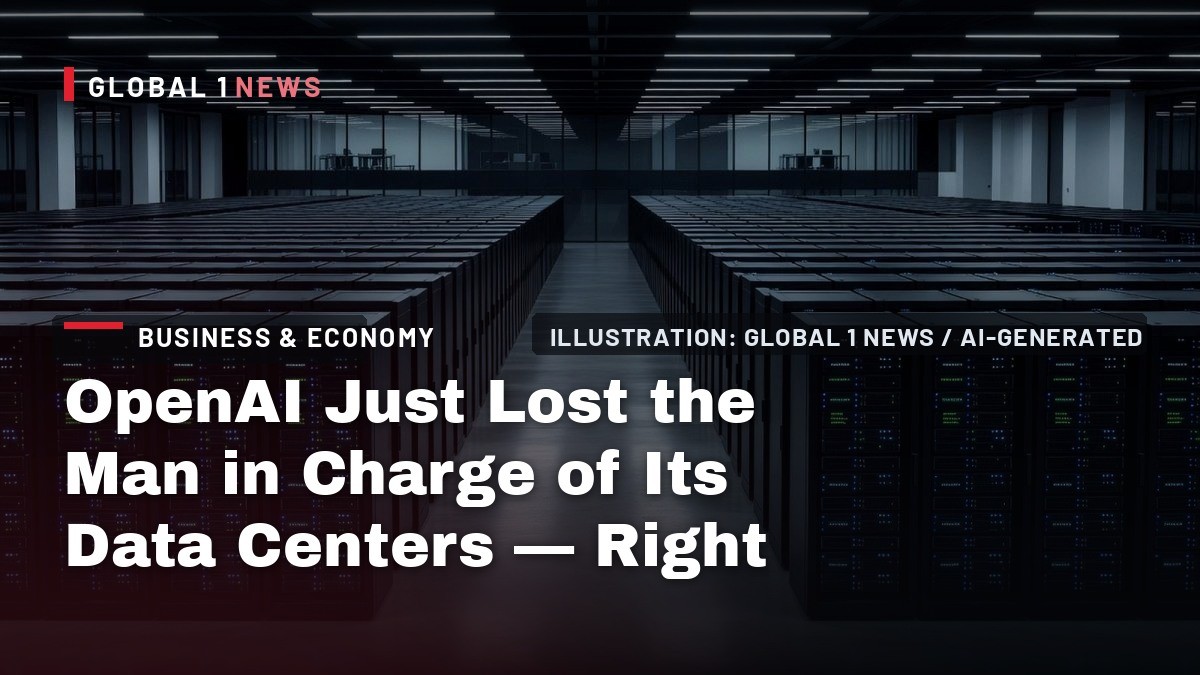
OpenAI Just Lost the Man in Charge of Its Data Centers — Right Before the Biggest Test of the AI Trade
I've been running hosting infrastructure for over a decade, and I can tell you the exact seat in any company I'd least want to see empty: the one responsible for delivering the buildings. Not the model. Not the product. The buildings. Because every promise a company makes — about scale, about revenue, about being the future — eventually has to be delivered in concrete, copper, and megawatts. So when I read that OpenAI's head of data centers, Chris Malone, had walked out the door, I didn't shrug. I sat up.
This isn't gossip about another tech executive heading for the exits. This is the person who was supposed to execute the most ambitious physical buildout in the history of the industry — a company that has signed up for close to a trillion dollars' worth of compute commitments — leaving in the middle of the biggest test of the whole AI trade: the IPO that's now expected in 2027. And he's not the first. He's the thirteenth. Ent?
The Setup — Who Chris Malone Was and Why His Seat Mattered
Malone wasn't some random VP who got reshuffled. He was a distinguished engineer — more than a decade at Google, around five years at Meta — who joined OpenAI in March of 2025, not long after the $500 billion Stargate Project was announced with Oracle, Nvidia, SoftBank, and Microsoft as partners. He walked into a company suddenly responsible for building more physical infrastructure than most countries have built in a decade.
How much infrastructure are we talking about? Reports put compute commitments under his watch at north of $600 billion. The Oracle partnership alone is worth $300 billion-plus over five years, with up to 4.5 gigawatts across multiple sites. The Financial Times did a back-of-the-envelope tally and landed at roughly $1 trillion in broad agreements. That's not a data center strategy. That's an industrial policy for the planet's compute capacity — and Malone was the guy responsible for the technical execution of it.
The Departure — a Reorg, a New Boss, and a Quiet Goodbye
According to the Wall Street Journal, Malone left last week. OpenAI says it "recently reorganized" its infrastructure organization "to support the scale and pace of our work," and that it has "a strong, deeply experienced data center team in place, with clear leadership and the technical expertise to execute our plans." As part of that reorganization, Malone stopped reporting directly to president Greg Brockman and started reporting to vice president Sachin Katti, who took over the group.
Now, I've been in enough companies to know that reorganizations happen. Reporting lines change. People leave. But read that statement again — "to support the scale and pace of our work." That's the language of a company that believes the machine is bigger than any one operator. Maybe that's true. Or maybe it's the language of a company that just watched the operator of the machine walk out and needs to convince everyone — investors, customers, the IPO market — that everything is fine.
There are still experienced people in the room: Uday Ruddarraju leads the data center team, Brent Mayo leads build and delivery, and Spas Lazarov — a real veteran of the data center and energy industries — leads data center engineering. That's not nothing. But here's the thing about infrastructure: the knowledge that matters most lives in people's heads. And that knowledge just left the building.
The Pattern — Thirteen Executives, One Year, Zero Quiet
Malone isn't isolated. Business Insider tallied 13 executive departures from OpenAI in 2026 — several in the last month. Two weeks ago the company replaced chief revenue officer Denise Dresser after about eight months in the seat. Two days before that, Brad Lightcap — the longest-serving chief operating officer — announced he was leaving to "start something new." About a month before that, Fidji Simo — the de facto second-in-command — stepped down with a chronic illness. Before that: head of ethics Chloe Bakalar left in July, the preparedness team was disbanded, Bill Peebles left when Sora was shut down, and CMO Kate Rouch left in April.
That's not a trickle. That's a current. And the timing should make everyone pay attention: OpenAI confidentially filed its IPO prospectus in June and is now expected to go public in 2027, pushed from earlier expectations. Every departure gets weighed by underwriters, institutional investors, and analysts paid to find cracks in the story. Brockman's defense — that the spotlight means "every departure gets scrutinized in a way that it doesn't otherwise" — has some truth to it. But scrutiny is exactly what an IPO is. You don't get to opt out because you don't like it.
The Two Readings — Mature Scaling, or the Canary in the Server Hall
Reading one: this is what growing up looks like. OpenAI is transitioning from a startup run by a tight circle of visionaries to a public company that needs professional, layered leadership. Reorganizations happen at every company that crosses this line — the people who thrive in a scrappy lab aren't always the people who can run a multi-hundred-billion-dollar delivery organization. Under this reading, Malone's departure is a footnote: the team is strong, the plans are funded, the machine is bigger than any one operator.
Reading two: this is the canary in the server hall. The market is pricing OpenAI — and by extension the entire AI infrastructure thesis — on the assumption of flawless execution. Trillion-dollar valuations have been floated for this cohort of labs, and the whole buildout narrative depends on these companies delivering gigawatts on schedule — every colo, every provider, every utility calibrates its plans off those promises. And the company at the center of it just lost the executive responsible for the technical execution of its data center strategy, right before the biggest transparency event in its history. Under this reading, the footnote is the story.
From running infrastructure, here's what I know: neither reading is fully wrong — the truth lives in the gap. The reorg may be exactly right, and the timing may still be terrible. The market doesn't punish companies for reorganizing. It punishes them for missing delivery dates when the whole world is watching.
The Secondary Bottleneck Nobody's Talking About — Execution Talent
Everybody's been talking about the visible bottlenecks in the AI buildout: chips, power, transformers, water, permits, community consent. But there's a bottleneck underneath all of them, and it's the hardest one to fix: the number of people who have actually delivered a hyperscale campus — taken a project from dirt to energization at hundreds of megawatts — is tiny. It's a small, aging, heavily recruited pool — and everyone from the hyperscalers to the colo operators is fishing in it.
OpenAI is now churning through that pond. And when you churn through your most execution-critical talent, you lose more than the person — you lose the institutional memory of which contractors deliver, which utilities move fast, which jurisdictions burn you, which designs fail in the field. That knowledge doesn't live in a slide deck — it lives in heads, and when they leave, it leaves with them.
The structural reality: you can order 9,000 GPUs tomorrow. You can't order 20 years of delivery experience. The physical bottlenecks get all the headlines, but the human bottleneck is the one that actually decides whether schedules slip.
What This Means for Independent Hosting Providers
So what does an executive shuffle at the world's most valuable private AI company mean for a hosting operator with a couple hundred servers in a colo? More than you'd think. Here's my advice:
First — treat OpenAI's delivery promises as guidance, not gospel. Every time a lab announces gigawatts, the whole supply chain prices itself off that announcement: GPU lead times, colo rates, power contracts. If the team that was supposed to deliver is in flux, the announced timeline is less certain. Plan your capacity as if delivery slips by six to twelve months — and be pleasantly surprised when it doesn't.
Second — the talent market is about to give you a gift. When a company churns 13 senior executives, those people land somewhere. Experienced data center delivery and operations folks are going to show up at colos, cloud startups, and independent providers — often at reasonable salaries, because they're coming from a stock-comp culture that can't be replicated. If you're hiring, this is your window. If you're not hiring, you should be.
Third — don't anchor your pricing to the giants' promises. The whole market is pricing in flawless execution from companies with churning org charts. That's a gift for the capital-light independent operator: when the giant's timeline slips, the customer still needs compute somewhere. Be the stable alternative that actually delivers on the date you promised.
Fourth — the IPO is the transparency event this industry has been waiting for. When OpenAI files its S-1, every footnote about purchase commitments, lease liabilities, and data center obligations becomes public. That's the first time anyone outside the inner circle sees the true shape of the trillion dollars of promises — more than any earnings call from the chip companies will ever tell you.
Fifth — watch the suppliers, not just the lab. When OpenAI's delivery timeline shifts, the first people to feel it are Oracle, CoreWeave, and the contractors building the sites. Their earnings calls will show the slippage before OpenAI ever admits it — watch the balance sheets of the people who build for OpenAI, not the press releases.
The Bottom Line
I don't know exactly why Chris Malone left — neither does anyone outside that building. What I do know is that the AI buildout is running on a promise: that a handful of companies can deliver physical infrastructure at a pace no industrial enterprise has ever achieved — flawlessly, at scale, on schedule. That promise just lost its technical quarterback, the thirteenth senior executive out the door in a year, right before the most scrutinized financial event in the industry's history.
Maybe the reorganization is exactly right and OpenAI comes out stronger. Maybe. But in my line of work, we've learned to read the signs nobody else is watching. When the person who builds the buildings walks out, you don't panic — you check your own capacity plans, your hiring pipeline, and your contracts. Because the machine is bigger than any one operator, sure. But machines need operators. And right now, the most important machine in the industry is short-handed.
— Allan Ali, Founder
This article was produced with AI-assisted research and editorial support. Sources: TechCrunch, The Wall Street Journal, CNBC, Financial Times, Business Insider.
What's Your Reaction?
 Like
0
Like
0
 Dislike
0
Dislike
0
 Love
0
Love
0
 Funny
0
Funny
0
 Wow
0
Wow
0
 Sad
0
Sad
0
 Angry
0
Angry
0

Publisher of Global1.News. Automation architect, systems builder, and the guy making sure the truth gets published.













Comments (0)