
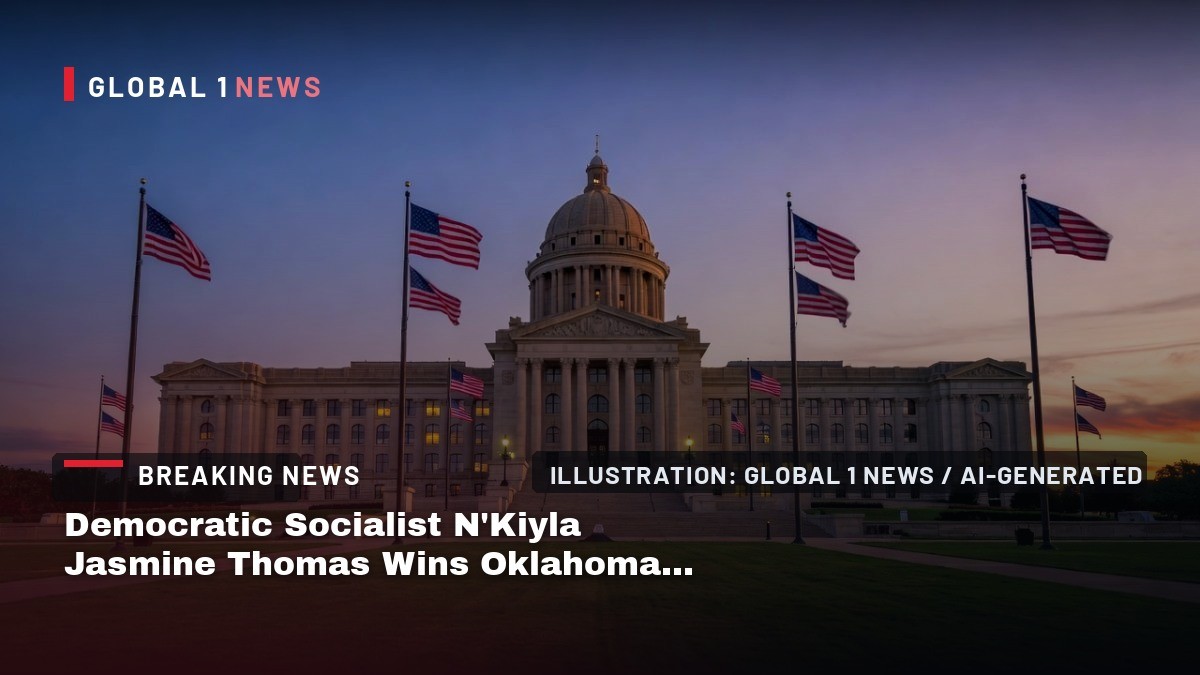
Democratic Socialist N'Kiyla Jasmine Thomas Wins Oklahoma Senate Runoff, Setting Up a November Showdown
Democratic socialist N'Kiyla Jasmine Thomas won Oklahoma's U.S. Senate Democratic runoff Tuesday, defeating Jim Priest and becoming the state's first democratic socialist Senate nominee. She now faces Republican Kevin Hern in November.
Folks, here is a sentence I never thought I would type: a self-described democratic socialist who is a registered nurse, a citizen of the Chickasaw Nation, and an active-duty military spouse just won a U.S. Senate primary in Oklahoma. Not in Portland. Not in Brooklyn. Oklahoma — the state that has not sent a Democrat to the United States Senate in more than three decades.
Democratic Socialist N'Kiyla Jasmine Thomas Wins Oklahoma Senate Runoff, Setting Up a November Showdown
Atlanta, Georgia – August 26, 2026 — Good morning, America. I'm Jessica Ali, and this is your Global1.News briefing. The Associated Press projected Tuesday night that N'Kiyla Jasmine Thomas won Oklahoma's Democratic U.S. Senate runoff, defeating attorney and minister Jim Priest and securing the nomination for the seat left open by Republican Sen. Markwayne Mullin, who departed the chamber to serve as Homeland Security Secretary. The win makes Thomas the first democratic socialist nominee for U.S. Senate in Oklahoma history — and it sets up a November general election against Republican Rep. Kevin Hern, a Tulsa congressman and former McDonald's franchisee with the full weight of President Donald Trump's endorsement behind him.
Let's be clear about what happened here. Oklahoma is about as red as American politics gets. Donald Trump carried the state by more than 30 points in 2024. Republicans hold every statewide office, both Senate seats, and five of the six House seats. And yet, on a Tuesday night in late August, a nurse from Ardmore who campaigned on healthcare access, economic justice, and tribal sovereignty walked away with her party's nomination by a wide margin. According to Newsmax, the victory was decisive — not the nail-biter that political operatives on both sides had quietly expected.
A Shock Win in a Deep-Red State
Let's put Tuesday night in perspective. While much of the national political media was watching the South Carolina Republican runoff — where Sen. Darline Graham survived a challenge from a Freedom Caucus-aligned opponent, a race I told you about earlier this week — Oklahoma was quietly delivering one of the most intriguing primary results of the 2026 cycle. Thomas did not just win. She won in a state where the Democratic brand has been radioactive for a generation.
Jim Priest, her opponent, was no pushover. The attorney and ordained minister had the backing of much of the state's Democratic establishment. He raised serious money, ran a disciplined campaign, and presented himself as the pragmatic, electable option in a state where Democrats have to scrape for every vote. Thomas ran on the opposite theory of the case: that a candidate who tells the truth about who she is and what she believes can energize a base that has been demoralized for years.
It worked. The Jewish Telegraphic Agency, covering the race Wednesday morning, described Thomas's victory as "progressive politics notching another deep-red win," noting that her campaign was bolstered by anti-AIPAC messaging that resonated with the party's progressive base. In a primary electorate that skews activist, the nurse from Ardmore was the candidate who sounded like she meant it.
Who Is N'Kiyla Jasmine Thomas?
If you have not heard of N'Kiyla Jasmine Thomas before today, you are not alone — but you will be hearing a lot more about her between now and November. Here is her story, straight from her campaign and from the reporting of KOSU, Oklahoma's NPR affiliate, and Ballotpedia.
Thomas was born in Ardmore, Oklahoma, a small city in the southern part of the state near the Texas border. She earned her high school diploma from Ardmore High School and built a career in healthcare, working as a nurse and community health worker before becoming a stay-at-home parent. She is a proud citizen of the Chickasaw Nation, one of Oklahoma's five federally recognized tribal nations, and she is the spouse of an active-duty service member. She is also the mother of a son with autism — and she has been deeply involved in autism support and advocacy groups, as well as military spouse networks and veterans advocacy organizations.
Her campaign's emphasis on tribal sovereignty is notable. Oklahoma is home to nearly 40 federally recognized tribes, and Native voters have become an increasingly important bloc in the state's Democratic primary. Thomas, as a Chickasaw citizen, speaks to that community with an authenticity no other candidate in the race could match.
Her platform, as summarized by the nonpartisan voter guide Smarter.Vote, centers on healthcare access, education reform, economic justice, and tribal rights. In a state that has refused to expand Medicaid under the Affordable Care Act — one of the last holdouts in the country — a nurse running on healthcare is a message with real teeth.
The Road to the Runoff
This did not happen overnight. In Oklahoma's June 16 primary, Thomas led a five-way Democratic field with 45.2 percent of the vote. Jim Priest finished second with roughly 24 percent. Because no candidate cleared 50 percent, Oklahoma law required a runoff between the top two finishers — and that set the stage for Tuesday's rematch.
The conventional wisdom heading into the runoff was that Priest, with his establishment backing and his appeal to the party's moderate wing, would consolidate support and close the gap. Instead, Thomas expanded it. Her campaign tapped into the same energy that has powered progressive insurgencies in other deep-red states — the argument that a Democrat who tries to out-Republican the Republican will never win, so Democrats might as well nominate someone who actually believes in something.
Her win also carries a historical footnote. According to NonDoc, Oklahoma's politics news outlet, Thomas is now the first democratic socialist nominee for U.S. Senate in the state's history. In a state where the word "socialist" has been used as a political weapon for a century, she wore the label as a badge of honor.
The November Matchup: Thomas vs. Hern
Now for the hard part. Awaiting Thomas in November is Republican Rep. Kevin Hern, who won his party's nomination on the same night. Hern is a Tulsa congressman first elected in 2018, representing Oklahoma's 1st District, and he has been a fixture of the House's conservative wing. Before entering politics, he was a McDonald's franchisee who owned 18 restaurants in the Tulsa metropolitan area — a biography he leans on heavily as proof that he understands the economy from the ground up.
Hern chaired the Republican Study Committee, the House's largest conservative caucus, and he ran for Senate with Trump's endorsement. ABC affiliate KVII reported that Hern's victory Tuesday was "the latest demonstration of the power of President Donald Trump's endorsements within the GOP." In a primary, that endorsement was decisive. In a general election in Oklahoma, it is essentially a prerequisite for Republican victory.
The structural math is brutal for any Democrat. Oklahoma has not sent a Democrat to the U.S. Senate since David Boren, who left the chamber in 1994. Since then, Democrats have routinely failed to crack 40 percent in statewide Senate races. The state's voters have not supported a Democratic presidential nominee since Lyndon Johnson in 1964.
And yet. Thomas's campaign is banking on a coalition that has been growing in Oklahoma even as the state's overall politics have shifted right: Native voters, young voters, labor households in Tulsa and Oklahoma City, and the state's substantial population of military families. She is also running as a woman, a person of color, and a member of a tribal nation in a year when national Democrats are desperate for evidence that their party can compete anywhere outside the coasts.
Why This Race Matters Beyond Oklahoma
Let me tell you why you should care about this race even if you have never set foot in Oklahoma. First, it is a live test of whether progressive candidates can win primaries in red states — and whether that energy can translate into general-election competitiveness. National Democrats have spent years arguing over exactly this question. Thomas just ran a very public experiment, and the early results are in: the progressive message did not just survive in Oklahoma's Democratic primary; it dominated.
Second, the race is a window into the 2026 midterm environment. Tuesday night's results — including the ouster of two Oklahoma Freedom Caucus-aligned incumbents in House primary runoffs, reported by The Oklahoman — suggest that the GOP's internal wars over Trumpism are not over. While Trump's endorsement carried Hern across the line in the Senate race, down-ballot, some of the party's most aggressive insurgents lost their seats. That is a story worth watching as we head toward November.
Third, there is the Mullin factor. The seat Thomas and Hern are fighting over belonged to Markwayne Mullin, who left the Senate to join the administration as Homeland Security Secretary. That means this race is not just about Oklahoma — it is about the national balance of power. Republicans are defending a map that is already difficult for them, and every seat matters. If Democrats can force Republicans to spend real money defending a seat in Oklahoma, that is money they cannot spend in Pennsylvania, Wisconsin, or Nevada.
Fourth, and most personally for me: this is a reminder that politics still has surprises left in it. A democratic socialist nurse from Ardmore, Oklahoma, did not get the memo that her state is unwinnable. She ran anyway. She won anyway. And now she is going to force one of the most conservative states in America to have a real conversation about healthcare, economic justice, and the meaning of representation.
What Happens Next
The general election is 10 weeks away. Here is what to watch between now and November 3.
First, watch the money. Hern is the heavy favorite and will be backed by national Republican committees and super PACs. Thomas will need to prove she can raise enough to compete — and her primary performance suggests the small-dollar progressive network is paying attention.
Second, watch the polling. If Thomas can hold the race to single digits, that is a moral victory with national implications. If she somehow keeps it competitive into October, Republicans will quietly start sweating.
Third, watch the debates. Hern is a seasoned debater with years of House floor experience. Thomas is a nurse and community organizer who has never held office. If she can hold her own on a debate stage, she will make national news all over again.
And fourth — watch Oklahoma itself. A state that has been written off by national Democrats for three decades just produced a nominee who is unlike any Senate candidate it has ever seen. Whatever happens in November, that is a story in itself.
Here is the bottom line, folks: on Tuesday night, Oklahoma's Democratic primary voters did something they have never done before. They nominated a democratic socialist. They nominated a nurse. They nominated a Chickasaw citizen. And in doing so, they reminded the rest of the country that in American politics, the one thing you can never predict is the next surprise.
Stay informed. Stay engaged. And if this story moved you, get out there and make your voice heard in your own elections — local races matter just as much as the big ones. This is Jessica Ali, Global1.News, signing off.
By Jessica Ali, Staff Writer
This article was produced with AI-assisted research and editorial support. Sources: NBC News, Associated Press (via News9), Newsmax, KOSU, The Jewish Telegraphic Agency, The Oklahoman, NonDoc, Ballotpedia, KVII/ABC7 Amarillo.
What's Your Reaction?
 Like
0
Like
0
 Dislike
0
Dislike
0
 Love
0
Love
0
 Funny
0
Funny
0
 Wow
0
Wow
0
 Sad
0
Sad
0
 Angry
0
Angry
0

Editor-in-Chief at Global1.News. Atlanta-based journalist who cuts through the BS and tells it like it is. Lead anchor, host, and the voice you hear when the spin stops and the truth starts.











Comments (0)