
Nepal-Tibet Border Flood Death Toll Tops 800 as Rescuers Race to Reach Trapped Hydropower Workers
A catastrophic flash flood on the Nepal-Tibet border has killed at least 800 people with over 3,000 missing, as rescuers race to reach hundreds of workers trapped in hydropower tunnels and a second glacial lake threatens further devastation.
A Catastrophic Surge With No Warning
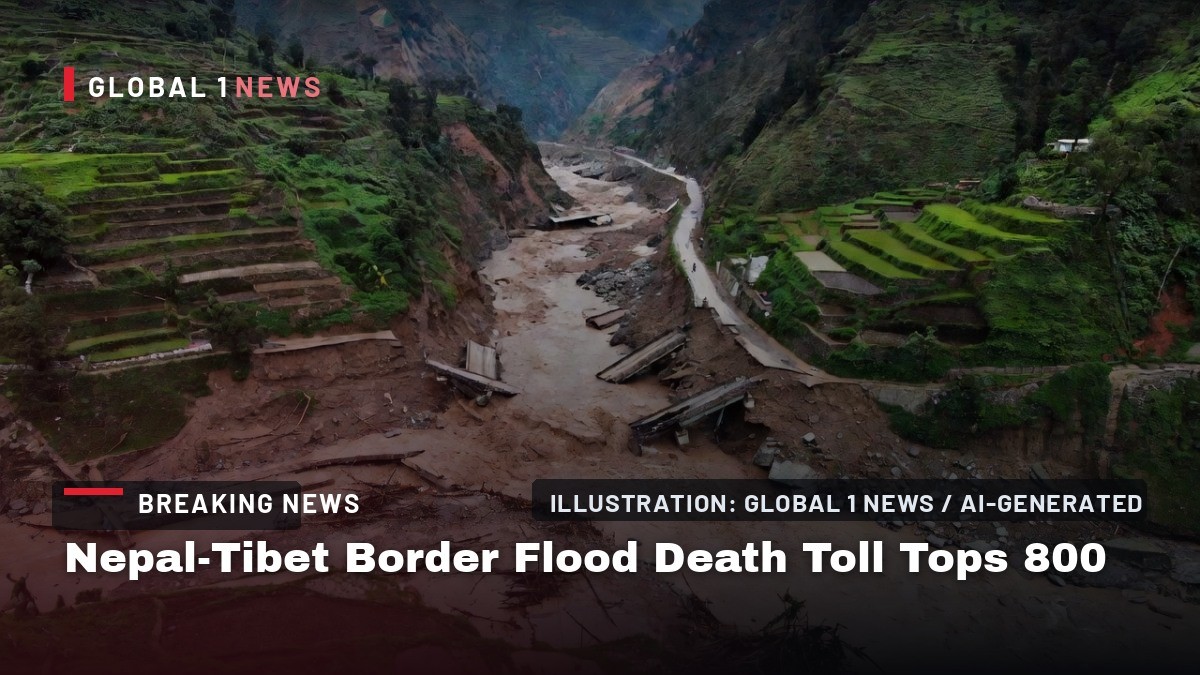
As of Sunday morning, the catastrophic flash flood that tore through the mountainous Nepal-China (Tibet) border region on Wednesday, August 26, 2026, has claimed at least 800 lives across both countries, with more than 3,000 people still unaccounted for, according to the Associated Press. The disaster struck at approximately 8:40 a.m. local time (02:55 GMT) when a massive ice-rock avalanche from the Langtang Lirung glacier blocked the Lhende Khola river, a tributary of the Bhote Koshi, before the natural dam failed and sent a wall of water, mud, and debris surging down the gorge.
Nepal's disaster authority, in its 9 a.m. bulletin on Sunday, put the recovery at 734 bodies within its borders, up from 669 logged by Nepal Police at 4 p.m. on Saturday. The Kathmandu Post had reported the toll at 626 on the morning of August 29. In Tibet, Xinhua confirmed 7 deaths, with 554 people missing in Gyirong County, though some reports cite 16 fatalities in China. The combined figures remain provisional and are expected to rise as search operations continue in some of the most inaccessible terrain on Earth.
Officials in Nepal said they had no advanced warning before the surge hit. The flood reached the Gyirong Port border crossing about seven minutes after the USGS recorded a magnitude-5.2 landslide event 55 kilometers northwest of Kodari, with an M4.2 follow-up. Analysis of satellite images suggests the debris flow reached speeds of up to 80 km/h, and the flood carried some victims' bodies as far as 240 kilometers away, with remains recovered as far downstream as Nawalparasi District in Nepal and Kushinagar and Maharajganj districts in Uttar Pradesh, India.
The Corridor of Destruction
The wall of water ran south through Rasuwagadhi, the main overland gateway to Tibet, then through Timure, the trading village that serves the border, past Syabrubesi, the trailhead town for Langtang treks, and onward toward Trishuli Bazar, damaging homes, roads, and power projects along roughly 60 kilometers of valley. Floodwaters surged more than 160 kilometers south, through the districts of Rasuwa, Nuwakot, Dhading, Gorkha, Tanahun, and Nawalparasi to Chitwan, near the Indian border.
Satellite images released by Planet Labs on August 27 show buildings and roads scoured away at Timure and Rasuwagadhi, with the trekking hub of Syabrubesi left submerged in mud. Gyirong Port is a strategic border crossing connecting Nepal's Rasuwa District and Gyirong County, Tibet, and nearly all trade between China and Nepal moves through it. On the Chinese side, 555 stranded tourists were relocated and 499 villagers evacuated.
The International Federation of Red Cross and Red Crescent Societies (IFRC) estimated that 93,000 people were impacted by the floods. The disaster authority's breakdown of recovered bodies in Nepal shows the uneven distribution of the carnage: 259 recovered in Chitwan, 184 in Nawalparasi East, 82 in Nawalparasi West, 58 in Gorkha, 52 in Nuwakot, 50 in Dhading, and only 13 in Rasuwa, the district where the flood started—a testament to how far the surge carried victims downstream.
The Missing: A Crisis of Unprecedented Scale
Nepal's disaster authority listed 2,498 people missing on August 30, 589 of them foreign nationals from 33 countries, with 122 already traced safe. Add the 554 missing in Tibet and the combined list is past 3,000. The toll includes at least 28 police officers, 13 Armed Police Force personnel, 44 Nepali Army personnel, 15 customs office employees, and 4 immigration office employees reported missing. The Independent Power Producers' Association Nepal (IPPAN) said 934 people involved in 11 hydropower projects were unaccounted for.
The international dimension is staggering. Australia has raised its count to 41 nationals missing; India listed 255 uncontactable with 84 rescued on August 28; about 90 U.S. citizens are unaccounted for, with 5 evacuated; Global Affairs Canada reported 30 Canadians and permanent residents missing; South Korea reported 9 citizens missing at a hydropower plant construction site; Nepal's tourism board counted 53 Ukrainians, 51 Malaysians, and 33 Britons; roughly 100 Chinese nationals are missing on the Nepali side of the border.
A group of 77 Isha Foundation pilgrims from 19 nationalities was at Gyirong Port during the flash flood. Late August is peak season for the Kailash Mansarovar pilgrimage, a holy site in Bon, Buddhism, Hinduism, and Jainism, and Rasuwagadhi is the main overland gateway. Authorities in both Nepal and China said they were unable to determine exactly what caused the massive flood, and the cause remains under investigation. Officials stress that out of contact is not a death toll—roads and phone links are gone, and many of the missing are alive but unreachable.
Underground Rescue: The Race Against Time in Hydropower Tunnels
The single largest block of the missing is underground. The Nepali Army prioritized 19 tunnels where workers were trapped when the floodwaters surged in. At Upper Trishuli-1, 254 people were brought out. At Upper Trishuli-3, 85 of 213 reported missing had been rescued as of August 29. At Upper Trishuli-3A, the cable tunnel entrance is buried and around 100 workers are still thought to be trapped; on Saturday, August 29, a controlled blast opened part of the buried entrance and crews broke through, began pumping air inside, and sending food in through bored holes.
Officials believe more than 100 workers may still be alive inside the Trishuli-3A and 3B tunnels. At Trishuli-III, the army brought 208 people out alive on August 29, 43 of them foreign nationals, including 38 Chinese and five Indians. At Chilime, six of the eight missing are believed to be inside a tunnel packed with mud. At Rasuwagadhi, 49 employees are missing. At Langtang Khola, 18 have been rescued and 40 to 45 are unaccounted for.
AFP reports the army has brought 350 people out of the flooded tunnels alive. Home Minister Sudan Gurung said the next step is to widen the hole and send rescuers in. Nepali Army spokesperson Brig. Gen. Raja Ram Basnet said rescue efforts would continue at the hydropower construction site. The Nepal Electricity Authority says 431 MW is off the national grid because of damage to hydropower plants, a significant blow to a country already grappling with energy shortages.
Rescue and Relief Operations Underway
More than 3,700 people have been rescued in Nepal so far, according to the Associated Press, with 8,186 rescued in all and 227 foreign nationals lifted out by helicopter. In a news briefing Saturday, Nepalese Foreign Minister Shisir Khanal said authorities have mobilized all available resources with support from international assistance. In Nuwakot, helicopters arrived loaded with aid including clothes, instant noodles, crackers, and rice. An older man was helped off one helicopter, a soldier carried an older woman to a medical tent, and soldiers carried several babies who had been evacuated.
One woman, Shoba Shretha, returned to find Sweetie, the dog she was forced to leave behind when the floods came—a small moment of relief in a landscape of loss. The human cost is measured not just in numbers but in the shattered lives of survivors who lost homes, livelihoods, and loved ones in a matter of minutes. The IFRC released 1 million Swiss francs (about $1.2 million) in emergency funding, and the United Nations allocated $2 million from its Central Emergency Response Fund (CERF).
India sent a rescue aircraft carrying about 10 tonnes of emergency supplies to Nepal, including temporary shelters, blankets, hygiene kits, solar lamps, and medicines. Indian Prime Minister Narendra Modi spoke with Nepalese Prime Minister Balendra Shah and pledged India's support. Australia announced $3.6 million in assistance and said it would send additional consular staff. The European Union activated its Copernicus Emergency Management Service, and the World Bank offered support.
The Looming Threat of a Second Flood
Rescuers had been on high alert for more flooding from a new barrier lake that formed high in the Himalayas after the initial flood. The barrier lake on the Nepal-China border broke its banks on August 28 and searches were suspended, but the river rose only about 0.6 meters and rescue work resumed the same afternoon. By the evening of August 29, China's water ministry, via CCTV, said that lake had essentially drained and was in normal natural outflow, with the water level dropping by 10 meters from its peak on August 27.
But a second blockage upstream is bigger and more dangerous. Measured at over 120,000 square meters by China's geological disaster center, glacial-hazards scientist Alton Byers of the University of Colorado Boulder said the debris holding it is loose and unstable. Jeffrey Kargel of the Planetary Science Institute called aerial footage of the second lake "extremely concerning." If the upper lake fails, its water would pour into the dammed lake below and the two could burst out together very rapidly.
China issued a Level-IV emergency response over the lake, and China's National Meteorological Center forecast further rain around Gyirong through August 29. The threat is not hypothetical—this is the Lhende Khola's second catastrophic flood since July 2025, when a glacial lake outburst flood destroyed the border bridge at the same spot. Langtang Lirung also experienced a major glacier collapse triggered by the April and May 2015 Nepal earthquakes, when a landslide destroyed and buried several villages in the Langtang valley, killing over 350 people.
The Economic and Climatic Context
Nepal's finance minister put rebuilding costs at $4 billion to $5 billion, close to a tenth of Nepal's economy. Wikipedia cites property damage in Nepal of more than 200 billion Nepali rupees (US$1.3 billion+) as of August 27. The destruction of hydropower infrastructure alone represents a major setback for a country that relies on electricity exports to India. Since 1900, dozens of floods have occurred near the border between Nepal and China, but the scale of this disaster is unprecedented in recent memory.
Climate change contributes to the melting of permafrost, which increases the likelihood of glacier collapses. Byers said: "Permafrost has been the cryospheric glue that's held the rock and the ice and the glaciers together for millennia, and now we're getting increasing evidence that it's being weakened by warming trends." Some scientists have not directly attributed the disaster to climate change, noting more proximate causes; others say climate change probably increased the likelihood of this event.
The disaster underscores the vulnerability of mountain communities and infrastructure to glacial hazards in a warming world. As rescue operations continue and the search for the missing goes on, the focus remains on the immediate humanitarian response. But the longer-term questions about how to protect people and infrastructure in these high-risk zones will demand urgent attention from both Nepal and China, as well as the international community that has pledged support.
What Comes Next
The toll is expected to rise as search teams reach more remote areas and as communication links are restored. The Nepali Army continues to prioritize the hydropower tunnels, where officials hold out hope that more than 100 workers may still be alive. The controlled blast at Trishuli-3A opened part of the buried entrance, and crews are pumping air inside and sending food through bored holes—a painstaking process that could yield more survivors in the coming days.
For the families of the missing, the wait is agonizing. For the survivors, the road to recovery will be long. The international response has been swift, but the scale of the need is immense. Nepal's disaster authority, the IFRC, and the United Nations are coordinating relief efforts, while countries from India to Australia to the United States are providing assistance and consular support for their citizens.
As the waters recede and the debris is cleared, the full picture of this catastrophe will emerge. But even now, one thing is clear: this is one of the deadliest flood disasters in the region's history, and its impacts will be felt for years to come. The cause remains under investigation, but the combination of glacial instability, extreme terrain, and vulnerable infrastructure has created a perfect storm that demands a coordinated, long-term response.
By Jessica Ali, Staff WriterThis article was produced with AI-assisted research and editorial support. Sources: Associated Press, CNN, Al Jazeera, The Guardian, Reuters, Wikipedia.
What's Your Reaction?
 Like
0
Like
0
 Dislike
0
Dislike
0
 Love
0
Love
0
 Funny
0
Funny
0
 Wow
0
Wow
0
 Sad
0
Sad
0
 Angry
0
Angry
0

Editor-in-Chief at Global1.News. Atlanta-based journalist who cuts through the BS and tells it like it is. Lead anchor, host, and the voice you hear when the spin stops and the truth starts.













Comments (0)