
Metro Manila's 'Ondoy-like' Downpour: 201.7 mm in 5 Hours Exposes Aging Flood Defenses, Experts Push 'Sponge' Solutions
Metro Manila's Aug 17 flood: 201.7mm rain in 5 hours, 44% of Ondoy's total. Experts cite delta geography, overwhelmed infrastructure. Lagmay urges nature-based solutions like sponge roads, retention basins. PAGASA warns of more rain.
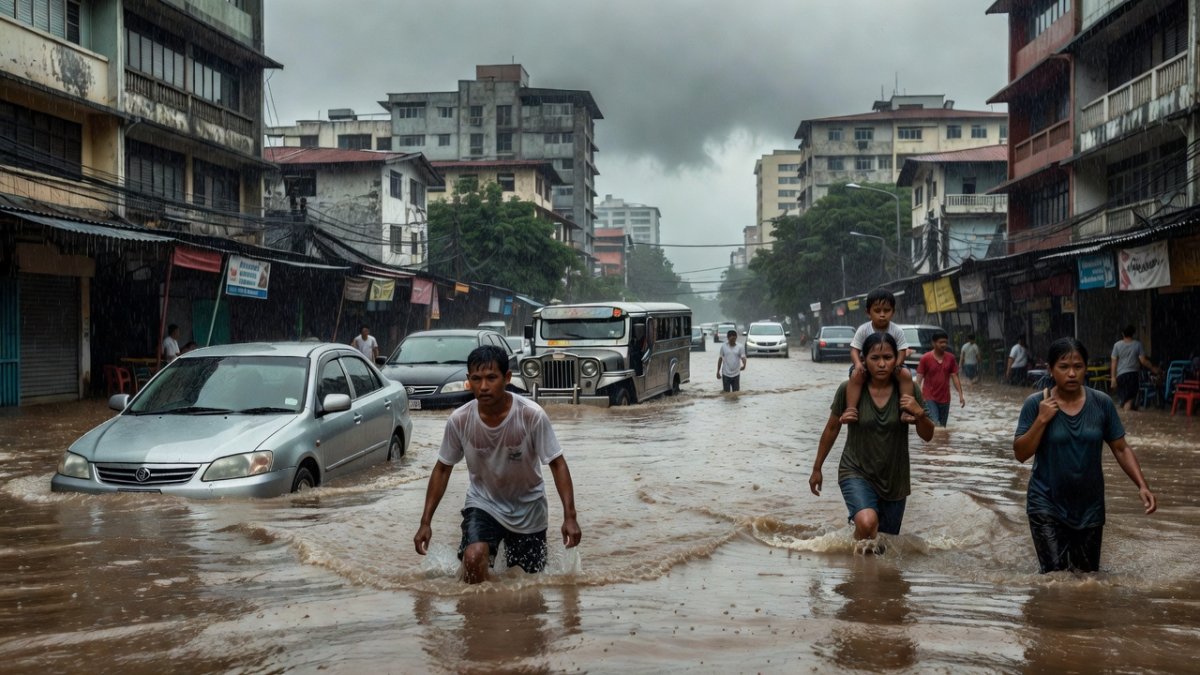
MANILA, Philippines — The water came fast, brown, and relentless. By noon on Monday, August 17, the sky over Quezon City had opened up with a fury that many residents said they had not seen since the dark days of Tropical Storm Ondoy in 2009. Within five hours, the Science Garden station in Quezon City recorded a staggering 201.7 millimeters of rain — nearly half of what Ondoy dumped in a full 24 hours. Roads became rivers, commuters were stranded on top of jeepneys, and families in low-lying barangays scrambled to move their belongings to higher ground as floodwaters reached tire-level, and in some Quezon City areas, above head-level.
For ordinary Filipinos, the scene was painfully familiar. The images flooding social media showed a first-time sight for many: water creeping up the EDSA-Shaw intersection, a rain garden at a Vertis North condominium complex nearly overflowing, and streets in Antipolo City turning into canals. The Metropolitan Manila Development Authority (MMDA) and Project NOAH experts have a clear message: this is not just about the rain. It is about a metropolis built on a flood-prone delta, with infrastructure designed for a milder climate, and a urgent need to rethink how we manage water before it reaches our homes.
The Numbers Behind the Flood: A Downpour That Overwhelmed the System
The statistics from Monday are stark. According to the MMDA, citing PAGASA's Science Garden station, the 201.7 millimeters of rain fell between 9 a.m. and 2 p.m. on August 17. More alarming is the concentration: 138 millimeters, or more than two-thirds of the total, fell within just two hours, from noon to 2 p.m. This intense, short burst of rainfall is exactly what Metro Manila's drainage and flood control systems are not designed to handle.
To put this in perspective, Tropical Storm Ondoy, which remains a traumatic memory for many Filipino families, dumped 455 millimeters of rain over 24 hours in 2009. Monday's five-hour deluge was equivalent to about 44 percent of that total. MMDA General Manager Nicolas Torre III explained the situation plainly in an interview with ANC. "So nakita natin, kahapon, ay sa isang napakaiksing panahon, binagsak ng langit ang almost kalahati ng Ondoy in 24 hours, so maiintindihan natin na talagang aapaw," he said, referring to the limited capacity of Metro Manila's waterways. (So we saw yesterday that the downpour within a few hours was almost half of what Ondoy made in 24 hours. So it is understandable that the waterways will overflow.)
The flooding was not confined to known trouble spots. Social media accounts and Interaksyon reports showed water reaching areas where residents said they had rarely seen inundation. One user noted it was the first time they had seen a flooded section of EDSA-Shaw reach that extent. In Quezon City, a resident reported that a rain garden at a condominium complex in Vertis North came close to overflowing. Flooding was also reported in Antipolo City in Rizal, including along Sen. L. Sumulong Memorial Circle and near SM Masinag. For many, the shock was not just the depth of the water, but where it appeared.
Why Metro Manila Floods: Geography, Infrastructure, and a Delta's Legacy
Project NOAH Executive Director Mahar Lagmay offered a clear explanation for why the metropolis turned into a swamp. It is not just the volume of rain; it is where Metro Manila sits. Lagmay told ANC on Tuesday, August 18, that Metro Manila and its neighboring province, Bulacan, are situated in naturally low-lying areas called "deltas" that were formed by centuries of flooding.
"That delta was formed because of floods. Kapag mayroong mga river, waters na lumalabas, dina-dump niya 'yung soil, 'yung silt and then form the delta," Lagmay explained. (That delta was formed because of floods. If there are rivers, waters released, soil and silt were dumped and then form the delta.) This means the very ground beneath our feet is a natural floodplain, a fact that has been known and mapped since 2012. "We are in an urbanized area sitting on land that is really flood-prone," he emphasized.
Compounding this geographic reality is the limitation of existing flood control structures. Lagmay was direct in his assessment: the infrastructure is simply not fit for the rainfall patterns we are now experiencing. "Malakas talaga 'yung ulan kahapon, expected po na talagang magbabaha. 'Yung mga flood control structures natin ay designed to accommodate only so much. Pero na-overwhelm talaga kasi the design is not fit for that," he said. (Yesterday's rainfall was really heavy, flooding was expected. Our flood control structures were designed to accommodate only so much. But these were overwhelmed because the design is not fit for that.) This aligns with the MMDA's own explanation that the region's limited waterways were simply overwhelmed by the sheer volume of water in a short span.
Human Impact: Commuters Stranded, Families Rescued, and the Bayanihan Spirit
Behind the statistics are the stories of everyday Filipinos whose lives were upended. From morning until late evening on Monday, several major routes were totally impassable for motorists and commuters as floodwaters reached at least 26 inches or tire-level deep. In Quezon City, some areas experienced above-head-level flooding, forcing residents to wade through chest-deep water or wait for rescue on rooftops.
For commuters, the ordeal was exhausting. Jeepney drivers navigated through waterlogged streets, their vehicles half-submerged, while passengers held their belongings above their heads. Tricycle drivers, the lifeblood of many barangays, found their routes cut off, leaving students and workers stranded. The scene was a test of patience and resilience, but it also brought out the bayanihan spirit. Neighbors helped neighbors, pulling each other to safety, sharing food and dry clothes, and checking on the elderly and the sick in flooded communities.
In sari-sari stores, owners scrambled to save their goods, lifting canned goods and rice sacks onto higher shelves as water seeped under their doors. For many, the flood was not just an inconvenience but a direct threat to their livelihood. The damage to goods and the loss of a day's sales will be felt for weeks. Students, meanwhile, were told to stay home. Malacañang ordered schools in Metro Manila and 14 provinces to shift to alternative learning modes on Tuesday, while government offices were directed to adopt alternative work arrangements because of the continuous heavy rain. This disruption, while necessary for safety, adds another layer of difficulty for families already struggling with the economic impact of the pandemic recovery.
What Experts Say Can Actually Help: Nature-Based Solutions and Smart Planning
According to Lagmay, the solution is not simply to spend more money on massive concrete dikes and floodwalls. Instead, he advocates for a mix of short-term, medium-term, and long-term interventions that work with nature, not against it. For the immediate term, he suggests using accurate weather forecasts and identifying flood-prone areas to move residents out of harm's way during heavy rains or storms. This proactive approach, he argues, can save lives and reduce the burden on emergency services.
For the medium to long term, Lagmay proposes studying the land and creating simulations to test the effectiveness of flood mitigation projects before pouring concrete. This means using computer models to see how water will flow and where it will accumulate, ensuring that any new infrastructure is actually effective. But his most compelling recommendation is a shift toward nature-based solutions. These include retention basins, which are areas designed to hold excess water; rainwater harvesting, which captures rain where it falls; and "sponge roads," or urban streets designed with porous materials to absorb rainwater instead of letting it run off into already-overwhelmed drainage systems.
"The idea being, before the water peaks dun sa low-lying areas na magkasabay-sabay sila, nabawasan na kasi kinapture mo na 'yung water in small amounts," Lagmay said. (The idea being, before the water peaks in the low-lying areas all at the same time, it is already reduced because you have captured the water in small amounts.) This decentralized approach, he argues, is more resilient and sustainable than relying solely on large-scale infrastructure that can be overwhelmed by extreme weather events.
The Threat Is Not Over: PAGASA Forecasts More Rain and Disruptions
As of 8 a.m. on Tuesday, August 18, PAGASA placed Metro Manila under a yellow rainfall warning, meaning flooding was possible in flood-prone areas. The weather bureau forecast 50 to 100 millimeters of rain over Metro Manila on Tuesday due to the southwest monsoon, with another 50 to 100 millimeters possible on Wednesday. PAGASA warned that the effects of additional rainfall may be worsened by the significant rain that has already fallen, as the ground is saturated and waterways are still swollen.
The situation is even more serious in other parts of Luzon. Benguet, La Union, Pangasinan, Zambales, Bataan, Cavite, Batangas, and Occidental Mindoro face heavier rainfall of 100 to 200 millimeters on Tuesday. PAGASA said numerous flooding events are likely in areas receiving that amount of rain, particularly in urbanized and low-lying communities and places near rivers. The MMDA has deployed flood control teams to affected roads to clear clogged drainage systems and help floodwaters recede, but the work is far from over.
A Call for Long-Term Thinking: Building a Resilient Future
The flooding of August 17-18 is a stark reminder that Metro Manila's vulnerability is not a new problem, but it is a worsening one. Lagmay's point is crucial: these flood-prone areas have been identified since 2012, yet little has been done to fundamentally change how we manage water in the region. The reliance on reactive measures — clearing drains, deploying rescue teams, and issuing warnings — is no longer enough. We need a proactive, science-based approach that includes nature-based solutions and smart urban planning.
For the Filipino people, this is not just an academic debate. It is about whether a mother can safely send her children to school, whether a worker can get to their job without risking their life, and whether a small business owner can protect their livelihood from a sudden downpour. The bayanihan spirit shown on Monday is admirable, but it should not be a substitute for systemic change. As the rain continues to fall, the question for our leaders in Congress, the Department of Public Works and Highways, and local government units is clear: will we invest in the "sponge" solutions that can absorb the shock of extreme weather, or will we continue to build on a delta and hope for the best?
The memories of Ondoy are still fresh for many, and Monday's flood brought them rushing back. But unlike 2009, we now have the data, the technology, and the expert knowledge to do things differently. The challenge is whether we have the political will and the collective resolve to act. For the sake of the commuters stranded on EDSA, the families in flooded barangays, and the students forced to learn from home, we must do better. The rain will come again; the question is whether we will be ready.
This article was produced with AI-assisted research and editorial support. Sources: Philstar.comBy Bella Reyes, Staff WriterWhat's Your Reaction?
 Like
0
Like
0
 Dislike
0
Dislike
0
 Love
0
Love
0
 Funny
0
Funny
0
 Wow
0
Wow
0
 Sad
0
Sad
0
 Angry
0
Angry
0

Philippines/Southeast Asia Correspondent at Global1.News. Manila-based journalist covering Philippine politics, environment, maritime security, and social issues. Passionate about marine conservation and the communities protecting the Philippines' natural heritage.












Comments (0)