
‘The Right to Be Named’: Russians in Amsterdam Remember Victims of Political Repression
Every October 29, a quiet ritual unfolds in Amsterdam’s Frederiksplein square, where a small group of Russians and supporters read aloud the names of victims of Soviet terror and contemporary political repression.
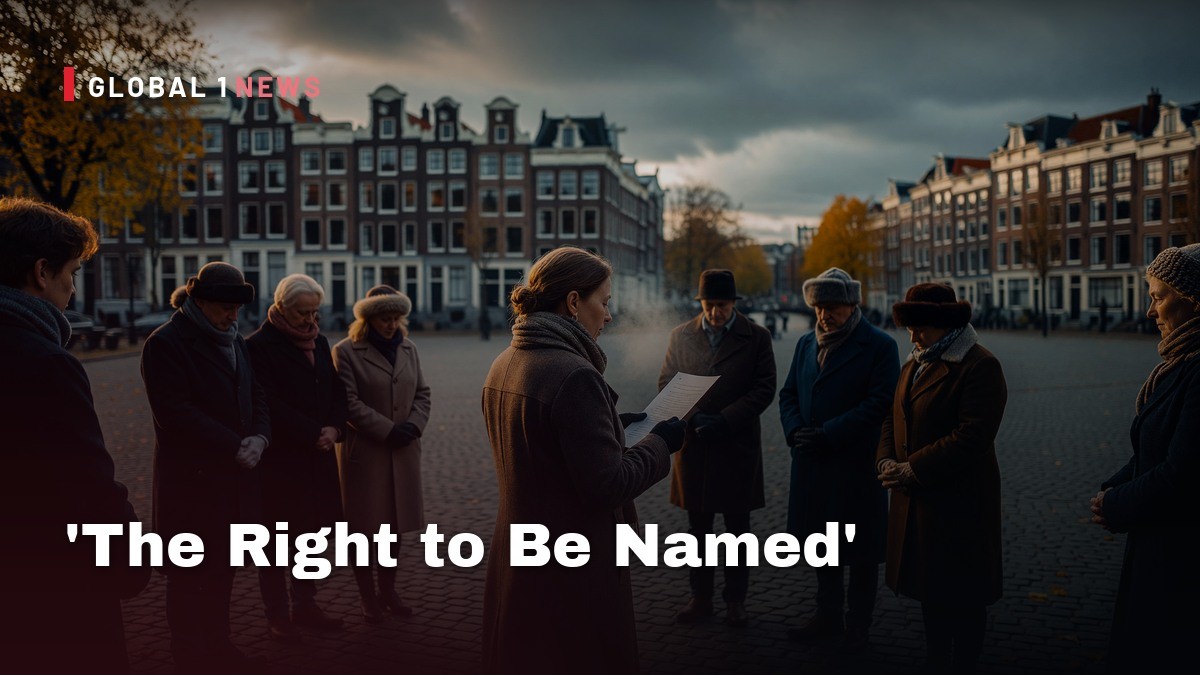
Every October 29, a quiet ritual unfolds in Amsterdam’s Frederiksplein square, where a small group of Russians and supporters read aloud the names of victims of Soviet terror and contemporary political repression. The ceremony, part of the “Returning the Names” initiative, is a stark reminder that the memory of Stalin’s Great Terror remains a living political tool for those who oppose the Kremlin’s current authoritarianism. By tracing the origins of this commemoration, its evolution under pressure from Russian security services, and its symbolic resonance in the diaspora, we can see how the past is mobilised to challenge the present.
The origins of “Returning the Names”
“Returning the Names” began almost two decades ago as a solemn act of remembrance for those executed during the Great Terror of the 1930s. The original gatherings took place at the Solovetsky Stone on Moscow’s Lubyanka Square, a site directly opposite the headquarters of the Soviet security services—now the Federal Security Service (FSB). The event was organised by Memorial, the human‑rights organisation tasked with documenting Soviet political repression. By situating the ceremony at the very heart of the Soviet security apparatus, activists highlighted the continuity between past terror and the modern state’s repressive mechanisms.
Since Memorial’s designation as an “extremist” organisation by Russian authorities, the ceremony has been stripped of its formal affiliation with the group. Nevertheless, activists continue to observe the ritual, underscoring the resilience of civil‑society memory practices even under legal suppression.
Global diffusion and the diaspora’s participation
In 2026 the “Returning the Names” ceremony was held in more than 100 cities worldwide, ranging from Irkutsk and Kirov in Russia to Melbourne, San Jose and Miami. The decentralized nature of the initiative allows each local organiser to adapt the event to its context, whether by focusing solely on Soviet victims or by extending the roll call to current political prisoners. This flexibility has enabled the commemoration to survive the Kremlin’s crackdown on independent memory projects.
In the Netherlands, the event has been organised by writer and historical‑memory researcher Nikolai Epple since 2022. He reports that each year roughly fifty participants attend, a figure that feels disproportionately low compared with the estimated eleven thousand Russians living in the country. Epple attributes the modest turnout to a lingering climate of fear, noting that many diaspora members avoid public political gatherings for fear of reprisals that can extend to family members still in Russia.
Challenges of outreach within the diaspora
Epple’s attempts to publicise the ceremony have encountered resistance from Russian‑language Telegram channels that cater to expatriates who left after the full‑scale invasion of Ukraine. These channels declined to share announcements, stating a focus on “culture, not politics.” This reticence reflects a broader tendency among Russian emigrants to distance themselves from overt political activity, a strategy shaped by the Kremlin’s systematic suppression of dissent and the personal risks associated with political expression.
Even among those who do attend, organisers stress the importance of consent when photographing participants, aware that images could be used by Russian authorities to identify and target individuals abroad. The careful handling of personal data underscores the pervasive reach of the Russian security apparatus, which now monitors not only domestic activists but also those who speak out from abroad.
Symbolic resonance of the Dutch setting
The Amsterdam gathering takes place beside the memorial to Walraven van Hall, a leading figure in the Dutch resistance during World War II. This juxtaposition links Russian remembrance of Soviet terror with broader European narratives of resistance against totalitarianism. Nearby, a candle‑lit tribute to the late Kremlin critic Alexei Navalny stands beneath a large tree, reinforcing the event’s dual focus on historical and contemporary victims.
During the ceremony, participants read names in multiple languages, enabling non‑Russian speakers to join. A man with a Dutch accent, for example, recited the name “Maria Georgiyevna Babek, 41, Slovak, head of the council of Kazan’s Catholic community, executed on July 7, 1938.” Such multilingual participation signals an effort to internationalise the memory of repression, inviting solidarity from broader civil‑society networks.
Linking past terror to present repression
Activists argue that the memory of Soviet terror is not merely a historical curiosity but a lens through which to view today’s authoritarian practices. Epple stresses that the event’s location at Lubyanka once gave it “immense political significance,” a significance that has intensified since the 2022 invasion of Ukraine. By reading the names of contemporary political prisoners alongside those of Stalin’s victims, organisers draw a direct line between the two eras, suggesting that the failure to fully reckon with past atrocities has enabled the current regime’s capacity for mass repression.
Polina, a 37‑year‑old psychologist who left Russia in 2022, articulates this connection. She notes that “hundreds of thousands of people were executed in Soviet times, and more than 1.5 million died in the camps,” and that each name read aloud restores “the right to be named, rather than remain a number in a case file.” Her testimony underscores how personal acts of remembrance serve as a form of resistance against the dehumanising bureaucracy of the state.
The Kremlin’s response and the broader climate of repression
The Russian government’s tightening grip on dissent is evident in several recent measures. The Prosecutor General’s Office has designated The Moscow Times as an “undesirable” organisation, criminalising its work and exposing its journalists to prosecution. This move, reported in the source article, reflects a broader strategy of labeling independent media and civil‑society groups as foreign agents or extremist organisations, thereby legitimising state‑sanctioned harassment.
Such legal designations have a chilling effect on diaspora activism. Even abroad, participants fear surveillance and potential retaliation against relatives in Russia. The insistence on consent for photographs and the reluctance of Russian‑language channels to promote the event illustrate how the Kremlin’s reach extends beyond its borders, shaping the behaviour of expatriate communities.
Future prospects for memory activism
Despite the obstacles, “Returning the Names” persists as a testament to the durability of memory activism. Its decentralized model allows it to adapt to local conditions while maintaining a core narrative that links Soviet‑era terror to contemporary political imprisonment. As long as the Kremlin continues to suppress independent historical inquiry and criminalise dissent, the ritual of naming victims will remain a potent form of symbolic opposition.
For the participants in Amsterdam, the act of reading a name aloud is both a personal catharsis and a collective assertion that the regime cannot erase the individual lives it has destroyed. In a climate where the state seeks to reduce dissent to anonymity, the simple act of restoring a name becomes a powerful defiance, reminding both the Russian diaspora and the international community that the memory of past atrocities is a weapon against ongoing repression.
This article was produced with AI-assisted research and editorial support. Reporting is based on the source material cited below. Sources: The Moscow Times; themoscowtimes.com; Global1.News (02 November 2026).
By Irina Volkov, Staff Writer
What's Your Reaction?
 Like
0
 Dislike
0
 Love
0
 Funny
0
 Wow
0
 Sad
0
 Angry
0
Russia/Eastern Europe Correspondent at Global1.News. Covering Russian politics, energy, security, and the shifting dynamics of the post-Soviet space. Provides clear-eyed analysis on one of the world's most opaque regions.










Comments (0)