
Zambia's President Wins Second Term with 60% of the Vote
In a decisive victory that echoed the will of the Zambian people, President Hakainde Hichilema has been re-elected for a second five-year term, securing a commanding 60% share of the vote.
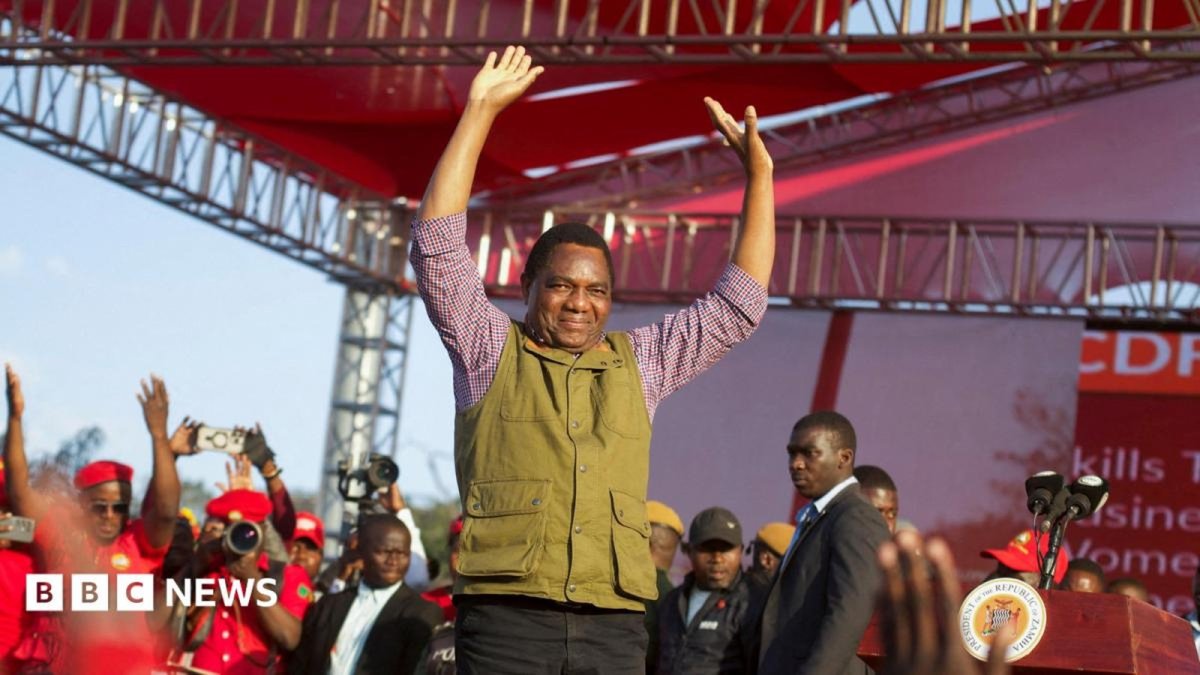
In a decisive victory that echoed the will of the Zambian people, President Hakainde Hichilema has been re-elected for a second five-year term, securing a commanding 60% share of the vote. The announcement by the electoral commission on Tuesday set off celebrations in the capital, Lusaka, where hundreds of supporters clad in the red of the United Party for National Development (UPND) flooded the streets, their joy a testament to a mandate that was as clear as it was resounding.
Lusaka, Zambia — Article continues...
The result, while widely anticipated, was not without its tensions. It followed a contested process marked by the arrest of leading opposition figures and allegations of irregularities from Hichilema's closest rival, Brian Mundubile. Yet, for a nation with a proud record of peaceful transfers of power since the return to multiparty democracy in 1991, the outcome reaffirms a familiar rhythm: Zambia settles its differences at the ballot box, and nowhere else.
A Mandate of 60 Percent: The Numbers Behind the Victory
The electoral commission’s announcement painted a picture of a decisive win for the 64-year-old incumbent. Hichilema’s 60% share of the vote stands in stark contrast to the 38% secured by his principal challenger, Brian Mundubile, of the Patriotic Front (PF). The remaining 12 candidates on the ballot trailed far behind, their combined support a mere footnote in a race that quickly became a two-horse contest. For Hichilema, a seasoned economist and businessman who has led the southern African nation since 2021, this is not just a victory; it is a consolidation of political power that few could have predicted when he first took office after three decades in opposition.
The margin is significant. In a region where electoral contests are often decided by razor-thin differences, a 20-point gap between the top two contenders sends a clear message of stability and public endorsement. It suggests that despite the economic headwinds and the controversies of the campaign period, a substantial majority of Zambians have placed their trust in Hichilema’s vision for the country’s future.
The Opposition’s Challenge: Claims of Irregularities and Arrests
The path to this declaration was not smooth. The 55-year-old Mundubile, who had earlier claimed victory and alleged, without providing evidence, that there had been voting irregularities, now faces the difficult task of deciding whether to challenge the official result. His camp has pointed to discrepancies between polling-station results and those officially announced, and has alleged military involvement at tallying centres—claims that have been met with skepticism by observers but have nonetheless cast a shadow over the process.
More concerning, however, was the arrest of several leading opposition figures on Friday, just days after the vote. The authorities accused them of plotting an insurrection, a charge that Mundubile has called a fabrication. These arrests, coming in the wake of a tense electoral period, have raised questions about the space for political dissent in Zambia. While the election day itself was described by regional and international observers as largely peaceful, the pre-election environment was marred by concerns over late electoral reforms, media freedom, and access to the media. The European Union observation mission went further, warning that restrictions on the opposition during the campaigning period may have contributed to an "uneven contest."
Hichilema’s Victory Speech: A Message of Unity and Humility
In his first statement after being declared the winner, Hichilema struck a tone of humility and reconciliation. "We are truly humbled by the trust you have placed in our hands," he said, his words broadcast to a nation that had watched the count with bated breath. He framed the election as a testament to Zambia’s democratic maturity, describing it as a place of peace, law, and order—a "democratic nation that settles our differences at the ballot box, and nowhere else."
Perhaps most importantly, he addressed the nearly 40% of voters who did not choose him. "To those citizens who preferred the ideas presented by our opponents, we hear you, and we will continue to work for you," he promised. This overture to the opposition’s base is a strategic and symbolic move, acknowledging the deep divisions that any national election can expose. For a leader who has often been criticized for a technocratic style, this was a moment of political warmth, an attempt to bridge the gap between the red of the UPND and the blue of the PF.
Celebration in Lusaka: The Streets Speak
As the results were announced, the streets of Lusaka transformed into a sea of red. Hundreds of Hichilema’s supporters, many draped in UPND flags and blowing vuvuzelas, poured out of their homes and workplaces to celebrate. The scene was one of unbridled joy—a stark contrast to the tense atmosphere that had hung over the capital in the days following the vote. For many, this was not just a political victory but a personal one; a validation of their faith in a leader who had promised to reform the economy and restore dignity to the common citizen.
The celebrations, however, were not universal. In the strongholds of the opposition, there was a quieter, more somber mood. The allegations of irregularities and the arrests of opposition figures have left a bitter taste for some, and the coming days will test whether the country can move forward as one. Yet, for now, the dominant image is that of a capital city celebrating a democratic milestone, a reminder that in Zambia, the people’s voice, however contested, ultimately prevails.
A Record of Peaceful Transitions: Zambia’s Democratic Legacy
Zambia’s history is a beacon of democratic resilience in a region often plagued by coups and constitutional crises. Since the return to multiparty democracy in 1991, when the late Kenneth Kaunda stepped down after a electoral defeat, the country has never experienced a violent transfer of power. This election, despite its tensions, continues that tradition. The brief suspension of counting and the announcement of results, which the electoral commission attributed to reports of violence targeting polling staff and the theft of marked ballot papers in some areas, was a worrying moment. But the fact that the process resumed and concluded with a clear winner is a testament to the strength of Zambia’s institutions.
Observers have urged all sides to remain calm and respect the official process, and so far, the country has heeded that call. The question now is whether Mundubile and the PF will pursue a legal challenge. If they do, Zambia’s courts will be tested once again. But the precedent is clear: in Zambia, the ballot box is the ultimate arbiter of political power, and the military has historically stayed out of politics—a crucial factor in the nation’s stability.
What a Second Term Means for Zambia and the Region
For Zambia, Hichilema’s second term is an opportunity to build on the reforms of his first. His administration has focused on debt restructuring, fiscal discipline, and attracting foreign investment, but the challenges remain immense. The country has made education free, leading to crammed classrooms, and the cost-of-living crisis continues to bite for ordinary Zambians. The president’s promise to "work for all" will be measured against his ability to deliver tangible improvements in the economy, create jobs, and address the inequalities that persist in both urban and rural areas.
For Southern Africa, the result is a stabilizing force. Zambia is a key player in the region, a member of SADC, and a neighbor to the Democratic Republic of Congo, Tanzania, and Zimbabwe. A peaceful, democratic transition in Lusaka sends a powerful signal to the region, where democratic backsliding has been a concern in recent years. Hichilema’s victory, achieved through the ballot box, reinforces the idea that democracy can deliver change without violence. It also strengthens his hand as a regional voice for economic integration and good governance.
As the dust settles on this election, one thing is clear: Zambia has once again demonstrated that its democratic institutions, however imperfect, are resilient. The celebrations in Lusaka are not just for a president, but for a system that, despite its flaws, continues to hold. For a continent that has seen its share of political turmoil, that is no small achievement.
By Amara Diop, Staff Writer
This article was produced with AI-assisted research and editorial support. Sources: BBC Africa.
What's Your Reaction?
 Like
0
Like
0
 Dislike
0
Dislike
0
 Love
0
Love
0
 Funny
0
Funny
0
 Wow
0
Wow
0
 Sad
0
Sad
0
 Angry
0
Angry
0

West Africa/Sahel Correspondent at Global1.News. Dakar-based journalist covering politics, security, climate, and development across Francophone and Anglophone West Africa. Tells the stories of a region undergoing profound transformation.












Comments (0)