
President Lee's Latin American Outreach Bolsters South Korea's AI and Mineral Supply Chains
The Architecture of an Eleven-Day Presidential Journey South Korean President Lee Jae-myung is concluding the longest overseas trip of his 14-month presidency, an 11-day itinerary that began in Silicon Valley and extended through Brazil, Chile, and a scheduled meeting in Argentina before a final stop in Frankfurt. The Blue House has positioned the tour as the operational core of its Global South diplomacy, an effort to diversify trade and diplomatic partnerships beyond the United States, China,
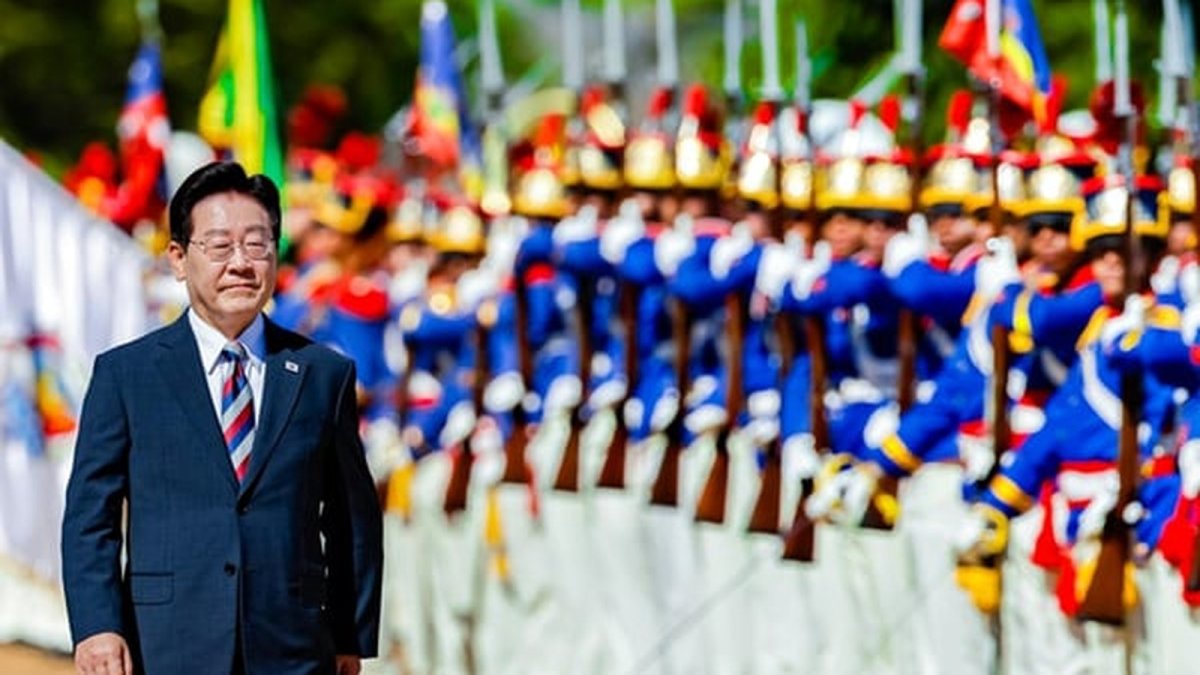
The Architecture of an Eleven-Day Presidential Journey
South Korean President Lee Jae-myung is concluding the longest overseas trip of his 14-month presidency, an 11-day itinerary that began in Silicon Valley and extended through Brazil, Chile, and a scheduled meeting in Argentina before a final stop in Frankfurt. The Blue House has positioned the tour as the operational core of its Global South diplomacy, an effort to diversify trade and diplomatic partnerships beyond the United States, China, and Japan. Brazil, Chile, and Argentina together represent a market of 280 million people with a combined GDP of $3.7 trillion, a scale the administration equates with the world's seventh-largest economy.
Silicon Valley Meetings and the San Francisco Declaration on AI
Lee opened the tour on July 24 with separate meetings in San Francisco involving Anthropic CEO Dario Amodei, OpenAI CEO Sam Altman, Nvidia CEO Jensen Huang, and Broadcom President and CEO Hock Tan. Policy chief Kim Yong-beom framed these encounters as direct support for the administration's three flagship megaprojects in semiconductors, AI data centers, and physical AI. At the San Francisco AI Summit on July 25, Lee presented the San Francisco Declaration on AI, committing South Korea to serve as a stable production base and supply-chain partner for AI chips even during global shortages. South Korean and U.S. companies concluded deals valued at $950 billion over five years, including a five-year, $200 billion arrangement between Samsung Electronics and Broadcom for advanced memory chips used in AI accelerators. The National Pension Service also signed a memorandum of understanding with a group of global venture capital firms to open channels into Silicon Valley startups.
In the context of intensifying global competition over advanced semiconductor technologies, South Korea's established strengths in high-bandwidth memory production position the country as a pivotal node within AI accelerator supply chains. These engagements underscore efforts to reinforce long-term partnerships that mitigate risks associated with concentrated production capacities and shifting export controls.
The San Francisco Declaration signals a deliberate policy orientation toward reliability as a supplier during periods of international strain, while the National Pension Service memorandum facilitates broader exposure to emerging innovation ecosystems. Such steps reflect ongoing strategies to diversify technological inflows without disrupting core industrial alignments.
Upgrading the Strategic Partnership with Brazil
Lee arrived in Brazil on July 26 for a state visit at the invitation of President Luiz Inacio Lula da Silva, marking the first such visit by a Korean leader since Park Geun-hye's trip in 2015. The July 27 summit at the Alvorada Palace produced a joint statement declaring 2026 the founding year of an upgraded strategic partnership. Seven memoranda of understanding were signed across industrial technology, space, energy, sports, education, film, and cybersecurity. The leaders also established a joint working group tasked with resuming long-stalled Korea-Mercosur trade negotiations, with a target of restarting talks by December. Brazil's position as holder of the world's second-largest rare earth reserves, approximately 21 million tons, placed critical-mineral supply chains at the center of the discussions.
Korea-Mercosur trade discussions have historically encountered repeated obstacles stemming from divergent agricultural and industrial priorities among member states, resulting in prolonged stagnation since earlier rounds. Brazil's substantial rare earth holdings offer a potential avenue for addressing South Korea's reliance on concentrated overseas sources for these materials essential to electronics manufacturing.
Setting a December target for resuming negotiations implies a structured push to establish incremental frameworks that could gradually integrate critical-mineral cooperation into wider commercial arrangements. This approach aligns with broader patterns of extending diplomatic outreach to resource-rich partners in Latin America.
Modernizing the Korea-Chile Free Trade Agreement
On July 29 Lee became the first South Korean president to visit Chile since Park Geun-hye's 2015 regional tour. The following day he and Chilean President Jose Antonio Kast agreed to revive the South Korea-Chile Free Trade Commission, dormant for a decade, and to modernize the free trade agreement that entered into force in 2004. Five memoranda of understanding were concluded on critical minerals and transnational crime. A partnership elevating the joint minerals committee to ministerial level was established to secure copper and lithium supplies valued at roughly $2.1 billion annually. These steps directly address South Korea's structural dependence on imported critical minerals for its semiconductor and battery industries.
As South Korea's inaugural free trade agreement, the 2004 pact with Chile carries enduring symbolic importance in demonstrating the viability of bilateral liberalization with resource-exporting economies. Reviving the associated commission after a decade of inactivity highlights renewed attention to updating provisions that support stable access to key inputs.
Copper and lithium remain foundational to Korea's battery and semiconductor sectors, where import dependencies create structural vulnerabilities. Elevating the minerals committee to ministerial status represents an institutional adaptation aimed at fostering more direct coordination on supply security and joint development initiatives.
Scheduled Engagements in Argentina and Germany
Lee is scheduled to meet Argentine President Javier Milei on July 31 at the Casa Rosada following a wreath-laying ceremony at Plaza San Martin. The visit would constitute the first bilateral meeting between Korean and Argentine presidents in 22 years. Seoul indicated ahead of the meeting that the agenda would center on building a supply-chain partnership around lithium. The final leg of the tour takes Lee to Frankfurt, Germany, next week, completing an itinerary that has sought to link technology investment pledges in the United States with mineral security arrangements in South America.
Strategic Implications for Korean Chaebol and Export Resilience
The tour illustrates how the Lee administration is leveraging presidential diplomacy to secure both upstream mineral inputs and downstream technology markets for Korea's export-led economy. Samsung Electronics' $200 billion commitment with Broadcom exemplifies the chaebol's continued centrality in translating diplomatic openings into concrete supply-chain contracts. By reviving the Korea-Mercosur talks and elevating the Chile minerals committee, Seoul is constructing institutional mechanisms that reduce exposure to single-source dependencies in rare earths, copper, and lithium. These moves align with the broader Global South diplomacy framework, which seeks to hedge against U.S.-China tensions while preserving South Korea's position as a trusted supplier of AI infrastructure components.
The sequence of visits illustrates South Korea's calibrated approach to balancing alignment with major technology partners against the need to cultivate alternative resource channels amid U.S.-China frictions. This hedging strategy seeks to preserve export competitiveness while reducing single-point exposures in upstream materials.
Critical-mineral legislation and related industrial policies emphasize coordinated state-chaebol mechanisms that translate presidential outreach into durable supply arrangements. Over time, these efforts may contribute to more resilient economic diplomacy frameworks that integrate Global South engagement with domestic technological priorities.
Historical Continuity and Future Diplomatic Pathways
Lee's itinerary consciously echoes Park Geun-hye's 2015 South American visits while extending their scope to encompass artificial intelligence and critical minerals. The emphasis on ministerial-level mineral committees and restarted trade negotiations signals an institutional approach designed to outlast any single administration. For a country whose economic security rests on uninterrupted access to semiconductors and battery materials, the agreements reached in San Francisco, Brasilia, and Santiago represent concrete steps toward diversified supply chains. The coming months will reveal whether the joint working group on Mercosur and the upgraded Chile minerals partnership can translate declarations into binding commercial outcomes.
By Prof. David Park, Staff WriterThis article was produced with AI-assisted research and editorial support. Reporting is based on sources cited in the article.
What's Your Reaction?
 Like
0
Like
0
 Dislike
0
Dislike
0
 Love
0
Love
0
 Funny
0
Funny
0
 Wow
0
Wow
0
 Sad
0
Sad
0
 Angry
0
Angry
0
East Asia/Technology Correspondent at Global1.News. Seoul-based voice covering Korean politics, technology, business, and culture. Analyzes how technology and geopolitics intersect across East Asia.










Comments (0)