
Kinshasa's To Skater Festival Carves a New Path for Congo's Urban Youth
In the heart of Kinshasa, where the Congo River hums beside a city of ten million dreams, a different kind of movement is gaining speed.
In the heart of Kinshasa, where the Congo River hums beside a city of ten million dreams, a different kind of movement is gaining speed. For three days this month, more than 500 young people gathered for the second edition of the To Skater Festival — a celebration of skateboarding, street art, and urban culture that is challenging the way the Democratic Republic of Congo sees its own creative youth.
Kinshasa's To Skater Festival Carves a New Path for Congo's Urban Youth
Kinshasa, DR Congo — The festival, which ran from August 7 to 9, brought together skaters, street artists, musicians, and filmmakers in a bold attempt to establish urban sports as an important part of Congo's cultural and sporting future. Organizers hope the momentum of this year's edition will change minds about a discipline still widely misunderstood across the country.
A Festival Born on Kinshasa's Streets
For three days in early August, the pulse of Kinshasa's youth culture could be felt in the sound of wheels rolling across concrete. The To Skater Festival, now in its second edition, turned the city into an open-air stage where skateboarding demonstrations and initiation clinics ran alongside street art performances, live music concerts, and film screenings. Young people from several zones of the sprawling capital came to watch, learn, and take part.
The festival's program was deliberately ambitious. Beginners received hands-on coaching from experienced skaters, while artists turned walls into canvases and musicians filled the air with the sounds of a city that has long been one of Africa's great music capitals. Film screenings offered another window into urban culture, and round-table discussions tackled the future of urban sports in the DRC.
More than 500 young participants passed through the festival over its three days — a powerful statement in a country where skateboarding is still finding its footing. The first edition arrived in 2025 as a celebration of skate and music culture, and this year's event built on that foundation with a wider artistic and sporting program.
For Kinshasa, a city whose cultural identity has been shaped by rumba and soukous, by painters and poets, the festival adds a new chapter to an old story: the city as a laboratory of African creativity. What makes this chapter different is the vehicle — a skateboard — and the generation pushing it forward.
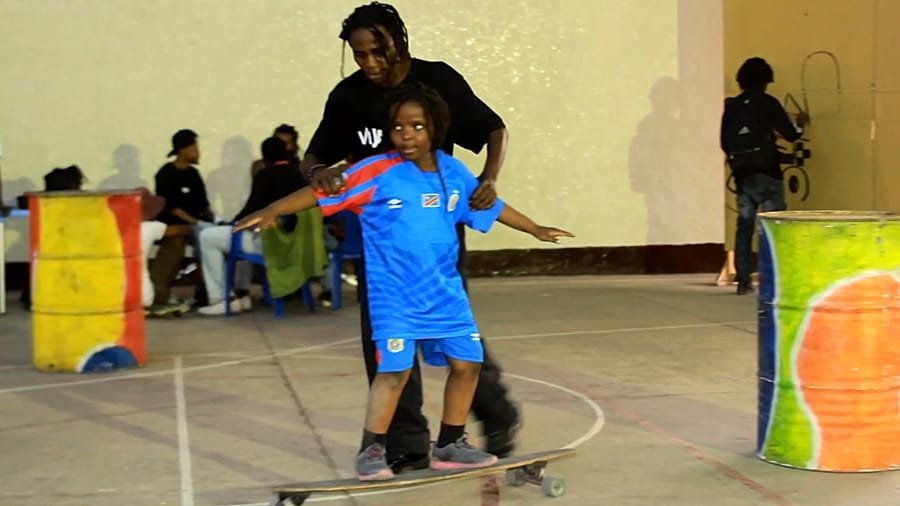
Challenging the Marginalization of Urban Sports
Behind the festival stands Eldie Malonga, a young Kinshasa skater who founded the To Skater Festival and serves as its director. His mission is simple to state but difficult to achieve: to make skateboarding and the urban arts visible in a country where they have long been pushed to the margins.
"The goal of the To Skater Festival is to promote skateboarding and urban arts in the DRC, encouraging young people to take their first steps in skateboarding, which is still not widely recognized in our country," Malonga told Africanews. "We want to highlight skateboarding and street art so people who marginalize these urban arts can change the way they see them."
The stigma Malonga describes is not unique to Congo. Across Africa, urban sports have often been viewed as a distraction — noise on the street, a foreign import, or a pastime for the idle. Skateboarders, in particular, have had to prove that their discipline demands skill, courage, and discipline of its own.
The festival is built as a direct answer to that skepticism. By pairing the sport with street art, music, and film, organizers make a cultural argument as much as a sporting one: these are not marginal activities but expressions of a generation finding its voice. When a young person sees a skater land a difficult trick, or an artist transform a wall, the perception begins to shift.
That cultural argument matters beyond the festival grounds. If urban sports become accepted as part of Congo's sporting landscape, they open doors to funding, facilities, coaching, and eventually international competition. The organizers are playing a long game, and the second edition suggests it is working.
Passing the Board to the Next Generation
One of the most striking features of this year's festival was the presence of veteran skaters eager to share what they know. Patrice Nelatera, a skateboard instructor and skater with the Kin Balabala club, came to the festival to work with young amateurs from across Kinshasa — part of a deliberate effort to build a bridge between generations.
"Skateboarding is a form of street art passed from one generation to the next," Nelatera said. "We're here to skate, but as we grow older, skateboarding will remain as a legacy for the younger generation. That's why we're here — to share that heritage."
That sense of inheritance is what separates a scene from a passing fad. In Kinshasa, the skateboard community is small but determined, and clubs like Kin Balabala are quietly building the infrastructure of a sport: regular practice, mentorship, and a growing roster of young riders.
The mentorship model on display at the festival mirrors traditions across African culture, where knowledge is passed from elders to the young — through music, through craft, and now through sport. A skater teaching a beginner to balance on a board is, in its own way, continuing that tradition.
For the younger skaters, the presence of role models who look like them and speak their language is transformative. It is one thing to watch skateboarding on a screen from afar; it is another to have a coach place a hand on your shoulder, correct your stance, and tell you to try again.
New Dreams, New Ambitions
Among the beginners at the festival was Atosha Goodlife, a young woman who stepped onto a skateboard for the first time and found a new direction. Her words capture the quiet revolution taking place: "Learning to skateboard makes me happy because many people still don't know how to skate. One day, I'd like to represent my country in major skateboarding competitions and then teach other young people what I've learned."
Goodlife's ambition — to compete for the DRC on the international stage and then pass on her knowledge — is exactly the cycle the festival hopes to create. And her presence speaks to another important theme: the place of women in urban arts and sports, which was one of the subjects addressed in the festival's conferences.
Across Africa, women are claiming space in skateboarding and other urban sports, often against cultural expectations. Festivals like To Skater matter because they make that space visible, normalizing the image of young women on boards, on stage, and in creative industries.
The festival also hosted discussions on the future of creative industries in the DRC, connecting the skate scene to a wider conversation about how young Congolese can build careers from their talents. From skateboarding to street art to music production, the creative economy is one of the most dynamic — and underfunded — sectors on the continent.
For a beginner like Goodlife, those conversations may feel distant. But the dream of representing one's country is not. Every young skater who leaves the festival with a new skill and a bigger ambition is evidence that the seeds planted in Kinshasa are already taking root.
Beyond the Board: Street Art, Music, and Creative Industries
The To Skater Festival is deliberately more than a sporting event. Its three-day program unfolded as a full celebration of urban culture, with street art performances that transformed public spaces, concerts that drew on Kinshasa's legendary musical energy, and film screenings that gave young creators a platform.
This holistic approach reflects a deeper truth about urban culture in Africa: the lines between sport, art, and music are thin. The same creative impulse that drives a skater to master a new trick drives a graffiti artist to master a wall, or a producer to master a beat. Festivals that recognize this connection are better positioned to nurture the whole ecosystem.
Kinshasa is the perfect backdrop for that vision. The city has shaped African music for generations — from the golden age of rumba to the electric energy of modern soukous and contemporary hip-hop — and its visual artists are celebrated across the continent. Adding skateboarding to that mix is not a departure from Kinshasa's identity; it is an extension of it.
The festival's conferences on the future of creative industries in the DRC pointed toward the economic stakes. Young Africans are already building careers in fashion, film, music, and digital content, often with little institutional support. Urban sports and the culture around them are part of that economy, and events like To Skater help demonstrate their value to policymakers and investors alike.
There is also a tourism dimension. Cultural festivals draw visitors, generate coverage, and put cities on the map. A successful skate festival, repeated year after year, becomes part of Kinshasa's cultural calendar — a reason for the world to look at the DRC not only through the lens of its challenges, but through the lens of its creativity.
Africa's Skateboarding Momentum and What to Watch For
The To Skater Festival arrives at a moment of continental momentum for skateboarding. In Nairobi, Kenya's skate scene has grown into a lively community with Olympic aspirations, celebrated for its creativity and inclusivity. South Africa has an underground skate culture, especially in Johannesburg, that has produced riders and artists with international followings. From Dakar to Dar es Salaam, young Africans are finding the board as a vehicle for expression and ambition.
Skateboarding's inclusion in the Olympic program — debuting at the Tokyo 2020 Games and returning at Paris 2024 — has given the sport a legitimacy it never had before. For African federations and grassroots communities, that global stage is both inspiration and opportunity. The question is whether the infrastructure and recognition will follow.
The organizers of the To Skater Festival hope their event will help answer that question for the DRC, establishing urban sports as an important part of Congo's cultural and sporting future. The second edition's success — 500 young people, a full artistic program, and a growing community — suggests the foundation is being laid.
What comes next will depend on sustaining that momentum. A third edition is the natural next step, and with it, hopes of more facilities, more sponsors, and more young Congolese discovering what a skateboard can offer. The festival's conferences have already started the conversation about where the sport goes from here.
For Africa's creative youth, the message of the To Skater Festival is simple and powerful: the streets belong to them, and what they build there deserves to be seen. From the banks of the Congo River, a generation is rolling forward — and it is not slowing down.
By Amara Diop, Staff Writer
This article was produced with AI-assisted research and editorial support. Sources: africanews (August 10, 2026).
What's Your Reaction?
 Like
0
Like
0
 Dislike
0
Dislike
0
 Love
0
Love
0
 Funny
0
Funny
0
 Wow
0
Wow
0
 Sad
0
Sad
0
 Angry
0
Angry
0
West Africa/Sahel Correspondent at Global1.News. Dakar-based journalist covering politics, security, climate, and development across Francophone and Anglophone West Africa. Tells the stories of a region undergoing profound transformation.









Comments (0)