
Israeli military court sentences Palestinian journalist to 4 years for 'incitement'
An Israeli military court on Tuesday sentenced Palestinian journalist and academic Mahmoud Fatafta to four years in prison on charges of so-called “incitement,” according to a statement from the Palestinian Journalists’ Syndicate.
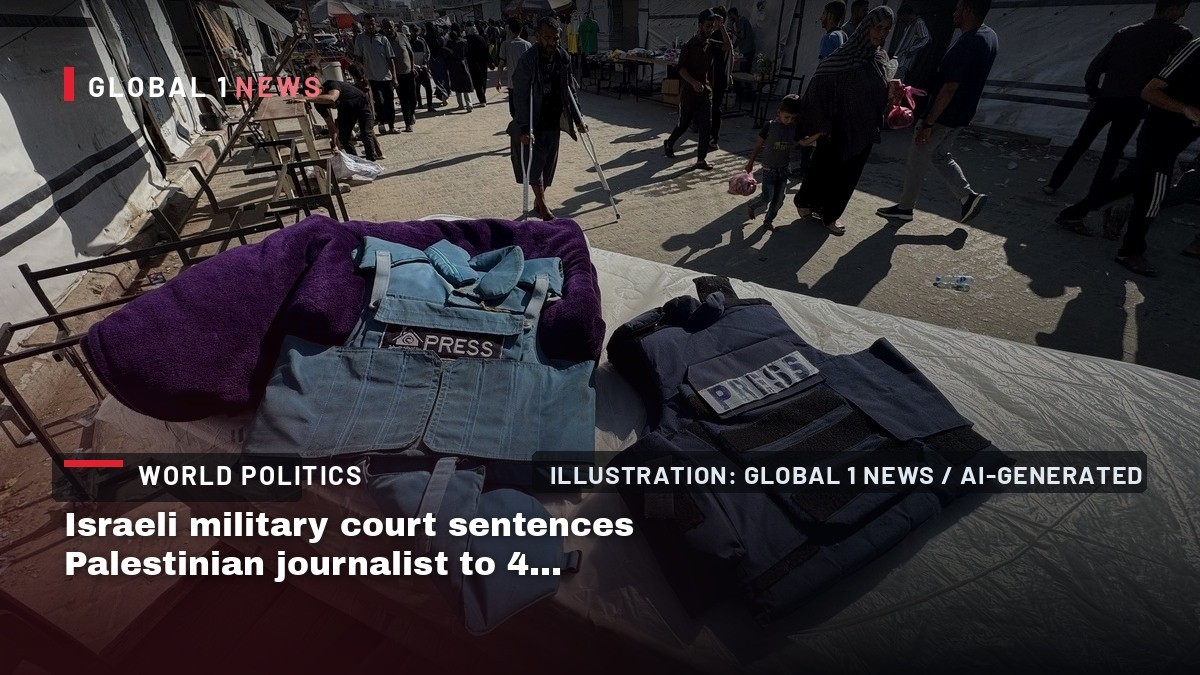
An Israeli military court on Tuesday sentenced Palestinian journalist and academic Mahmoud Fatafta to four years in prison on charges of so-called “incitement,” according to a statement from the Palestinian Journalists’ Syndicate. The syndicate condemned the ruling as “a new chapter in the targeting of Palestinian journalists and a systematic attempt to silence voices and suppress freedom of opinion and expression,” warning that the military justice system is being weaponized to punish media workers for carrying out their professional duties.
A Four-Year Sentence Handed Down in a Military Court
The sentence was delivered on Tuesday, 8 September 2026, by an Israeli military court operating in the occupied West Bank. The Palestinian Journalists’ Syndicate, which first reported the verdict, said Fatafta was convicted on charges of “incitement,” a term it described as a broad and vague pretext used by Israeli authorities to pursue journalists, activists, and ordinary citizens expressing their views. Fatafta, a columnist, political commentator, and professor of politics and media at the Arab American University in Ramallah and the Palestinian Technical University-Khadoury, has been in Israeli custody since late May 2024. The syndicate said he was arrested on 30 May 2024 while passing through the Container checkpoint northeast of Bethlehem in the southern occupied West Bank. The Committee to Protect Journalists (CPJ) documented the arrest as occurring on 29 May 2024 at a checkpoint near the West Bank village of Abu Dis, while Fatafta was driving with his son to Tarqumiyah, northwest of Hebron. His then-10-year-old son was left at the checkpoint until a relative could travel from Ramallah to collect him. The discrepancy in dates between the syndicate’s account and CPJ’s documentation reflects the chaotic circumstances surrounding the arrest, but both organizations place the detention in the same area and timeframe. Fatafta was initially held at a police station in the Israeli settlement of Ma’ale Adumim before being transferred to Ofer prison in the occupied West Bank, according to his wife, Rasha, who spoke to CPJ in November 2024.Who Is Mahmoud Fatafta?
Fatafta is not a street reporter or a wire-service stringer. He is an established academic and commentator who regularly appears on television and radio to analyze the war in Gaza and its regional implications. He contributes columns and commentary to the Wattan Media Network, among other outlets, and holds professorships at two Palestinian universities in the West Bank. His case has drawn attention not because he was caught documenting sensitive military movements or embedded with armed groups, but because of his public writing and commentary. According to his wife, Rasha, Fatafta was charged with incitement over social media posts. The syndicate said the charges stem from his journalistic work and expression of his views, asserting that prosecuting journalists in Israeli military courts for such activity constitutes “a flagrant violation of international law and international humanitarian law.” PEN International has listed Fatafta as a writer at risk, underscoring the concern that his prosecution is part of a broader pattern targeting Palestinian voices rather than an isolated legal matter.
The Syndicate’s Condemnation and Broader Warning
In its statement condemning the sentence, the Palestinian Journalists’ Syndicate framed the ruling as part of an ongoing Israeli policy of pursuing, arresting, and prosecuting Palestinian journalists in an attempt to “hide the Palestinian narrative and silence voices reporting the truth about what is happening on the ground.” The syndicate argued that the military court system is being used to punish and intimidate journalists, preventing them from carrying out their professional duties. It said “incitement” charges have become a catch-all tool, applied broadly to journalists, activists, and individuals expressing their views, in violation of the right to freedom of expression and journalistic work. The statement reflects a growing frustration among Palestinian media organizations, who say that the Israeli military court system operates outside the protections normally afforded to journalists under international law. Military courts in the occupied West Bank try Palestinians under military orders rather than civilian law, a system that human rights organizations have long criticized as lacking due process guarantees.A Wider Pattern: Journalists Detained Since October 2023
Fatafta’s case is not an anomaly. CPJ has documented the detention of at least 94 Palestinian journalists and one media worker between October 2023 and January 2026. That figure includes 32 journalists and one media worker from Gaza, 60 from the West Bank, and two in Israel. As of 17 February 2026, thirty of those journalists remained in custody. The scale of detentions points to a systematic approach rather than isolated incidents. Journalists covering the war in Gaza and its aftermath have faced arrest, administrative detention, and prosecution in military courts across the occupied territories. The West Bank has seen a particularly sharp increase in detentions of journalists since the war began, with many held without charge under administrative detention orders. CPJ’s documentation shows that Fatafta is one of many Palestinian journalists whose work has made them targets. His arrest in May 2024 came during a period of intense Israeli military operations in the West Bank, and his subsequent prosecution on incitement charges fits a pattern of using vague legal categories to detain media workers.Conditions in Israeli Prisons: Torture and Abuse Allegations
The treatment of detained Palestinian journalists has become a matter of grave concern. In February 2026, CPJ published a report titled “‘We returned from hell’: Palestinian journalists recount torture in Israeli prisons,” which documented widespread allegations of abuse. The report found that of 59 journalists released by Israel during the period covered, all but one reported being subjected to what they described as torture, abuse, or other forms of violence while in Israeli custody. More than 80 percent of the Palestinian journalists interviewed—48 of 58—had never been charged with any crime and were held under Israel’s administrative detention system, which allows for indefinite detention without trial. CPJ CEO Jodie Ginsberg said in connection with the report: “The scale and consistency of these testimonies point to something far beyond isolated misconduct. When dozens of journalists independently describe physical and psychological abuse, the international community must take action.” Fatafta’s case differs from those held under administrative detention in that he was formally charged and tried. But the allegations of abuse in the broader journalist prisoner population raise questions about the conditions he may have faced during his more than two years in custody. His wife told CPJ in November 2024 that he was being held at Ofer prison, and in April 2026, his son Sharaf told CPJ that his father had been transferred to Nafha prison, also known as Ganot. A court hearing scheduled for 15 April 2026 was delayed to 17 May 2026, according to Sharaf.
The Military Court System and the ‘Incitement’ Charge
The use of military courts to try Palestinian journalists is a central point of contention. The Palestinian Journalists’ Syndicate said prosecuting journalists in these courts over their journalistic work or expression of their views is a violation of international law and international humanitarian law. The military justice system, the syndicate said, is being used to punish and intimidate journalists and prevent them from carrying out their professional duties. The charge of “incitement” is particularly problematic, according to the syndicate, because it has become a broad pretext used by Israeli authorities to pursue journalists, activists, and people expressing their views. The vagueness of the charge allows authorities to target individuals based on content that would be protected speech in most legal systems. For Fatafta, a commentator who regularly analyzes the war in Gaza, the line between analysis and “incitement” appears to have been drawn by Israeli military prosecutors reviewing his social media posts. His conviction sends a chilling signal to other Palestinian journalists and commentators that their work could result in prosecution.What This Case Means for Press Freedom and the Palestinian Narrative
The sentencing of Fatafta comes at a time when the Palestinian media landscape is under severe strain. Journalists in Gaza have faced extraordinary dangers during the war, with many killed, injured, or displaced. In the West Bank, the primary threat has been detention and prosecution. The syndicate’s statement explicitly linked Fatafta’s case to a broader effort to “hide the Palestinian narrative and silence voices reporting the truth about what is happening on the ground.” This framing reflects a belief among Palestinian journalists that their work is seen by Israeli authorities as a threat not because it is inaccurate, but because it presents a perspective that challenges the official Israeli narrative. Fatafta’s case also highlights the particular vulnerability of Palestinian journalists who work in both academic and media settings. As a professor and a commentator, he occupies a role that amplifies his voice, making him a target for authorities seeking to suppress critical analysis of the war and occupation.The International Accountability Question
The international community has repeatedly expressed concern about the treatment of Palestinian journalists, but concrete action has been limited. CPJ’s documentation of detentions and abuse has been cited by human rights organizations and press freedom advocates, yet Israeli authorities have continued to arrest and prosecute journalists. The syndicate’s condemnation of Fatafta’s sentence is likely to be echoed by international press freedom groups, but whether that translates into meaningful pressure on Israel remains uncertain. CPJ’s Ginsberg has called on the international community to take action in response to the abuse allegations, but no major diplomatic consequences have followed the publication of the February 2026 report. For Fatafta, the four-year sentence means more time away from his family, his students, and his readers. His son Sharaf, who was a child when his father was arrested, has been communicating with CPJ about his father’s condition. The family has not issued a public statement about the sentence as of this writing, and figures on how many journalists remain in Israeli custody were most recently documented by CPJ as of 17 February 2026, when thirty were reported held. The case raises fundamental questions about the ability of Palestinian journalists to work without fear of prosecution. If expressing views critical of Israeli policy is treated as a crime punishable by years in prison, the space for independent journalism in the occupied territories will continue to shrink. The Palestinian Journalists’ Syndicate has made clear that it views Fatafta’s sentence as part of a systematic campaign, and the evidence documented by CPJ supports that assessment. This article was produced with AI-assisted research and editorial support. Sources: Middle East Monitor (middleeastmonitor.com) and the Committee to Protect Journalists (cpj.org). By Fatima Al-Rashid, Staff WriterWhat's Your Reaction?
 Like
0
Like
0
 Dislike
0
Dislike
0
 Love
0
Love
0
 Funny
0
Funny
0
 Wow
0
Wow
0
 Sad
0
Sad
0
 Angry
0
Angry
0

Fatima Al-Rashid
Gulf/MENA Correspondent at Global1.News. Based in Doha, covering Gulf politics, energy markets, diplomacy, and development across the Middle East and North Africa. Tracks the economic transformation of the Gulf states.












Comments (0)