
Resto in 'residential' land? Defense witness' answer draws senator-judge's ire
Manila — As the impeachment trial of Vice President Sara Duterte reaches its final stretch, a seemingly routine question about a single lot in Davao City has sparked a heated exchange that underscores the broader struggle over transparency and public trust.
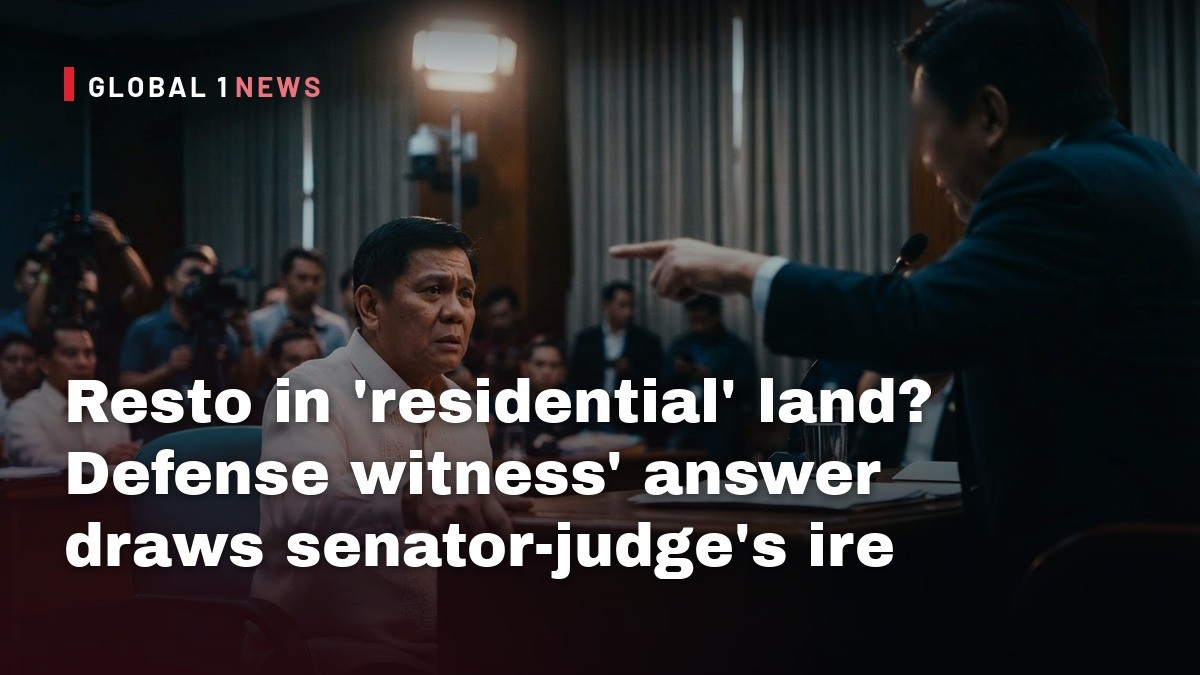
Manila — As the impeachment trial of Vice President Sara Duterte reaches its final stretch, a seemingly routine question about a single lot in Davao City has sparked a heated exchange that underscores the broader struggle over transparency and public trust. Senator‑Judge Raffy Tulfo, known for his hard‑hitting style, accused the vice president’s first defense witness of “lying through his teeth” when the witness tried to reconcile a property listed as residential on the official Statement of Assets, Liabilities and Net Worth (SALN) with its actual use as a bustling restaurant called Prime Bistro. The clash, captured in the Senate hearing on November 9, 2026, reflects the intense scrutiny of Duterte’s wealth that has become a litmus test for accountability in Philippine politics.
The contested property: a residential lot turned restaurant
At the center of the dispute is a parcel of land in Davao City marked “910” on the city’s property identification map. The lot is covered by a Transfer Certificate of Title ending in 775 and is listed in Vice President Duterte’s SALN as a “residential lot.” In reality, the same parcel hosts Prime Bistro, a commercial establishment that serves diners and operates as a full‑service restaurant.
Defense counsel called Davao City Assessor Jaime Adalin to explain the apparent mismatch. Adalin testified that the property in question is indeed the same one declared in Duterte’s SALN, but he emphasized that a building can be classified as commercial while its actual use is residential. “There are times na commercial ang building pero ang gamit is residential,” he said, suggesting that the classification on tax records does not always reflect how the space is occupied.
Senator‑Judge Tulfo’s sharp rebuke
Senator‑Judge Raffy Tulfo, who presides over the impeachment proceedings, reacted with visible frustration. He accused Adalin of “lying through his teeth,” arguing that the presence of a dining sign and a fully equipped restaurant could not be dismissed as a mere technicality. “It’s clearly stated that Prime Bistro is commercial… He said it was commercial, but it’s being used as residential. He’s lying through his teeth, making it look as though he’s taking us for fools,” Tulfo asserted, echoing the sentiment of many Filipinos who feel that public officials should not be allowed to mask commercial interests behind residential labels.
Tulfo’s pointed question—“So you set up a dining area, you put up a sign, just so you could sleep there?”—highlighted the perception that the defense was attempting to blur the line between personal wealth and public service. The exchange resonated beyond the Senate floor, reminding barangay leaders and sari‑sari store owners that the integrity of elected officials directly impacts everyday life.
Financial details of the Prime Bistro property
The National Bureau of Investigation (NBI) previously flagged the Prime Bistro site as part of a broader probe into the Duterte couple’s asset declarations. Records presented during the trial reveal that the land’s assessed value stands at about P82,000, while the combined market value of the land and the building, according to tax declarations, is roughly P9 million. Duterte’s own SALN, however, lists an acquisition cost of P10 million for the same property.
These figures, while modest compared to the multi‑billion‑peso assets often discussed in high‑profile corruption cases, have become symbolic. They illustrate the gap between what is declared and what is observed on the ground—a gap that fuels public suspicion and calls for stricter oversight by agencies such as the Office of the Ombudsman and the Commission on Elections.
The legal backdrop: Article II of the impeachment
Only one charge remains against Vice President Duterte: Article II, which alleges that she amassed unexplained wealth and failed to fully disclose assets belonging to herself and her husband, lawyer Manases Carpio, in their SALNs for the years 2022 to 2024. The article also accuses her of not divesting from business interests while serving as vice president from 2022 to 2025.
The Prime Bistro case is a microcosm of this broader accusation. By linking the property to Carpio—who is listed as the registered owner of the land—the prosecution aims to demonstrate that the couple’s wealth has been funneled through family holdings, thereby evading full transparency. The defense, meanwhile, leans on technical explanations like Adalin’s, hoping to show that the classification discrepancy does not constitute a deliberate concealment.
Implications for ordinary Filipinos
Beyond the legal jargon, the dispute touches the daily concerns of ordinary Filipinos. In many barangays, the line between residential and commercial spaces is fluid; a family may run a small eatery out of their home, blurring the categories used by tax authorities. However, when high‑ranking officials are seen to exploit this fluidity for personal gain, it erodes trust in institutions that already struggle with perceptions of corruption.
For OFWs sending remittances home, for students paying tuition at public schools, and for jeepney drivers navigating the streets of Manila, the principle remains the same: public officials must be held accountable for any attempt to hide wealth behind technical loopholes. The Prime Bistro episode serves as a reminder that transparency is not a luxury but a necessity for a functioning democracy.
What the Senate hearing reveals about the defense strategy
The defense’s reliance on the testimony of a local assessor highlights a tactical shift. Rather than contesting the existence of the property, the defense seeks to reinterpret its classification, arguing that the SALN’s “residential” label does not automatically imply a lack of commercial activity. By invoking the notion that a building can serve dual purposes, the defense hopes to create reasonable doubt about intentional misrepresentation.
Adalin’s statement that “Nakalagay na nga ‘yung Prime Bistro, commercial ‘yun… Sabi niya commercial pero ginagamit residential” underscores this approach. He acknowledges the commercial signage while insisting that the underlying use aligns with the residential classification. Whether this nuanced argument will satisfy the Senate’s standards of proof remains to be seen, but it illustrates the complexity of property law in the Philippines, where tax maps, land titles, and SALN entries often speak different languages.
Looking ahead: the stakes for the impeachment and public trust
As the impeachment trial draws to a close, the Prime Bistro controversy may seem like a small piece of a larger puzzle. Yet it encapsulates the core issue at stake: whether elected officials can be trusted to disclose their wealth honestly, and whether the mechanisms of accountability—such as the Senate’s impeachment power and the NBI’s investigative role—are robust enough to uncover hidden assets.
The outcome will reverberate through the halls of Congress, the offices of the Department of Justice, and the homes of ordinary Filipinos who watch with a mixture of hope and skepticism. If the Senate finds that the Vice President’s SALN disclosures were indeed misleading, it could set a precedent that strengthens the culture of transparency and reinforces the principle that no one is above the law. Conversely, a dismissal of the charge may deepen cynicism, prompting citizens to demand even stricter oversight from the Commission on Elections and the Office of the Ombudsman.
In the end, the story of a restaurant tucked into a residential lot is more than a footnote; it is a mirror reflecting how the nation grapples with the balance between legal technicalities and the moral expectations of public service. As the nation watches, the hope is that the process—messy, contentious, and deeply human—will ultimately reaffirm the democratic ideals that bind the Filipino people together in bayanihan.
This article was produced with AI-assisted research and editorial support. Reporting is based on the source material cited below. Sources: Philstar.com; Global1.News (09 November 2026).
By Bella Reyes, Staff Writer
What's Your Reaction?
 Like
0
 Dislike
0
 Love
0
 Funny
0
 Wow
0
 Sad
0
 Angry
0

Philippines/Southeast Asia Correspondent at Global1.News. Manila-based journalist covering Philippine politics, environment, maritime security, and social issues. Passionate about marine conservation and the communities protecting the Philippines' natural heritage.














Comments (0)