
Israeli drone strike on crowded Gaza cafe kills 6 Palestinians, eyewitnesses and medical sources say
GAZA CITY — The sea breeze that usually carries the scent of salt and grilled fish through Gaza City's port district was replaced Tuesday evening by smoke, dust, and the cries of survivors. An Israeli drone strike targeted a crowded beachfront cafe in the port area, killing six Palestinians, including a child, and wounding more than a dozen others, according to eyewitnesses and medical sources who spoke to Anadolu Agency.
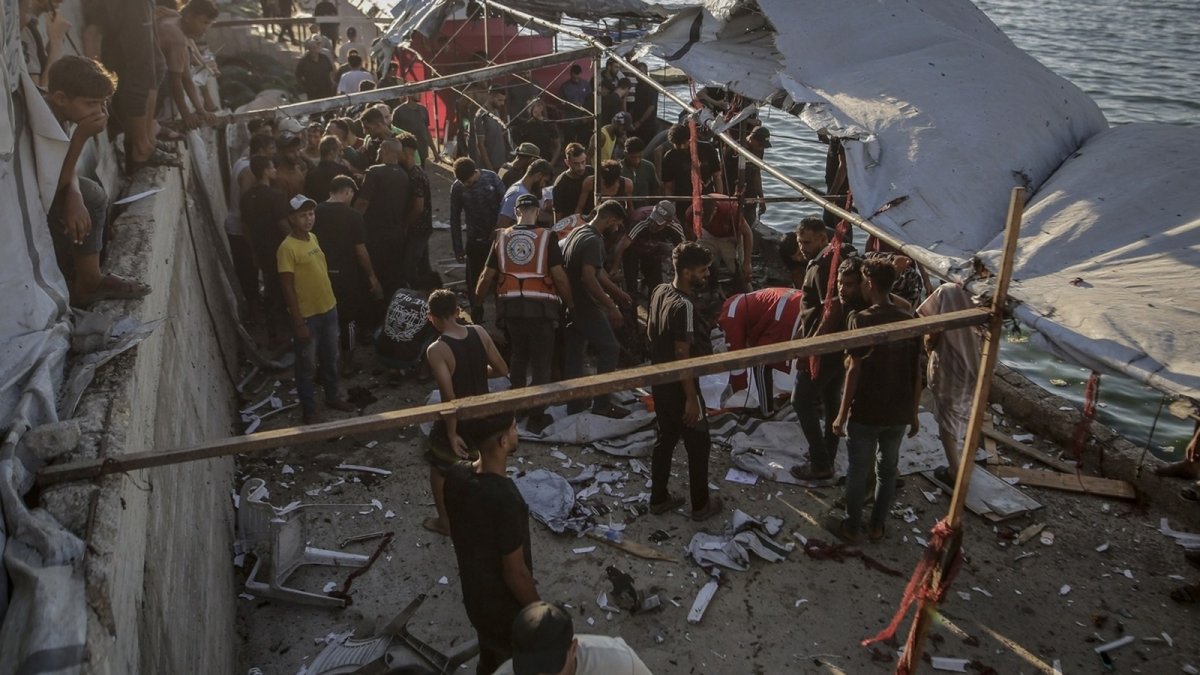
GAZA CITY — The sea breeze that usually carries the scent of salt and grilled fish through Gaza City's port district was replaced Tuesday evening by smoke, dust, and the cries of survivors. An Israeli drone strike targeted a crowded beachfront cafe in the port area, killing six Palestinians, including a child, and wounding more than a dozen others, according to eyewitnesses and medical sources who spoke to Anadolu Agency.
The attack, which involved at least two missiles fired from an unmanned aerial vehicle, according to witnesses, struck as the cafe was filled with families and young men enjoying an evening that had been quieter than most. In the immediate aftermath, the bodies of the dead and the severely wounded were rushed to nearby hospitals, a medical source told Anadolu. The precise number of those injured remained fluid Tuesday night, with figures not immediately available from Gaza's Health Ministry.
The Attack: A Quiet Evening Shattered
The port of Gaza City, known locally as the "sea port," has long been a gathering place for residents seeking respite from the grinding conditions of life under blockade and war. The cafe that was struck sits along the waterfront, a spot that had become popular in recent months as families sought to reclaim some semblance of normalcy during a fragile ceasefire that has been repeatedly violated.
Witnesses described a scene of sudden, catastrophic violence unfolding without warning. According to eyewitness accounts reported by Anadolu Agency, people were drinking tea and children were playing nearby when the first missile hit, with the second striking moments later as panicked survivors attempted to pull the wounded from the rubble and debris.
The targeting of a civilian gathering place, particularly one frequented by families, raises serious questions under international humanitarian law, which prohibits attacks that do not distinguish between combatants and civilians or that cause disproportionate harm to civilian life. The beachfront cafe had no visible military infrastructure, according to witnesses, and was not located near any known military installation.
Eyewitness Accounts: 'There Was No Safe Place'
Local journalists and first responders who arrived at the scene described a chaotic and heart-wrenching tableau. Ambulances navigated narrow streets clogged with debris and onlookers, while medics worked to stabilize the wounded. In the immediate wake of the strike, the bodies of those killed and the severely injured were taken to nearby hospitals, a medical source and eyewitnesses told Anadolu Agency.
The port area of Gaza City, including the Al-Shati refugee camp to the west, has been a recurring target throughout the war. Al-Shati, one of the most densely populated areas in the Gaza Strip, has seen repeated Israeli bombardments since October 2023, displacing thousands of families who have since lived in makeshift shelters or with relatives in other parts of the city.
For many Palestinians, Tuesday's strike is a grim reminder that no place—not even a seaside cafe—is beyond the reach of Israeli fire. Residents of the port district expressed despair at the recurrence of strikes on civilian gathering places, noting that areas designated as "safe zones" during the war have themselves been hit repeatedly, leaving families with nowhere to turn.
Israel's Account: Claims of Targeting Hamas Commanders
The Israeli army issued a statement claiming the attack had targeted Hamas commanders operating in the Al-Shati area west of Gaza City, alleging that the group had been planning attacks on Israeli forces. Israeli Army Radio, citing an unnamed security source, claimed the strike had killed four Hamas commanders who had gathered at the cafe, including a "company commander" and three "faction commanders."
Hamas, for its part, has yet to issue a statement on the Israeli claims. The group has historically denied using civilian infrastructure for military purposes, and no independent verification of the Israeli military's assertions was immediately available. In previous incidents during the war, Israeli claims about targeted killings have been challenged or disproven by on-the-ground reporting.
The use of an unnamed security source to brief Israeli media is a common practice, allowing the military to shape the narrative without subjecting its claims to direct scrutiny. In past strikes, on-the-ground reporting has sometimes shown victims of such targeted operations to be civilians, including journalists, medical workers, and children.
The Ceasefire Under Strain: A Truce in Name Only
Tuesday's drone strike is the latest in a long series of Israeli violations of a ceasefire deal that ostensibly went into effect last October (2025). The agreement, brokered after months of intense international diplomacy, was intended to halt the fighting and allow for the delivery of humanitarian aid to Gaza's besieged population. Instead, it has been marked by near-daily Israeli incursions, airstrikes, and drone attacks.
According to Gaza's Health Ministry, which is run by Hamas, repeated Israeli breaches of the truce agreement have killed 1,266 Palestinians and left another 4,200 injured since the ceasefire was declared. These figures, which are compiled from hospital records and do not distinguish between civilians and combatants, underscore the extent to which the "ceasefire" has failed to provide the protection that civilians were promised.
The United States and other mediators have repeatedly called on Israel to honor the terms of the agreement, with a US envoy recently urging Israeli Prime Minister Benjamin Netanyahu to "not create obstacles" in the Gaza peace plan, according to a report from Middle East Monitor. Those appeals have done little to change the reality on the ground, where Israeli forces continue to operate with near-total impunity.
The Broader Human Toll: A War Without End
Tuesday's deaths add to a staggering and ever-growing toll. More than 73,000 Palestinians have been killed—and over 174,000 others injured—since Israel began its genocidal war on the Gaza Strip in October 2023, as Middle East Monitor's reporting describes it. These figures, compiled by the Hamas-run Health Ministry, are cited by the United Nations and international agencies, which note they cannot independently verify them. They represent one of the highest civilian death tolls of any conflict in the 21st century.
The majority of those killed have been women and children, according to UN agencies, which have repeatedly described the scale of destruction as "unprecedented." Entire neighborhoods have been reduced to rubble, hospitals have been bombed and besieged, and the vast majority of Gaza's 2.3 million residents have been displaced from their homes, many of them multiple times.
The psychological toll is equally devastating. Children who have known nothing but war, who have never experienced a full school year or a night without the sound of drones overhead, are growing up in a landscape of trauma and loss. Mental health professionals in Gaza have warned of a generation that will carry the scars of this war for decades to come.
What Comes Next: A Fragile Hope Under Fire
The international community's response to the ongoing violations has been marked by a combination of diplomatic hand-wringing and continued military and political support for Israel. The United States, Israel's closest ally, has continued to provide billions of dollars in military aid, even as it publicly calls for restraint. European nations have issued statements of concern but have taken little concrete action to hold Israel accountable.
For Palestinians in Gaza, the question of what comes next is not one of politics but of survival. Each day brings the possibility of another strike, another funeral, another family wiped out in an instant. The ceasefire, such as it is, has provided only a partial and precarious reprieve from the full-scale bombing campaigns of the war's first year, but it has not brought safety or security.
Efforts to negotiate a more permanent end to the conflict continue, with mediators shuttling between regional capitals. But the repeated violations of the current truce, and the apparent unwillingness of the Israeli government to rein in its military, cast a long shadow over any prospects for a lasting peace. For residents of Gaza City, the sense of suspended life is pervasive — waiting for the next strike, waiting for the next funeral, waiting for someone, anyone, to stop the violence.
The bodies of those killed Tuesday, including the child, were taken to nearby hospitals in Gaza City, where medical staff already overwhelmed by months of casualties continued to treat the wounded through the night. The full list of casualties was expected to be released by the Health Ministry in the coming hours.
This article was produced with AI-assisted research and editorial support. Sources: Middle East Monitor, Anadolu Agency.
By Fatima Al-Rashid, Staff Writer
What's Your Reaction?
 Like
0
Like
0
 Dislike
0
Dislike
0
 Love
0
Love
0
 Funny
0
Funny
0
 Wow
0
Wow
0
 Sad
0
Sad
0
 Angry
0
Angry
0

Gulf/MENA Correspondent at Global1.News. Based in Doha, covering Gulf politics, energy markets, diplomacy, and development across the Middle East and North Africa. Tracks the economic transformation of the Gulf states.













Comments (0)