
Israeli defense chief renews threat to punish Gaza for flying kites
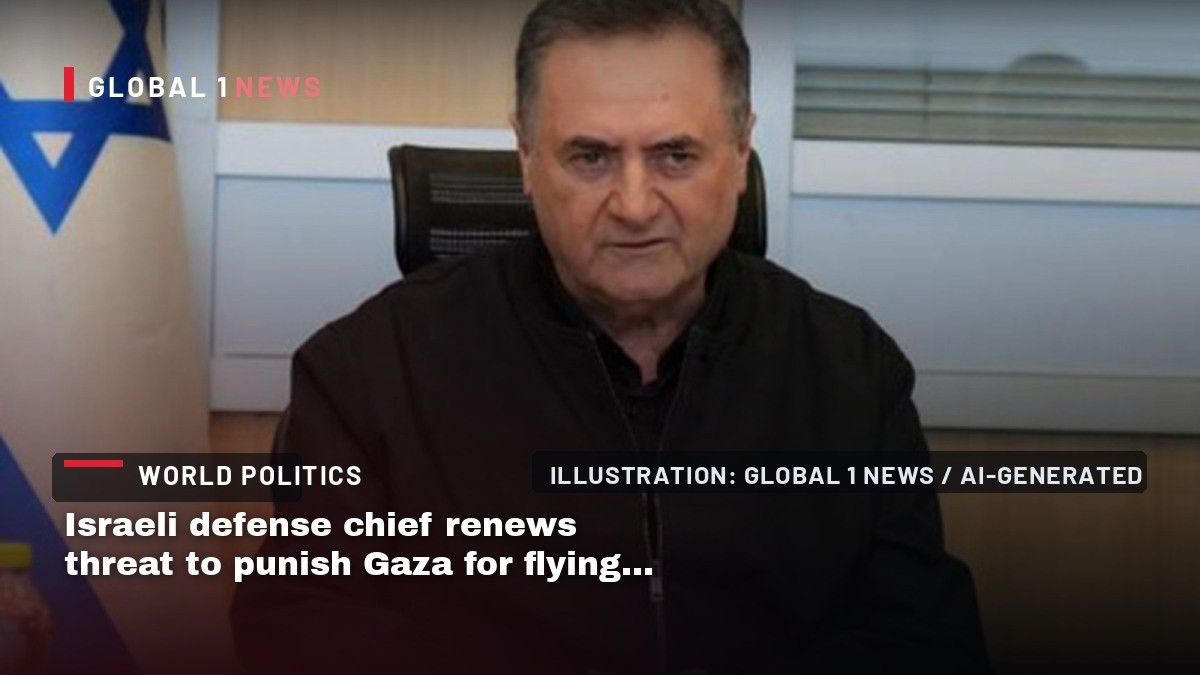
Israeli defense chief renews threat to punish Gaza for flying kites Gaza Strip — Israeli Defense Minister Israel Katz on Thursday renewed his threat to expel Palestinians from any area in the Gaza Strip from which kites or balloons are flown, a warning that UN human rights officials have condemned as a violation of international law and that has already pushed local families to keep their children indoors.
Israeli defense chief renews threat to punish Gaza for flying kites
Gaza Strip — Israeli Defense Minister Israel Katz on Thursday renewed his threat to expel Palestinians from any area in the Gaza Strip from which kites or balloons are flown, a warning that UN human rights officials have condemned as a violation of international law and that has already pushed local families to keep their children indoors.
Katz issued the latest ultimatum during a high-level security meeting with army chief Eyal Zamir, the head of Israeli air defense, and other top military officials, according to a statement released by his office. The defense minister said the warning came after balloons and kites were flown from areas inside the Gaza Strip, and he vowed that such launches would be met with a "firm response" against those responsible and against the areas from which they were flown.
"Based on the instructions of Prime Minister Benjamin Netanyahu and my instructions, the Israeli army will use all necessary tools, including evacuating Gaza residents from any area or neighborhood from which [kite and balloon] launches are carried out," Katz said.
The threat marks the second time in less than a week that senior Israeli officials have raised the prospect of mass displacement over an activity that, in ordinary circumstances, would be considered child's play. Katz and Netanyahu issued similar warnings on Sunday, threatening stepped-up assassinations and expulsions of Palestinians in the Gaza Strip if the flying of kites and balloons toward Israel did not stop.
A threat that targets children's play
The objects at the center of the military escalation are lightweight kites, typically flown by children and controlled by strings pulled from the ground. If a string breaks, wind can carry the kites beyond the Gaza Strip toward nearby Israeli communities, some of which are located only a few kilometers away. Israel has not reported any deaths or injuries from the kites and balloons it says originated from the Gaza Strip.
Yet the threat of expulsion has been enough to change behavior on the ground. Local groups in the Gaza Strip have begun urging families to stop their children from flying kites, fearing that Israel could use the practice as a pretext to escalate attacks or carry out forced displacement. For parents, the warning has turned a childhood pastime into a source of dread: in a territory where the sound of Israeli drones has become a constant backdrop, even a kite flown from a rooftop can now be presented as a reason to lose one's home.
The fear is not abstract. Since the ceasefire that ostensibly went into effect last October, Israel has continued strikes across Gaza, and the UN has repeatedly warned of forced displacement and restrictions on movement. The threat to expel residents over kite-flying has drawn sharp criticism from the UN human rights office, which on Tuesday said such threats contravened international legal obligations to protect civilians.
UN condemnation and legal questions
The UN human rights office issued its statement after Katz and Netanyahu first floated the expulsion threat on Sunday. The office said that threatening to evacuate areas in the Gaza Strip over the flying of children's kites violated international humanitarian law, which prohibits collective punishment of civilians and requires parties to a conflict to distinguish between combatants and non-combatants.
Under international law, collective punishment is a grave breach of the Fourth Geneva Convention. The prohibition is absolute: no civilian may be punished for acts they did not personally commit. The threat to expel entire neighborhoods because a kite, possibly carried by wind, drifted across a boundary line would appear to fall squarely within that prohibition, legal experts say.
The UN has also warned that any forced displacement of Palestinians from Gaza would constitute a war crime under the Rome Statute, which prohibits the unlawful deportation or transfer of civilians from territory they lawfully occupy. Israel has long disputed the applicability of occupation law to Gaza, arguing that its withdrawal of settlers and soldiers in 2005 ended its occupation. The UN and most international legal scholars reject that position, noting that Israel retains effective control over Gaza's borders, airspace, territorial waters, and the movement of people and goods.
The threats have also drawn attention to the broader pattern of displacement in Gaza. Since the start of the current round of hostilities, hundreds of thousands of Palestinians have been displaced, many multiple times, as Israeli forces have issued evacuation orders for various areas before conducting operations. The UN has described the situation as a "forced displacement crisis" and has called on Israel to allow civilians to return to their homes and to ensure their protection.
Netanyahu denies Erez crossing reopening
In a separate development Thursday, Netanyahu denied that Israel plans to reopen the Erez (Beit Hanoun) crossing to goods entering Gaza, following Israeli reports that the crossing might soon resume operations. "There are absolutely no instructions to open the Erez crossing for goods," Netanyahu said in a joint statement with Katz.
"Israel's policy in Gaza is clear and has not changed: there will be no reconstruction before Hamas is disarmed and the Gaza Strip is fully demilitarized," he added.
The denial came after Israel's Channel 24 reported that Israel was expected to reopen the Erez crossing on Sept. 1 amid mounting Western pressure to increase humanitarian aid deliveries into the northern Gaza Strip. The crossing, a major entry point for goods and people before the war, has been closed for months, contributing to severe shortages of food, medicine, fuel, and other essentials.
The timing is significant. With the ceasefire holding, however tenuously, there has been growing international pressure on Israel to ease the blockade and allow a meaningful increase in humanitarian assistance. Western governments, including the United States and European Union member states, have urged Israel to open additional crossings and to allow the UN and aid agencies to operate without hindrance. Netanyahu's statement, however, suggests the government is not prepared to make concessions on reconstruction or humanitarian access without first achieving its stated goal of disarming Hamas and demilitarizing the Gaza Strip.
The broader siege and humanitarian crisis
The threat to expel residents over kite-flying must be understood within the context of the broader siege that has strangled Gaza for years. Even before the current hostilities, Gaza was under a land, air, and sea blockade imposed by Israel, which restricted the movement of people and goods and severely limited the territory's ability to rebuild or develop its economy. UN officials have described the blockade as a form of collective punishment in itself, a characterization Israel rejects.
The October 2024 Knesset laws targeting UNRWA, the UN agency for Palestinian refugees, have further compounded the crisis. Those laws, which barred UNRWA from operating in Israeli territory and prohibited Israeli authorities from cooperating with the agency, have severely hampered the delivery of aid and basic services to Palestinian refugees in Gaza and the occupied West Bank. UNRWA has been the backbone of humanitarian operations in Gaza, providing food, healthcare, education, and shelter to millions of Palestinians, and its diminished capacity has left gaps that no other organization has been able to fill.
The combination of the blockade, the restrictions on UNRWA, and the continued threat of military operations has created a humanitarian catastrophe. The UN has warned of famine conditions in parts of Gaza, with children particularly vulnerable to malnutrition and disease. Hospitals are operating with minimal supplies, and the health system is on the verge of collapse. The threat of expulsion, even if not immediately carried out, adds another layer of psychological trauma to a population that has already endured unimaginable loss.
What the threat signals about the ceasefire
The renewed threat over kites and balloons is a telling indicator of the fragility of the ceasefire and the Israeli government's approach to the post-war period. On one level, it reflects a security establishment determined to maintain a posture of deterrence and to respond to any perceived provocation, no matter how minor. On another, it signals that the ceasefire is not a return to normalcy but rather a pause in a conflict that could resume at any moment.
The fact that the threat is being made over kites — objects that are not weapons and that have caused no reported casualties — suggests that the Israeli government is using the ceasefire period to establish new red lines and to test the limits of what the international community will tolerate. It also suggests that the government is preparing the ground for further displacement, should it decide that military operations are necessary.
For Palestinians in Gaza, the threat is a reminder that the ceasefire has not brought security or stability. It has brought a reduction in the intensity of strikes, but not an end to the occupation, the blockade, or the threat of forced displacement. The kite, once a symbol of childhood joy and resistance, has become another tool in the arsenal of collective punishment.
Local groups in Gaza have urged families to comply with the threat, not out of agreement with it but out of fear of the consequences — telling parents to keep children away from kites because families cannot afford to give the occupation any excuse to do more harm. The international community, for its part, has been largely silent on the specific threat beyond the UN human rights office's statement. Human rights organizations have called on Israel to rescind the threat and to comply with its obligations under international law, but there has been no indication that the Israeli government is prepared to back down.
A pattern of impunity
The threat to expel Palestinians over kite-flying is part of a broader pattern of impunity that has characterized Israel's actions in Gaza. Despite repeated calls from the UN, human rights organizations, and the International Court of Justice for accountability, Israel has continued to operate with little regard for international law. The ICJ has issued advisory opinions and provisional measures in cases brought by South Africa and others, but these have not been enforced, and Israel has dismissed them as biased or irrelevant.
The result is a situation in which the threat of collective punishment is used as a routine tool of policy, and in which the lives of civilians are treated as bargaining chips in a larger political and military strategy. The kite-flying threat is a stark illustration of this dynamic: a child's toy, a family's home, and an entire community's future are all placed at risk over an act that, in any other context, would be unremarkable.
As the ceasefire continues, the question is whether the international community will take meaningful action to protect Palestinian civilians and to hold Israel accountable for its threats and actions. The evidence so far is not encouraging. The United States has continued to provide military and diplomatic support to Israel, and European governments have been reluctant to impose sanctions or take other measures that might pressure Israel to change course.
For the people of Gaza, the immediate priority is survival. The threat of expulsion, the blockade, the lack of reconstruction, and the ongoing strikes all contribute to a sense of precariousness that defines daily life. The kite, once a source of joy, has become a symbol of that precariousness — a reminder that even the most innocent act can be used as a justification for punishment.
By Fatima Al-Rashid, Staff Writer
This article was produced with AI-assisted research and editorial support. Sources: Middle East Monitor / Anadolu Agency.
What's Your Reaction?
 Like
0
Like
0
 Dislike
0
Dislike
0
 Love
0
Love
0
 Funny
0
Funny
0
 Wow
0
Wow
0
 Sad
0
Sad
0
 Angry
0
Angry
0

Gulf/MENA Correspondent at Global1.News. Based in Doha, covering Gulf politics, energy markets, diplomacy, and development across the Middle East and North Africa. Tracks the economic transformation of the Gulf states.















Comments (0)