
Six Months After the Iran War: Ceasefire Holds, but the Battle for Iran's Future Is Just Beginning
Six months after the United States and Israel launched the largest coordinated military campaign against Iran in modern Middle Eastern history, the region finds itself in a precarious limbo—a ceasefire that holds by a thread, a nuclear file in diplomatic limbo, and a Tehran regime fractured from wit
Six months after the United States and Israel launched the largest coordinated military campaign against Iran in modern Middle Eastern history, the region finds itself in a precarious limbo—a ceasefire that holds by a thread, a nuclear file in diplomatic limbo, and a Tehran regime fractured from within. In a recent i24NEWS English panel discussion marking the somber anniversary, analysts weighed the question that now dominates Jerusalem’s security establishment: what more can be done, when the guns have fallen silent but the war’s objectives remain only partially achieved?
Six Months After the Iran War: Ceasefire Holds, but the Battle for Iran’s Future Is Just Beginning
Jerusalem, Israel — The date February 28, 2026, is now etched into the collective memory of the Israeli public alongside the Yom Kippur War and the October 7 massacre. On that morning, the Israeli Air Force (IAF) and US Central Command (CENTCOM) launched Operations "Roaring Lion" and "Epic Fury," a synchronized aerial assault that killed Supreme Leader Ayatollah Ali Khamenei in a Tehran bunker, along with Iran's defense minister and several Islamic Revolutionary Guard Corps (IRGC) generals. It was the largest-ever aerial attack by the IAF, and it fundamentally redrew the strategic map of the Middle East. Six months later, as the i24NEWS panel noted, the question is no longer whether the war was justified, but whether the uneasy quiet can be converted into a durable new order—or whether it is merely the prelude to a second, more chaotic round.
The War’s Legacy: Achievements, Casualties, and the Fragile Ceasefire
The military achievements of the opening phase are undeniable from an Israeli perspective. The decapitation strike against Iran's leadership, the destruction of command centers in Tehran and Sanandaj, and the significant damage inflicted on the Natanz nuclear facility in Isfahan—confirmed by satellite imagery—represent a strategic triumph that the IDF has quietly touted in internal briefings. The strike on Natanz, in particular, set back Iran's enrichment program by years, according to assessments shared with the Knesset Foreign Affairs and Defense Committee. For the Israeli public, the war was framed as a preemptive necessity, a blow against a regime that had spent two decades inching toward a nuclear threshold capability.
But the cost has been steep. Since February 28, 39 IDF soldiers and 23 civilians have been killed, with at least 7,693 people injured in ballistic missile attacks across Israel. The home front, from Tel Aviv to Haifa to Beersheba, has endured barrages that tested the limits of the Iron Dome and David's Sling systems. Eighteen US soldiers were also killed, according to CENTCOM, a fact that has deepened American domestic debate about the war. The ceasefire, announced on April 7 and effective April 8, has held for nearly five months, but it is an uneasy peace. The i24NEWS panel highlighted that the quiet is maintained less by mutual trust and more by mutual exhaustion—and by the looming threat of what comes next.
For Israeli defense officials, the war's legacy is double-edged. On one hand, the IDF demonstrated unprecedented reach and precision, striking targets deep inside Iran while defending the home front against a sustained missile campaign. On the other hand, the war exposed the vulnerability of Israeli population centers to ballistic missile attacks, prompting a renewed push for additional interceptors and the development of laser-based defense systems. The Shin Bet and IDF Intelligence have both warned in recent weeks that the ceasefire is not a peace treaty—it is a tactical pause, and Iran's leadership is using it to rebuild.
The Nuclear Standoff: IAEA Inspections and the Natanz Question
At the heart of the current diplomatic maneuvering is the fate of Iran's nuclear program. This week, Iran's atomic energy chief, Mohammad Eslami, delivered a stark message: the International Atomic Energy Agency (IAEA) cannot inspect nuclear facilities damaged in the US-Israeli strikes unless a new protocol for inspecting sites under wartime conditions is established. Eslami's statement, reported by Iranian state media, is a direct challenge to the IAEA's mandate and a signal that Tehran is seeking to control the narrative of what remains of its nuclear infrastructure.
The Natanz facility, once the crown jewel of Iran's enrichment program, now lies in partial ruin. Satellite images obtained by international media show extensive damage to centrifuge halls and support buildings. But the IAEA's ability to verify the extent of the damage—and to ensure that no materials were clandestinely moved before the strikes—remains a critical gap. Recent reports indicate that IAEA-Iran talks on resuming nuclear inspections are moving forward in a cautious but positive direction, with both sides acknowledging the need for a new framework. However, the i24NEWS panel noted that Eslami's precondition is a classic Tehran negotiating tactic: delay, obfuscate, and extract concessions while the international community's attention wanes.
For Israel, the nuclear file is existential. The strike on Natanz was a necessary first step, but it did not eliminate Iran's nuclear knowledge or its stockpile of enriched material. The Mossad and IDF Military Intelligence have both assessed that Iran retains the technical expertise to reconstitute its program, albeit at a slower pace. The question now is whether the IAEA can be empowered to conduct intrusive inspections, or whether Israel will be forced to act again unilaterally. The i24NEWS panelists were divided: some argued that the diplomatic window is closing, while others insisted that the economic pressure campaign will make the nuclear question moot by bringing the regime down.
The Economic War: Operation Economic Outcast and the Strait of Hormuz
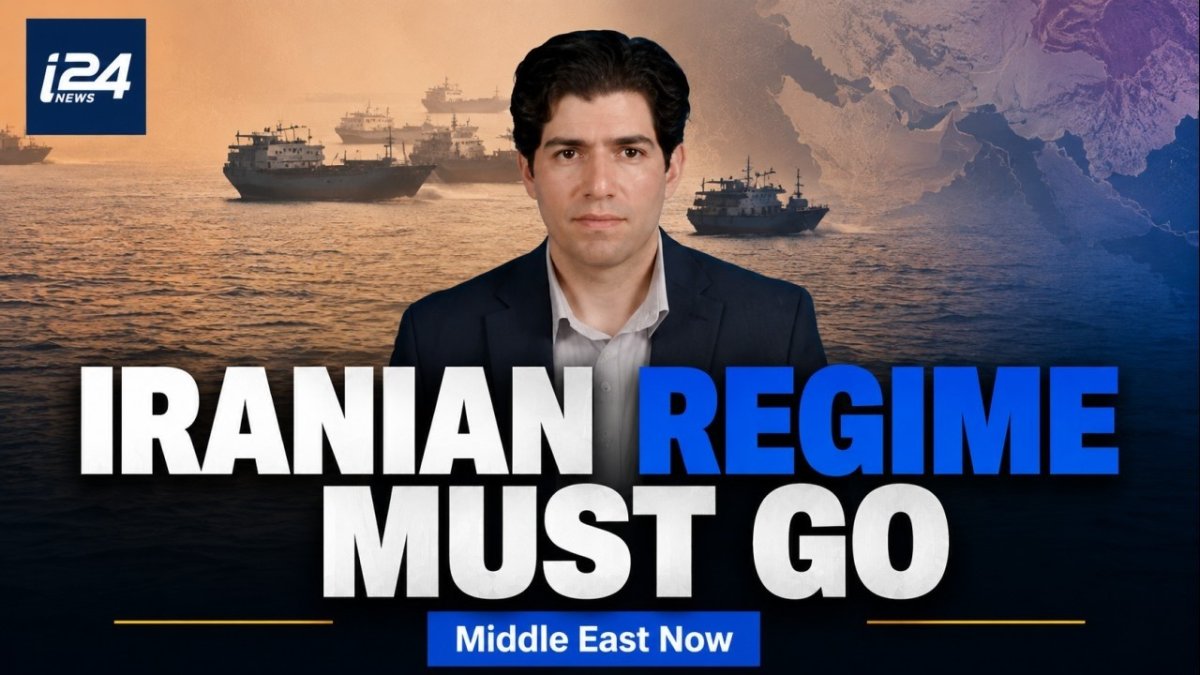
While the military campaign has paused, the economic war has intensified. This week, the United States announced "Operation Economic Outcast," a sweeping global pressure campaign against Iran, including sanctions targeting Iran's sanctions-evasion networks. The operation is the latest phase of a strategy that began in April with the US blockade of Iranian ports and the maintenance of a naval cordon in the Strait of Hormuz, backed by some 50,000 US troops in the region. CENTCOM announced this week that mines had been cleared from the strait, a significant logistical achievement that allows for the continued enforcement of the blockade while keeping international shipping lanes open.
President Donald Trump, in a statement accompanying the announcement, declared that Iran is "begging for a deal" and is "in deep trouble." The rhetoric is characteristic of the administration's approach, but the underlying reality is stark. Iran's economy is collapsing under the weight of the blockade and sanctions. Oil exports, the lifeblood of the regime, have plummeted to near zero. The rial has lost more than half its value against the dollar, and inflation is running at triple-digit rates. The i24NEWS panel noted that the economic pressure is not just a tool of coercion—it is a weapon of regime change, designed to starve the IRGC of resources and to stoke popular discontent.
For Israel, the economic war is a welcome complement to the military campaign. The blockade of Hormuz, which Iran had long threatened to close in any conflict, has been turned against Tehran itself. Israeli officials have privately praised the US Navy's effectiveness in clearing the mines and maintaining the cordon, while noting that the real test will come if Iran attempts to break the blockade with fast attack boats or anti-ship missiles. The i24NEWS panelists agreed that the economic pressure is working, but they cautioned that it is a slow burn—and that the regime's collapse is not inevitable.
Iran’s Internal Crisis: Succession, Infighting, and the Hardliner Gambit
The most significant development in recent weeks has been the internal implosion of the Iranian regime. Fortune reported this week that Supreme Leader Mojtaba Khamenei, the son of the slain Ali Khamenei who succeeded him, has reshuffled the country's leadership, elevating hardliners who favor a return to war over another ceasefire deal. The move is a sign of deep infighting in Tehran and a succession crisis that shows no signs of resolution. State media have warned of factional warfare, a rare admission of the chaos gripping the Islamic Republic's upper echelons.
Mojtaba Khamenei's elevation was never a foregone conclusion. In the immediate aftermath of his father's death, there were reports of a power struggle between the IRGC, the clerical establishment, and the remnants of the civilian government. The new Supreme Leader has sought to consolidate power by purging moderates and elevating hardliners, but the result has been a government that is more radical and less stable. The i24NEWS panel noted that the hardliners' preference for war is a double-edged sword: it reflects their ideological commitment, but it also stems from a desperate calculation that a new conflict would distract the population from the economic collapse.
Former Mossad chief Yossi Barnea, a frequent commentator on Iranian affairs, has been unequivocal in his assessment: the regime will fall through a mix of military operations and economic pressure. Barnea, who has deep experience with Iranian intelligence, argues that the current leadership is isolated, unpopular, and incapable of reversing the economic freefall. The question, he and other analysts say, is not whether the regime will collapse, but when—and what will replace it. The i24NEWS panelists were more cautious, warning that a chaotic collapse could produce a failed state with nuclear knowledge and a fractured military, a scenario that would pose its own existential threats to Israel.
Regional Fronts: Syria, Lebanon, and the Gulf’s Uneasy Wait
While the focus remains on Tehran, Israel has not neglected the regional fronts. This week, Israeli forces struck targets in southern Syria, a continuation of the campaign to prevent Iranian and Hezbollah entrenchment near the Golan Heights. Israeli officials have also told the US that the Lebanese army is failing to curb Hezbollah activity in southern Lebanon, a warning that has been met with concern in Washington. On August 25, Israel shelled the Marjayoun plain area in southern Lebanon, a clear message to Hezbollah that the ceasefire does not extend to its rearmament efforts.
The Gulf states, which were hit by Iranian ballistic missiles in the opening days of the war, remain in a state of uneasy vigilance. The attacks on Gulf nations and US military bases in the region were a shock, demonstrating that Iran could project power beyond its borders even under assault. The Gulf monarchies have largely stayed quiet publicly, but behind the scenes, they are pressing Washington for security guarantees and for a resolution that prevents Iran from reconstituting its missile program. The i24NEWS panel noted that the Gulf states' support for the blockade has been crucial, but their patience is not unlimited—they want to see a clear endgame.
The United Nations and the European Union have played a peripheral role, with the EU attempting to mediate between Washington and Tehran while the UN Security Council remains paralyzed by the threat of vetoes. The IAEA's cautious diplomacy is the only multilateral track showing progress, but it is contingent on Tehran's cooperation. Israeli officials have made clear that they will not accept a return to the status quo ante, and that the international community must choose between supporting the economic pressure campaign or risking a renewed military confrontation.
What More Can Be Done: Options for Israel and the International Community
The i24NEWS panel's central question—what more can be done—yields no easy answers. For Israel, the options range from maintaining the current posture of strategic patience to launching a second round of strikes if the IAEA talks collapse. The IDF has maintained a high state of readiness, and the IAF has continued to conduct reconnaissance flights over Iran, a signal that the military option remains on the table. The Israeli government, led by Prime Minister Benjamin Netanyahu, has been clear that it will not allow Iran to rebuild its nuclear program, regardless of the diplomatic track.
For the international community, the path forward is more complex. The US, under President Trump, has committed to the economic pressure campaign, but there are signs of fatigue in Washington, with some lawmakers questioning the cost of maintaining 50,000 troops in the region indefinitely. The EU has floated the idea of a new diplomatic framework, but Tehran's hardliners have shown little interest in negotiations. The IAEA talks are the most promising avenue, but they are fragile, and Eslami's precondition could derail them at any moment.
The most realistic scenario, according to the i24NEWS panelists, is a prolonged period of economic strangulation combined with targeted military strikes against any attempt to reconstitute Iran's nuclear or missile programs. This approach, sometimes called the "Barnea Doctrine" after the former Mossad chief, aims to create the conditions for regime change without a full-scale invasion. It is a strategy of attrition, and it requires patience, resolve, and a willingness to accept ongoing low-level conflict.
The alternative—a return to full-scale war—is a prospect that neither Israel nor the US desires, but it cannot be ruled out. The hardliners in Tehran, now ascendant under Mojtaba Khamenei, may calculate that a new war is their only chance to survive. If they launch another missile barrage, the ceasefire will collapse, and the region will be plunged back into conflict. The i24NEWS panelists were unanimous on one point: the next six months will be decisive, and the window for a diplomatic solution is closing.
Six months after the outbreak of the Iran War, Israel has achieved its primary military objectives, but the strategic outcome remains uncertain. The ceasefire holds, but it is a fragile construct, maintained by the threat of overwhelming force and the collapse of Iran's economy. The nuclear question is unresolved, the regime in Tehran is in crisis, and the regional order is in flux. For Israeli policymakers, the lesson of the past six months is clear: the war may have ended, but the battle for Iran's future is just beginning. The question is whether Israel and its allies have the will to see it through.
By Hannah Berg, Staff Writer
This article was produced with AI-assisted research and editorial support. Reporting is based on sources cited in the article.
What's Your Reaction?
 Like
0
Like
0
 Dislike
0
Dislike
0
 Love
0
Love
0
 Funny
0
Funny
0
 Wow
0
Wow
0
 Sad
0
Sad
0
 Angry
0
Angry
0

Israel Correspondent at Global1.News. Based in Tel Aviv, covering Israeli politics, security, technology, and society. Provides balanced, deeply-sourced reporting on one of the most closely-watched regions in the world.











Comments (0)