
Ukraine Strikes Crimean Bridge for Second Day as Russia Pounds Kyiv Bridges
Ukraine launched a coordinated drone strike on the Crimean Bridge for the second consecutive day on Tuesday, marking what Ukrainian analysts described as the largest drone offensive of the war to date.
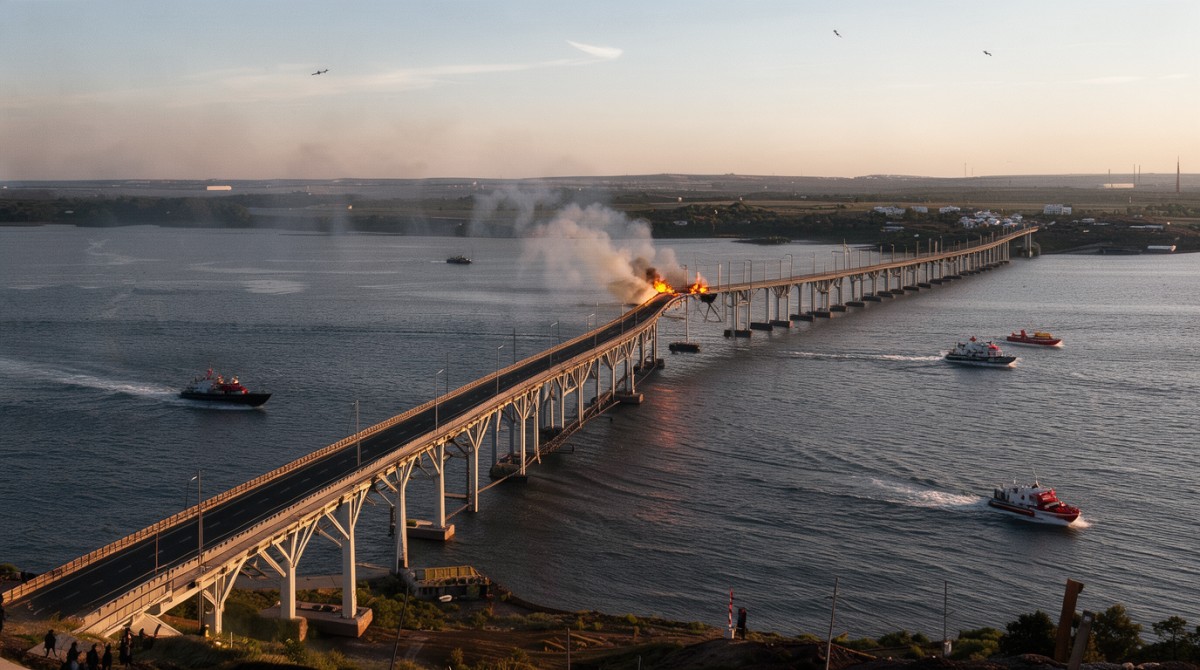
Ukraine launched a coordinated drone strike on the Crimean Bridge for the second consecutive day on Tuesday, marking what Ukrainian analysts described as the largest drone offensive of the war to date. The attack targeted the bridge’s 227‑metre road arch, with unverified footage showing the arch collapsing into the Kerch Strait while the adjacent railway arch remained intact. President Volodymyr Zelensky confirmed the strike, framing it as a direct response to recent Russian attacks on Ukrainian infrastructure, including bridges in the capital.
Scope of the Crimean Bridge assault
The Crimean Bridge, a 19‑kilometre combined road‑rail link between Russia’s Krasnodar region and the annexed peninsula, has become a symbolic and strategic asset closely associated with President Vladimir Putin. Since its inauguration four years after the 2014 annexation, the bridge has been repeatedly targeted by Ukrainian forces. The latest strike focused on the road arch, a critical component that supports the span, according to BBC Russian military analyst Ilya Abishev. Damage to this element could force traffic to rely heavily on ferries and the land corridor through occupied southern Ukraine.
Russian officials acknowledged the damage. Spokesman Dmitry Peskov said President Putin had been briefed and that a repair plan would be prepared, asserting the bridge would emerge “stronger than before.” Sergei Aksyonov, the Russian‑installed head of Crimea, confirmed traffic suspension across the bridge, while railway services resumed later on Tuesday. The incident follows a series of attacks on the bridge, including a truck bomb in October 2022 that killed four people and limited the bridge’s capacity for months.
Parallel Russian strikes on Kyiv’s infrastructure
While Ukraine targeted the Crimean Bridge, Russian forces intensified attacks on Kyiv, striking two bridges spanning the Dnipro River and damaging other critical infrastructure. Mayor Vitali Klitschko reported that the North and South bridges were hit, a claim later corroborated by Moscow authorities, along with partial damage to the metro system. The strikes triggered power and water outages and prompted transport restrictions in the capital.
Russia’s Defense Ministry confirmed that its operations hit transport, military and energy facilities across Kyiv, Zaporizhzhia, Cherkasy and Dnipropetrovsk, as well as port infrastructure and cargo ships. Deputy Energy Minister Artem Nekrasov reported that overnight attacks on energy infrastructure left consumers without power in eight Ukrainian regions, highlighting the broader strategy of targeting utilities alongside transport links.
Escalation of drone warfare
The twin offensives underscore a rapid escalation in the use of drones by both sides. Russia’s Defense Ministry announced it had shot down 1,441 drones over 22 regions, surpassing the previous record of 1,336 set the day before. Moscow Mayor Sergei Sobyanin reported that roughly 800 Ukrainian drones approached the capital region, with 321 intercepted before reaching the city. The scale of these operations reflects a grinding war of attrition in which both Moscow and Kyiv increasingly rely on unmanned aerial systems to strike strategic assets.
Ukrainian officials, meanwhile, have framed the Crimean Bridge attack as a proportional response to Russian aggression against Ukrainian infrastructure. Zelensky’s statement on X emphasized that “war will always return to where it began,” positioning the strike as a reminder to Russia of its own vulnerabilities.
Impact on civilian mobility and logistics
The temporary loss of the road arch has immediate logistical consequences. With the road portion compromised, most traffic between the peninsula and the Russian mainland has shifted to ferries, while the railway line remains operational. Abishev warned that a prolonged closure would strain these alternatives, especially given the limited capacity of ferry services and the vulnerability of the land route through occupied southern Ukraine.
Beyond the immediate transport disruption, the bridge’s symbolic value as a flagship project of Putin’s annexation policy amplifies the political impact of its damage. Each attack erodes the narrative of permanence that Moscow has sought to project regarding its control over Crimea, while simultaneously exposing the logistical fragility of supply lines that support Russian forces in the broader conflict.
International diplomatic context
The heightened military activity occurs against a backdrop of renewed diplomatic overtures. Recent U.S.–brokered peace talks in Abu Dhabi marked the first such engagement in nine months, accompanied by separate meetings between U.S. envoys and the leaders of Moscow and Kyiv. Despite these talks, both sides have continued high‑intensity strikes, suggesting that diplomatic signals have not yet translated into a de‑escalation on the ground.
Analysts note that the simultaneous escalation of drone attacks and the continuation of diplomatic channels reflect a complex calculus: each side seeks to maintain leverage while avoiding a full‑scale escalation that could jeopardize negotiations. The dual focus on strategic infrastructure underscores the importance both parties place on shaping the post‑war bargaining landscape.
Domestic repercussions and media suppression
Amid the intensifying conflict, the Russian government has intensified its crackdown on independent media. The Prosecutor General’s Office designated The Moscow Times as an “undesirable” organization, criminalizing its operations and exposing its staff to prosecution. This follows earlier labeling of the outlet as a “foreign agent.” The move is part of a broader effort to suppress reporting that challenges official narratives, particularly regarding the effectiveness of Russian military operations and the civilian impact of strikes.
Such restrictions raise concerns about the flow of information within Russia and the ability of citizens to assess the true cost of the war. Independent outlets like The Moscow Times have highlighted the discrepancy between official statements—such as the Kremlin’s description of the bridge damage as “minor”—and visual evidence from satellite imagery and social media footage showing significant structural impact.
Strategic implications for the Kremlin
The twin assaults on the Crimean Bridge and Kyiv’s bridges illustrate a shifting balance in the conflict’s infrastructure war. For Moscow, the bridge represents a tangible legacy of the 2014 annexation and a logistical conduit for forces operating in southern Ukraine. Repeated damage forces the Kremlin to allocate resources for repairs and to reinforce the narrative of resilience, as articulated by Peskov’s promise of a stronger bridge post‑repair.
Conversely, Ukraine’s ability to strike high‑profile targets deep within Russian‑controlled territory signals a growing proficiency in drone warfare and a willingness to target symbols of Russian power. This capability may embolden Kyiv to pursue further strikes on other strategic assets, potentially stretching Russian defensive capacities across multiple fronts.
Overall, the escalation underscores a war increasingly fought through infrastructure disruption and information control. As both sides intensify drone campaigns, the civilian populations on both sides of the border face heightened vulnerability, while the Kremlin grapples with the dual challenge of defending its symbolic projects and maintaining domestic narrative control amid tightening media repression.
This article was produced with AI-assisted research and editorial support. Reporting is based on the source material cited below. Sources: The Moscow Times; themoscowtimes.com; Global1.News (17 November 2026).
By Irina Volkov, Staff Writer
What's Your Reaction?
 Like
0
 Dislike
0
 Love
0
 Funny
0
 Wow
0
 Sad
0
 Angry
0
Russia/Eastern Europe Correspondent at Global1.News. Covering Russian politics, energy, security, and the shifting dynamics of the post-Soviet space. Provides clear-eyed analysis on one of the world's most opaque regions.












Comments (0)