
Israel's Airstrikes on Abu al-Duhur: A Warning to Damascus and Ankara
Eight Israeli airstrikes hit the Abu al-Duhur military airbase in Syria's Idlib province early Tuesday, targeting the runway and storage facilities with no casualties reported. Netanyahu's office says the strike blocked a Turkish troop deployment, drawing strong condemnation from Turkey, Syria and Jordan — and a rare US rebuke from envoy Tom Barrack.
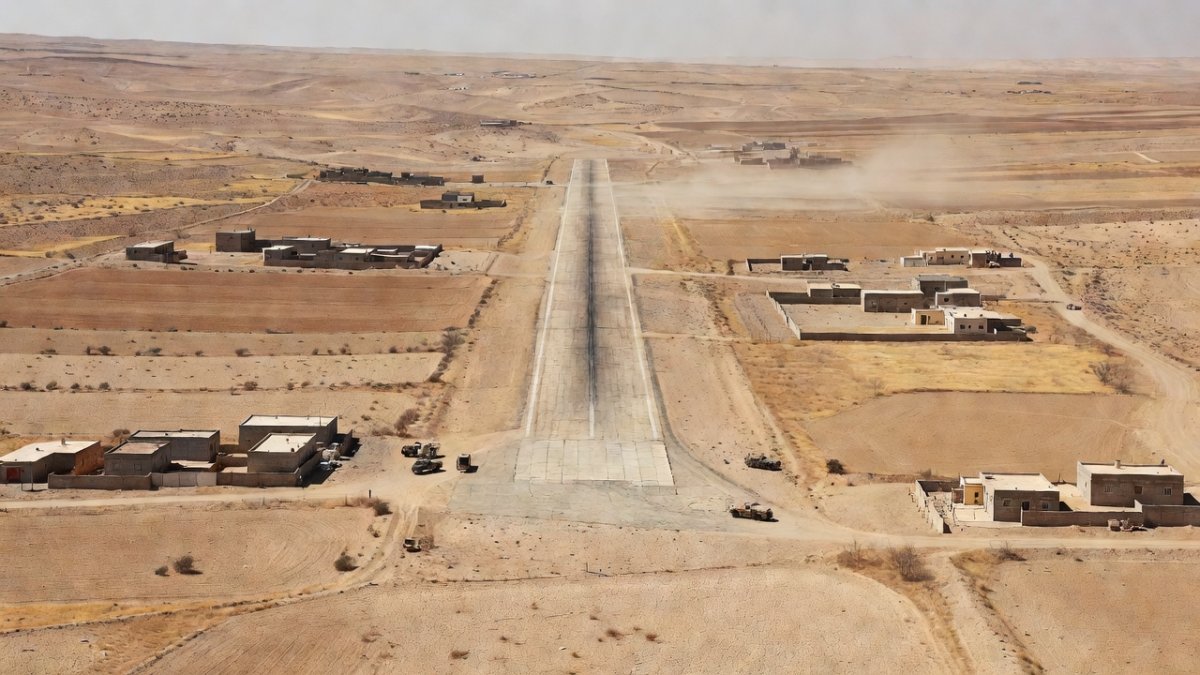
The predawn silence over northwestern Syria shattered Tuesday with eight Israeli airstrikes on the Abu al-Duhur military airbase, a strike that wasn't just about runways and warehouses — it was a warning shot fired across the bow of two American allies, and Washington is suddenly caught in the middle of a collision it helped set in motion. The attack, confirmed by Syrian state media and later owned by Israel, targeted a base that has been a ghost of Syria's civil war for over a decade, but its resurrection as a flashpoint tells you everything about the new, post-Assad Middle East — where the old rules are dead, and the new ones are being written in fire.
Israel's Airstrikes on Abu al-Duhur: A Warning to Damascus and Ankara
Washington, D.C. — Eight Israeli airstrikes slammed into the Abu al-Duhur military airfield in Idlib province early Tuesday, August 18, 2026, targeting the runway and storage facilities in what Israeli Prime Minister Benjamin Netanyahu's office described as a preemptive strike against a brewing Turkish military deployment. Syrian state television Ekhbariya, citing a military source, reported material damage to infrastructure but no casualties — a detail that suggests this was less about destruction and more about delivering a message. And folks, that message was heard loud and clear from Damascus to Ankara to Washington.
What Happened: Eight Strikes at Dawn
The strikes came in waves at dawn Tuesday, hitting the Abu al-Duhur Military Airfield in the southeastern Idlib countryside, roughly 27 kilometers east of the city of Saraqib. Syrian state media was quick to report the attack, framing it as an act of aggression, while Israel initially declined to comment — the standard dance of plausible deniability that has characterized its shadow campaign inside Syria for years. But this time, the silence didn't hold. Within hours, Netanyahu's office issued a statement confirming the strikes and laying out a justification that has now put Washington in an extraordinarily awkward position.
The base itself is strategically located at the crossroads of Idlib, Hama, and Aleppo provinces, near the edge of the Syrian desert, and sits about 40 miles (64 kilometers) from the Turkish border — though some reports put the distance closer to 70 kilometers. It's the second-largest airbase in the Idlib countryside, but here's the thing: it's been largely out of service since 2013. It changed hands multiple times during Syria's brutal civil war, and was captured by anti-Assad forces in December 2024 after the fall of the Assad regime. In other words, this isn't a base that poses an imminent military threat to Israel — unless you believe, as Netanyahu's office claims, that it was about to become a Turkish forward operating base.
Why Abu al-Duhur Matters: A Strategic Chokepoint
Let's talk geography, because that's what this is really about. Abu al-Duhur sits in a corridor that connects three provinces — Idlib, Hama, and Aleppo — and its proximity to the Syrian desert makes it a natural staging ground for any military force looking to project power across northwestern Syria. For Turkey, which has been the key backer of Syria's new authorities since Assad fell, the base represents an opportunity to solidify its influence in a region that borders its own southern flank. For Israel, that's a red line.
The base has been out of service for over a decade, but that's almost beside the point. The Israeli strikes weren't aimed at degrading a functioning military asset — they were aimed at preventing one from coming online under Turkish control. The runway was hit, storage facilities were hit, but no one was killed. That's a deliberate signal, folks. Israel wasn't trying to bleed Syria; it was trying to send a message to Ankara and Damascus that certain deployments are simply unacceptable. And the choice of target — a base that has symbolic and strategic weight but no active military value — underscores that this was about deterrence, not destruction.
Israel's Justification: The Status Quo Argument
Netanyahu's office didn't mince words. The statement read: "Israel and Syria agreed to a status quo in security matters, which Syria was on the verge of breaching by permitting Turkish troops to deploy at an airbase near Aleppo." It went on to say that Israel had "repeatedly warned Syria that such a deployment would pose a threat to Israel's security," and that "Syria chose to ignore these warnings." The conclusion was stark: "Israel will not tolerate threats to its security, and would welcome a return to the status quo."
That status quo, for those keeping score at home, was established after Assad's fall in December 2024 — a quiet understanding between Israel and Syria's new leadership that Israel would continue to strike targets it deemed threats inside Syrian territory, and Damascus would look the other way. It's an arrangement that has allowed Israel to conduct hundreds of strikes inside Syria over the past years against what it calls threats, from Iranian proxies to weapons shipments to Hezbollah. But this strike represents something different — it's the first major test of whether that status quo can survive the involvement of a third party, namely Turkey.
Israeli officials told the Trump administration that the attack was aimed at preventing a Turkish military buildup in the area, according to U.S. and Israeli officials who spoke to Axios. Israel also shared intelligence with Washington about alleged Turkish plans for the base, and an Israeli security source told Kan that the strikes were launched only after diplomatic efforts with Syria failed. In other words, Israel is arguing that it tried the quiet route first, and only when that didn't work did it resort to airstrikes. Whether you buy that framing or not, it's the narrative Israel is pushing — and it's one that puts Washington in a bind.
Turkey's Response: Strong Condemnation and Rejection
Turkey's Foreign Ministry was quick to respond, "strongly" condemning the strikes, according to Anadolu Agency. Ankara firmly rejected Israeli claims of military meddling in Syria, and accused Netanyahu of seeking to justify the strikes with false pretenses. Turkey rejected allegations that it posed a threat by preparing to send troops to the airbase, calling the Israeli narrative a distortion of reality.
This is where things get genuinely dangerous, folks. Turkey is a NATO member. It's a key backer of Syria's new authorities, and it has invested significant political capital in the post-Assad transition. Israel just bombed a base that Turkey allegedly had designs on — and while Ankara denies those designs, the fact that Israel believed them enough to launch airstrikes tells you how deep the mistrust runs. The Turkish response wasn't just diplomatic boilerplate; it was a warning that Israel's actions could have consequences for regional stability. And when Turkey talks about regional stability, it's not just talking about Syria — it's talking about its own security interests, its own military posture, and its own relationship with Washington.
Washington's Rebuke: Tom Barrack's Rare Warning
Here's where the story gets even more complicated. The United States, which has been trying to manage this three-way relationship between Israel, Turkey, and Syria's new government, found itself in the unusual position of publicly rebuking Israel. Special presidential envoy for Syria Tom Barrack — who also serves as U.S. ambassador to Turkey — posted on X that the United States is "deeply concerned that the confirmed Israeli airstrikes on Abu al-Duhur Airbase constitute an unnecessary escalation that does not advance regional stability."
Barrack went further, warning that the strike risked scrambling Turkish jets and could lead to a rapid escalation toward direct military confrontation with Turkey. The BBC described this as a rare U.S. rebuke of Israel, and it's not hard to see why. The United States has historically shielded Israel from international criticism, but this time, Washington is caught between two allies — Israel, which it has long supported, and Turkey, which is a NATO partner and a key player in the post-Assad order. Barrack's statement was carefully worded, but the message was clear: this strike was a step too far, and it threatens to unravel the very stability the United States has been trying to build in Syria.
It's worth noting that Barrack's dual role — envoy for Syria and ambassador to Turkey — makes him uniquely positioned to understand the stakes. He's not just a diplomat; he's the guy who has to manage the fallout on both sides. And his public statement suggests that the administration is genuinely worried about where this could lead. The phrase "unnecessary escalation" is diplomatic language for "you've made our job a lot harder, and we're not happy about it."
Regional Escalation Risks: An Ally-on-Ally Collision
Let's be real about what's happening here. This strike highlights friction between three U.S. partners — Israel, Turkey, and the new Syrian government — as Washington tries to prevent escalation. Turkey is a key backer of Syria's new authorities, and Israel has been conducting strikes inside Syria for years. The collision was inevitable, but that doesn't make it any less dangerous.
Analysts at Al Jazeera framed the attack as "an Israeli message to Damascus and Ankara," and that framing is spot on. Israel is telling Damascus that it won't tolerate Turkish military deployments on Syrian soil, and it's telling Ankara that Israel's security concerns trump any diplomatic niceties. But here's the problem: Turkey is not a passive actor. It has its own security interests, its own military capabilities, and its own red lines. If Israel keeps pushing, Turkey could respond in ways that escalate the conflict — and that's a scenario nobody in Washington wants to contemplate.
The risk of direct military confrontation between Israel and Turkey is no longer theoretical. Barrack's warning about scrambled Turkish jets wasn't hyperbole; it was a realistic assessment of what could happen if Turkish aircraft were operating near the base when Israeli jets struck. The fact that no such confrontation occurred this time is a stroke of luck, not a sign of stability. The next strike could be different.
What Happens Next: The Bigger Picture
Syria's Foreign Ministry condemned the strikes "in the strongest terms," calling them "an unjustified act of aggression" and urging action by the UN Security Council. Jordan also condemned the strikes, calling on the international community to compel Israel to cease attacks on Syria. But let's be honest: the UN Security Council isn't going to do anything meaningful. The United States has veto power, and it's not going to sanction Israel over a strike it privately may have been informed about in advance.
The bigger question is what happens to the status quo. Israel says it would "welcome a return to the status quo," but that status quo was already fraying before this strike. The post-Assad security arrangement between Israel and Syria was always fragile, and the introduction of Turkey as a major player in Syria's reconstruction has made it even more so. Israel's strikes have been a constant feature of the Syrian landscape for years, but this one was different — it was aimed at a base that Turkey allegedly wanted, and it was justified in terms that directly implicate Ankara.
For Washington, the challenge is managing a three-way relationship where each party has legitimate grievances. Israel has security concerns that it believes are existential. Turkey has strategic interests in Syria that it believes are non-negotiable. And Syria's new government is trying to rebuild a shattered country while navigating between two powerful neighbors. The United States wants to prevent escalation, but it can't force any of these actors to back down. All it can do is try to keep the lines of communication open and hope that cooler heads prevail.
Folks, here's the bottom line: this strike was a warning, but it was also a gamble. Israel bet that a show of force would deter Turkey without triggering a broader conflict. Turkey bet that international pressure would force Israel to back off. And Washington is betting that it can keep the peace between two allies that are increasingly at odds. Those are three bets that can't all pay off, and the fallout is going to define the region for months to come. The status quo is dead. What replaces it is anyone's guess — but one thing is certain: the next move in this high-stakes game is coming, and it won't be quiet.
By Jessica Ali, Lead Anchor — Global 1 News
This article was produced with AI-assisted research and editorial support. Sources: Reuters, The Associated Press, BBC, Al Jazeera, The New York Times, Axios, Anadolu Agency, The Jerusalem Post, DW.
What's Your Reaction?
 Like
0
Like
0
 Dislike
0
Dislike
0
 Love
0
Love
0
 Funny
0
Funny
0
 Wow
0
Wow
0
 Sad
0
Sad
0
 Angry
0
Angry
0

Editor-in-Chief at Global1.News. Atlanta-based journalist who cuts through the BS and tells it like it is. Lead anchor, host, and the voice you hear when the spin stops and the truth starts.














Comments (0)