
Houthi Attack on Saudi Arabia Wounds 73 in Largest Strike Since Truce Collapse
Abha International Airport was among the targets hit as Iran-backed Houthi rebels launched their heaviest assault on Saudi Arabia since the collapse of a four-year truce in Yemen's long-running civil war, wounding at least 73 people, including women and children, according to Saudi authorities.
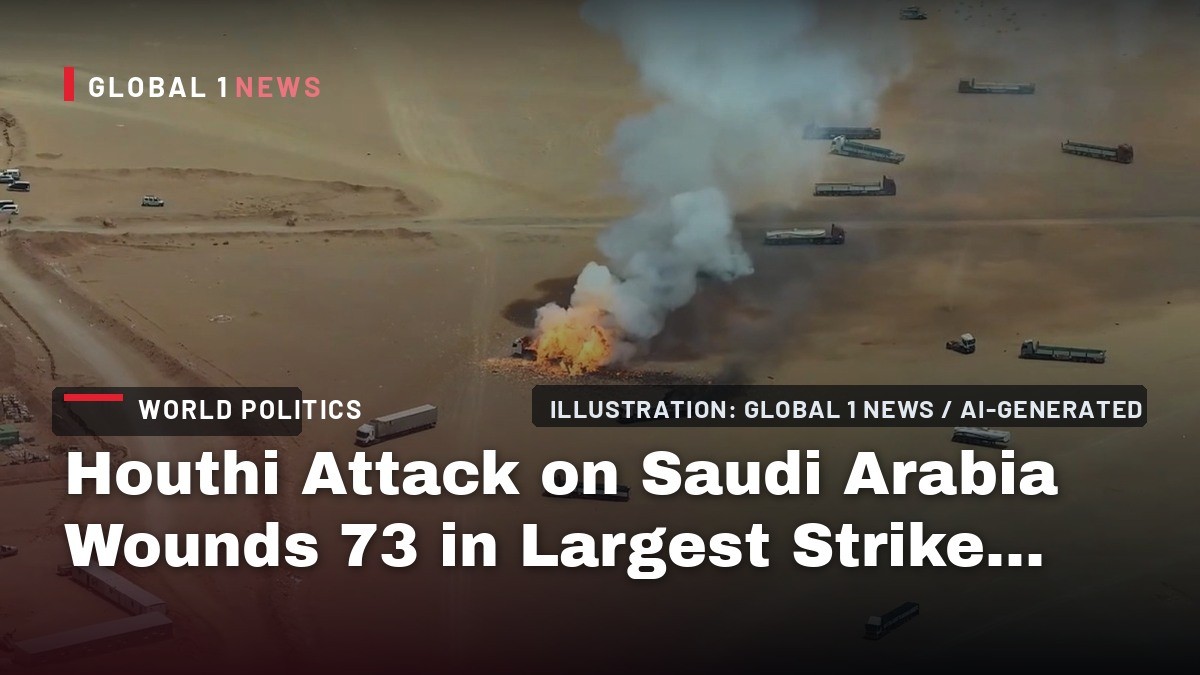
Abha International Airport was among the targets hit as Iran-backed Houthi rebels launched their heaviest assault on Saudi Arabia since the collapse of a four-year truce in Yemen's long-running civil war, wounding at least 73 people, including women and children, according to Saudi authorities. The coordinated strikes on civilian and economic infrastructure mark a dangerous escalation that links the Yemeni battlefield to the broader war between Iran and the United States.
Houthi Barrage Wounds 73 in Saudi Arabia in Largest Attack Since Yemen Truce Collapsed
Riyadh, Saudi Arabia – Sep. 8, 2026 — Yemen's Houthi rebels struck deep into Saudi territory on Tuesday in their most significant military operation since the unraveling of a UN-brokered truce in July, wounding at least 73 civilians in a coordinated assault on airports, a military base, and energy infrastructure belonging to state-owned oil giant Aramco, the Saudi-led coalition said.
The attack, which targeted the southern cities of Abha, Khamis Mushait, Jizan, and Najran, represents a dramatic escalation in a conflict that had been largely frozen for four years. Saudi coalition spokesman Major General Turki al-Maliki confirmed that women and children were among the wounded, describing the strikes as "senseless attacks" on civilian and economic sites.
A Coordinated Assault on Civilian and Economic Infrastructure
The Houthi operation, claimed by the Iran-backed rebels, struck multiple targets simultaneously across Saudi Arabia's southern border region. According to the rebels, the barrage hit Abha International Airport, King Khalid Air Base, and Aramco facilities in both Abha and Jizan. Saudi authorities confirmed fires broke out at several locations, forcing temporary shutdowns of some energy sector operations.
"Several energy sector facilities and installations in the southern region of the kingdom were targeted this morning," an Energy Ministry source told the Saudi Press Agency. "The attacks caused fires at several locations, leading to a temporary halt in some operations."
The choice of targets is significant. Abha International Airport serves as a critical civilian hub for the southern Asir region, while King Khalid Air Base is a key military installation. The inclusion of Aramco facilities echoes the 2019 Abqaiq-Khurais attack, which temporarily knocked out half of the kingdom's crude output and sent shockwaves through global energy markets.
Collapse of the Truce and Return to Hostilities
Tuesday's attack marks the worst Houthi assault on Saudi Arabia since the four-year truce in Yemen's civil war unraveled in July 2026. The ceasefire, which had held since 2022, collapsed when the Houthis allowed an Iranian plane to land in Sanaa, directly defying Saudi control of Yemeni airspace.
The Saudi Foreign Ministry issued a strongly worded statement demanding an immediate halt to Houthi strikes and their attacks on Red Sea shipping, vowing that the kingdom would "take all necessary measures to defend its sovereignty." The coalition's Joint Forces Command went further, declaring: "The Command will also take all necessary measures and actions to respond to the sources of the threat and neutralize its danger."
The Houthi attack came just one day after the rebels accused Riyadh of carrying out deadly strikes around Yemen, including a bombardment of a prison in al-Hazm in the country's northern Jawf province. According to rebel television channel Almasirah, the jail attack killed 11 people and left 20 inmates missing under the rubble, as quoted by Jawf province's civil defense chief.
The Red Sea Front: A Strategic Prize
Beyond the immediate violence, the Houthi escalation is part of a broader strategic push toward the Bab el-Mandeb Strait, the narrow waterway at the southern mouth of the Red Sea through which a substantial share of global maritime trade and Gulf energy exports pass. The rebels are pressing a wide offensive along frontlines on Yemen's western Red Sea coast, seeking to seize government-held territory and position themselves astride one of the world's most critical shipping lanes.
The timing is no coincidence. With Iran having blockaded the Strait of Hormuz as part of its direct war with the United States, the Red Sea route has become exponentially more important for Gulf energy exports. Saudi Arabia, in particular, relies on the Red Sea as an alternative export corridor when Hormuz is threatened — a fact that makes the Houthi push toward Bab el-Mandeb a direct strategic threat to the kingdom's economic lifeline.
The humanitarian cost of this renewed offensive is mounting rapidly. The United Nations' International Organisation for Migration estimated that approximately 18,500 people have been displaced in the flashpoint governorates of Taiz and Hodeidah, with the agency warning that "the number is increasing by the hour." Clashes along the western front have left hundreds dead and forced thousands of residents to flee their homes.
Regional Dynamics: Iran's Proxy Network and Saudi Calculations
The Houthi escalation must be understood within the broader context of Iran's proxy network across the Middle East. The rebels, who seized Sanaa in 2014 and have since functioned as Tehran's most effective proxy force on the Arabian Peninsula, are now operating in coordination with Iran's wider war effort against the United States and its regional allies.
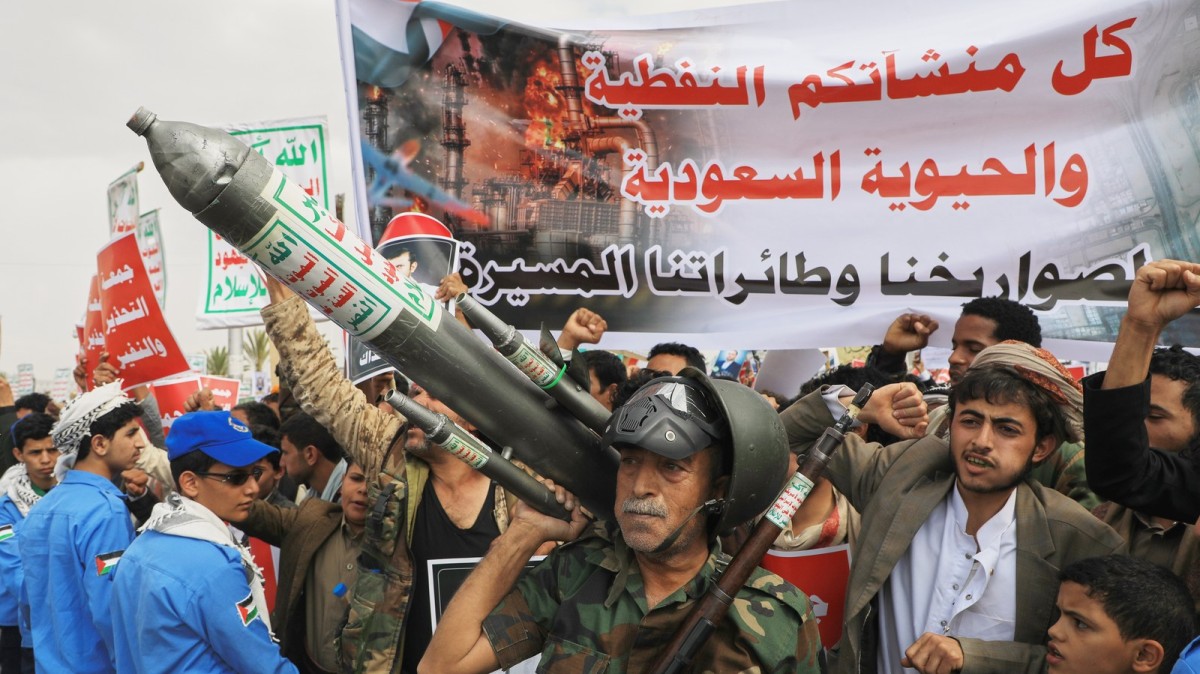
For Tehran, the Houthis serve multiple strategic purposes. They tie down Saudi military resources along a lengthy border, threaten critical energy infrastructure, and now hold the potential to disrupt Red Sea shipping at a moment when Iran's own blockade of Hormuz has already constrained global oil flows. The rebels' ability to strike Saudi soil with impunity demonstrates the limits of the kingdom's sophisticated air defense systems against a determined adversary employing drones and missiles.
Saudi Arabia faces a complex strategic calculus. The kingdom has spent years attempting to extricate itself from the Yemen quagmire, pursuing Oman-mediated de-escalation talks with the Houthis as recently as 2025. The collapse of the truce in July, however, has dragged Riyadh back into a conflict it had hoped to leave behind — and at the worst possible moment, with regional tensions already at their highest point in decades.
Energy Security and Global Market Implications
The attack on Aramco facilities in the kingdom's southern region carries particular weight given the current state of global energy markets. With Iranian oil effectively removed from international markets due to the Hormuz blockade and the US-Iran war, Saudi Arabia's export capacity has become even more critical to global supply stability.
While Tuesday's attack appears to have caused only temporary disruptions, the psychological impact on markets could be significant. Any sustained threat to Saudi energy facilities or Red Sea shipping lanes has the potential to drive global oil prices higher.
The kingdom's southern energy installations, including those in Jizan and Abha, are particularly exposed given their proximity to the Yemeni border. This geographic vulnerability has long been a strategic concern for Saudi planners, who have invested heavily in missile defense systems and hardened infrastructure in response to repeated Houthi attacks since 2015.
What Comes Next: Escalation Risks and Diplomatic Options
The Saudi coalition's promise to "respond to the sources of the threat and neutralize its danger" suggests that a significant military retaliation is likely in the coming days. Previous patterns of escalation suggest Riyadh may target Houthi leadership positions, weapons depots, and launch sites in Yemen — though such strikes carry their own risks of civilian casualties and further international condemnation.
The Houthis, for their part, appear undeterred by the prospect of Saudi retaliation. Their successful defiance of Saudi airspace control in July, combined with their ongoing territorial advances along the Red Sea coast, has emboldened the movement. The rebels calculate that their position as Iran's most effective proxy — and their control over territory adjacent to critical shipping lanes — gives them leverage that transcends the Yemeni battlefield.
For the international community, the renewed Saudi-Houthi conflict presents a dilemma. The United States, already engaged in direct conflict with Iran, has limited bandwidth to address a secondary front in Yemen. Gulf states, including the UAE, have their own complicated relationships with the various Yemeni factions. And the humanitarian catastrophe in Yemen — already one of the world's worst — threatens to deepen further as fighting intensifies.
The path to de-escalation remains unclear. The Oman-mediated talks that showed promise in 2025 have been rendered moot by the July collapse of the truce. The Houthis' demand for control over Yemeni airspace and their push toward Bab el-Mandeb suggest ambitions that extend far beyond the borders of Yemen itself. And with Iran's regional war showing no signs of abating, the Houthis are unlikely to moderate their behavior while their patron in Tehran remains locked in conflict with the United States.
What is clear is that Tuesday's attack has fundamentally altered the strategic landscape. The four-year truce, however imperfect, had provided a measure of stability along the Saudi-Yemeni border and allowed for a partial de-escalation of regional tensions. Its collapse has now produced the largest Houthi attack on Saudi soil in years — and the trajectory suggests worse may be yet to come.
By Malik Hassan, Staff Writer
This article was produced with AI-assisted research and editorial support. Sources: AFP via Daily Sabah, Reuters, Al Jazeera.
What's Your Reaction?
 Like
0
Like
0
 Dislike
0
Dislike
0
 Love
0
Love
0
 Funny
0
Funny
0
 Wow
0
Wow
0
 Sad
0
Sad
0
 Angry
0
Angry
0

Middle East Correspondent at Global1.News. Based in Beirut, covering politics, conflict, energy, and society across the Middle East. Brings context and depth to a region often reduced to headlines.












Comments (0)