
First-Ever Endangered Hawk-Eagle Nest Found in Leyte
First-ever active South Philippine Hawk-Eagle nest documented in Burauen, Leyte. PEF followed full nesting cycle from November 2025 to May 2026 fledging, sparking PAMB resolutions and local conservation action for the endangered endemic raptor.
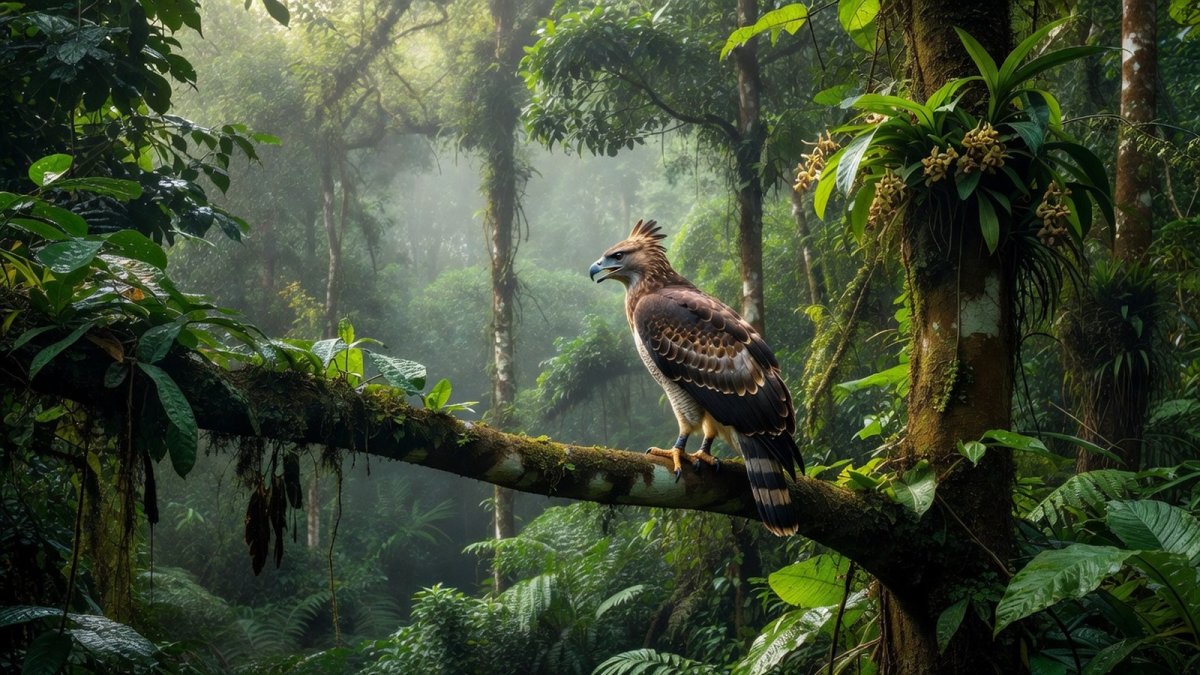
Deep in the forests of Burauen, Leyte, a quiet drama unfolded this year that has electrified the Philippine conservation community. For the first time in recorded history, researchers have documented an active nest of the endangered South Philippine Hawk-Eagle (Nisaetus pinskeri) on Leyte Island — the first ever recorded in the entire Eastern Visayas region. And they didn't just catch a glimpse. They witnessed everything: from the first twig placed on the nest to the triumphant moment a young eagle spread its wings and took to the sky.
For the Philippine Eagle Foundation (PEF), which led the effort, this is more than a scientific footnote. It is a testament to patience, the resilience of nature, and the quiet collaboration between scientists and local communities who chose to protect rather than disturb.
The Discovery: A Whistle in the Canopy
The story begins in November 2025. A team from the Philippine Eagle Foundation — composed of a biologist, a field technician, and local forest guards — was conducting routine fieldwork in the forests of Burauen. They were monitoring the movements of a Philippine Eagle named Lakpue when something unusual caught their attention.
Perched atop a large native tree locally known as Tiga, a hawk-eagle was calling repeatedly. Its loud, two-note whistle echoed through the forest — a sound that would become the soundtrack of the next several months. Then, another hawk-eagle appeared. Hidden among the branches was a large stick nest, and one of the birds was carefully arranging fresh twigs on it.
The team knew they had stumbled onto something extraordinary — but also that birds of prey are especially sensitive while building nests. Too much disturbance could cause the pair to abandon the site entirely. So the team made a difficult decision: they left the birds alone and waited.
For nearly two months, they stayed away.
Patience and the Long Wait
When the team finally returned in January 2026, their patience was rewarded. The female was sitting on the nest, incubating a single egg. From that point on, researchers observed the nest every single day, from sunrise until sunset, using a camouflaged observation blind.
Field biologist Tristan Luap P. Senarillos kept watch. For 41 days, little seemed to happen — the female rarely moved as she kept the egg warm, while the male occasionally delivered food. It was a test of endurance for the researchers, who sat in silence for hours, documenting every small movement.
Then, on March 2, 2026, the egg hatched.
The dynamic shifted immediately. The male became the family's provider, hunting and bringing food back to the nest with remarkable regularity. The female stayed close to the chick, shielding it from heavy rain, intense heat, and potential predators. She tore food into small pieces and kept the nest clean. Both parents regularly brought fresh leafy branches to the nest, helping keep it clean and well maintained.
For 76 days, the team monitored the family's every move, watching the chick grow from a helpless ball of fluff into a juvenile eagle practicing its balance and flapping its wings. They observed "branching" behavior — the young eagle transferring from the nest to different branches.
A First Flight and a Historic Milestone
On May 17, 2026, the moment everyone had been waiting for arrived. The young hawk-eagle spread its wings and made its very first flight, covering approximately 15 meters from the nest. It was a short distance by eagle standards, but a giant leap for Philippine conservation.
"For conservationists, this is more than just finding a nest, it is a milestone that offers new hope for the future of this globally endangered bird," the Philippine Eagle Foundation said in its announcement.
It is the first time researchers have documented the complete nesting cycle of this species — from nest building and egg incubation to hatching and successful fledging. Previously, birdwatchers, researchers, and local communities had only occasionally seen adults soaring above the forest or young birds after they had already left the nest.
"Because so little is known about this endangered bird, each observation helps fill important gaps in our understanding of its life in the wild," the foundation said. "These findings will provide valuable information for future conservation efforts and help guide the protection of the species and its remaining forest habitat."
Why This Matters: A Species on the Brink
The South Philippine Hawk-Eagle, also known as Pinsker's Hawk-Eagle or the Mindanao Hawk-Eagle, is a bird of prey in the family Accipitridae. It is endemic to the Philippines — found only on the islands of Leyte, Samar, Negros, Basilan, Bohol, and Mindanao. Locals often call it "lawin," the general term for hawk.
But this magnificent raptor is in serious trouble. The International Union for Conservation of Nature (IUCN) lists it as Endangered, with its population estimated at just 1,300 to 3,600 mature individuals. The species breeds yearly but produces only one egg every breeding season — a slow reproductive rate that makes recovery incredibly difficult.
"It's one of the most threatened raptors we have in the Philippines; despite its conservation importance, we know so little about it," said biologist Tristan Senarillos.
This nesting record in Burauen is therefore not just a feel-good story. It provides critical data that could shape the species' future — where they nest, how they raise their young, and what they need to survive.
Conservation in Action: From Resolutions to Community
The discovery has already sparked concrete action. During their May 7, 2026 meeting, the Protected Area Management Board (PAMB) of Mahagnao Volcano Natural Park passed four resolutions aimed at protecting the nesting site and the hawk-eagle family.
These resolutions include: protecting the nest site and prioritizing it for conservation, even though it lies outside the protected area; including the species among priority species for long-term monitoring and research; capacity building for stakeholders and partners, particularly forest rangers and field staff, on how to monitor the species; and organizing a public naming ceremony where suggestions from the public will be collected for the juvenile eagle's name.
The Local Government Unit of Burauen is also preparing an ordinance that would recognize the South Philippine Hawk-Eagle as one of the municipality's flagship species for conservation.
But the challenges remain significant. One of the biggest threats to the species is the practice of kaingin (slash-and-burn farming). The nesting site is located outside the protected area and sits on privately owned land that is actively farmed. This puts the eagle family in a precarious position, dependent on the goodwill of landowners and the vigilance of local communities.
To address this, signs have been installed around the eagle's territory. Written in English with translations in the local dialect, Waray, the signs state that an endangered bird is breeding in the area. They advise the public to keep a safe distance, avoid loud noises and sudden movements, and move through the area quickly and quietly.
"Human disturbance during the nesting season can cause parents to abandon their eggs or chicks, leading to nesting failure," the sign reads.
The research team is also preparing scientific papers, and later this year hopes to begin the first telemetry study of the species — fitting GPS transmitters to adult birds and the young eagle to learn how large their territories are, how they use the forest, and where young birds travel after leaving the nest.
A Future Written in the Forest
For the people of Burauen, this story is deeply personal. The discovery was made possible by the collaboration of biologists, DENR staff, and local forest guards — a modern-day bayanihan where the community came together to protect something precious.
The forest guards who first spotted the eagles and kept the discovery quiet for months are unsung heroes. The local officials now championing the species as a conservation flagship are showing that environmental protection and community development can go hand in hand.
Dr. Jayson Ibañez, PEF director for operations, said the foundation hopes to expand its efforts to include the Philippine serpent eagle and other raptors. The success in Burauen could serve as a model for other regions.
For the young hawk-eagle that took its first flight on May 17, the future is uncertain but hopeful. It will need to find its own territory, its own mate, and eventually raise its own family. The forests of Leyte will need to remain intact for that to happen.
As Filipinos, we have a shared responsibility. We can support conservation organizations like the Philippine Eagle Foundation. We can report sightings of these magnificent birds to authorities. And we can respect nesting areas — keeping our distance, avoiding loud noises, and allowing these creatures the space they need to thrive.
The story of the Burauen hawk-eagle is a reminder that hope is not a passive emotion. It is something we build, day by day, observation by observation, resolution by resolution. In the quiet forests of Leyte, a pair of endangered eagles and a team of dedicated humans have written a new chapter in Philippine conservation. May it be the first of many.
This article was produced with AI-assisted research and editorial support. Sources: Philippine Star, Philippine Eagle Foundation, SunStar Philippines, BirdLife International.
By Bella Reyes, Staff Writer
What's Your Reaction?
 Like
0
Like
0
 Dislike
0
Dislike
0
 Love
0
Love
0
 Funny
0
Funny
0
 Wow
0
Wow
0
 Sad
0
Sad
0
 Angry
0
Angry
0

Philippines/Southeast Asia Correspondent at Global1.News. Manila-based journalist covering Philippine politics, environment, maritime security, and social issues. Passionate about marine conservation and the communities protecting the Philippines' natural heritage.















Comments (0)