
Fields Medalist Praise Highlights China's Strategic Bid for Scientific Talent
In a recent CGTN report, Fields Medalist Martin Hairer offered a notable endorsement of China's approach to scientific development, stating that the nation's strategy on science and technology attracts top-tier talent.
In a recent CGTN report, Fields Medalist Martin Hairer offered a notable endorsement of China's approach to scientific development, stating that the nation's strategy on science and technology attracts top-tier talent. Hairer, who received the prestigious mathematics prize in 2014 and serves as an international member of the Chinese Academy of Sciences (CAS), has maintained long-standing cooperation with the Chinese academic community. His remarks arrive at a pivotal moment, as the 2026 Fields Medals—awarded in July—marked a historic milestone: for the first time, a Chinese woman claimed the medal, and two Chinese-born mathematicians secured the honor this year, bringing the total count of Chinese-born medalists to three. This convergence of international recognition and strategic policy underscores a broader narrative about Beijing's intensifying pursuit of global scientific leadership.

A Strategic Endorsement from a Global Mathematics Leader
Hairer's comments, featured in the CGTN video, carry particular weight given his stature in the global mathematical community. As an international member of CAS, he represents a growing cohort of foreign scholars who have formal ties to China's research ecosystem. His observation that China's science and technology development strategy draws top talent is not merely a polite diplomatic gesture; it reflects a tangible shift in how global researchers perceive opportunities within the Chinese system. The CAS has actively recruited international members as part of its broader global engagement, signaling that Beijing views scientific collaboration as a two-way street—one that enhances its domestic capabilities while also offering foreign scientists access to substantial resources and ambitious research agendas.
The timing of Hairer's endorsement is significant. It comes as China's leadership has elevated technological self-reliance to a core national priority, articulated through frameworks such as the Dual Circulation strategy and successive Five-Year Plans. The 15th Five-Year Plan period, which began in 2026, places even greater emphasis on foundational research and the cultivation of homegrown innovation. For a mathematician of Hairer's caliber to publicly acknowledge the effectiveness of this strategy lends credibility to Beijing's claims that its investments in science are yielding measurable dividends—not just in output metrics, but in the ability to attract and retain exceptional minds from around the world.
The 2026 Fields Medals: A Watershed for Chinese Mathematics
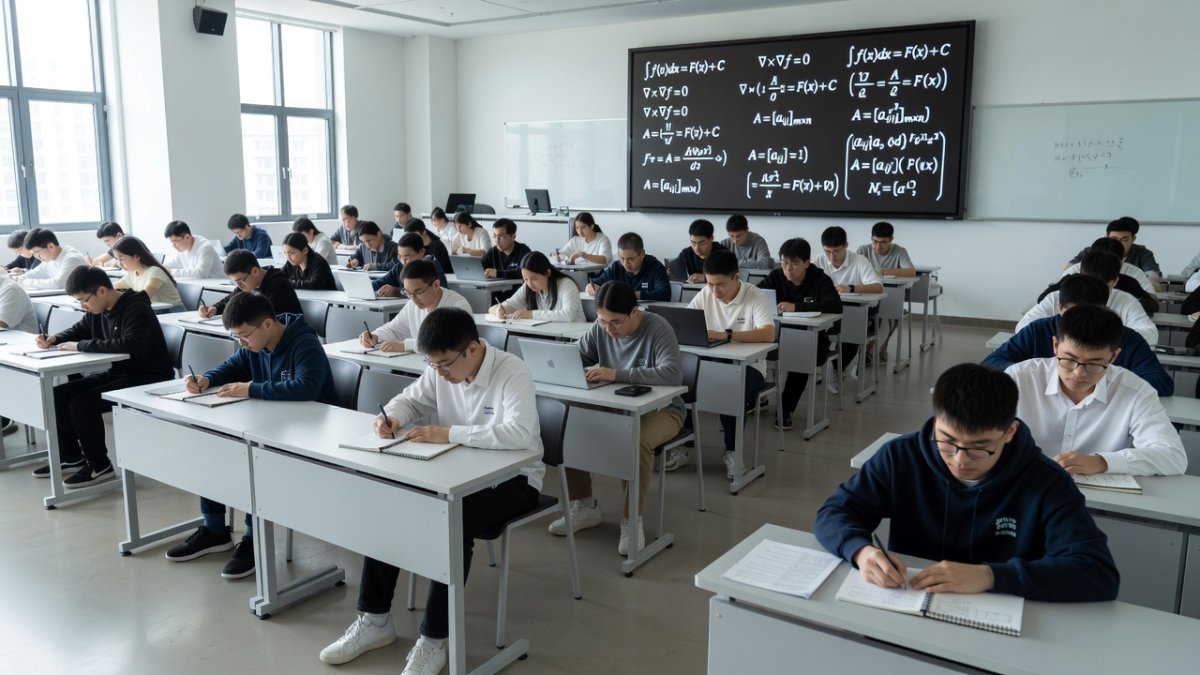
The 2026 Fields Medal results, as reported by NPR, represent a watershed moment for Chinese mathematics. The awarding of medals to two Chinese-born mathematicians—including the first Chinese woman to receive the honor—marks a generational achievement. This brings the total number of Chinese-born medalists to three, a statistic that would have seemed improbable just two decades ago. The significance extends beyond individual accolades; it signals the maturation of China's mathematics education and research infrastructure, which has benefited from sustained state investment and a cultural emphasis on rigorous quantitative training.
The New York Times reported on August 17, 2026, in an article titled "As China Hunts for Scientific Talent, the US Makes It Easier," that Deng, a 37-year-old 2026 Fields medalist, has received inquiries from universities in China, the United States, and elsewhere. Deng indicated he is considering his options but will remain at the University of Chicago for now. This detail illuminates a critical dynamic: while China has become remarkably successful at producing world-class mathematicians, the competition for their allegiance remains fierce. The fact that a Chinese-born medalist currently chooses to stay in the United States underscores the ongoing transatlantic—and transpacific—competition for scientific human capital.
Dual Circulation and the Logic of Talent Acquisition
China's strategic framework for scientific development cannot be understood in isolation from its broader economic doctrine. The Dual Circulation strategy, which emphasizes domestic economic resilience while maintaining international engagement, has direct implications for science policy. In practical terms, this means China seeks to build self-sufficient research capabilities—reducing dependence on foreign technology—while simultaneously remaining open to international collaboration that can accelerate progress. The recruitment of international CAS members like Hairer exemplifies the "external circulation" component: leveraging global expertise to strengthen domestic institutions.
The 15th Five-Year Plan period, which commenced in 2026, operationalizes these goals through targeted funding mechanisms, infrastructure development, and policy incentives designed to attract both Chinese diaspora researchers and foreign nationals. The strategy appears to be working, at least in part. The growing number of high-impact publications from Chinese institutions, the expansion of world-class research facilities, and the increasing presence of international scholars in Chinese universities all point to a system that is becoming more competitive on the global stage. However, the case of Deng—choosing to remain in Chicago—reveals the limits of this approach. China can produce talent, but retaining it in the face of attractive offers from Western institutions remains a challenge.
The US-China Technology Competition and Its Talent Implications
The New York Times headline—"As China Hunts for Scientific Talent, the US Makes It Easier"—captures a paradoxical dimension of the current geopolitical landscape. The United States has pursued export controls on advanced semiconductors and engaged in a broader technology competition with China, exemplified by the CHIPS Act's efforts to bolster domestic semiconductor manufacturing. These measures are designed to limit China's access to cutting-edge technology, but they may have unintended consequences for America's ability to attract and retain scientific talent.
Restrictive visa policies, heightened scrutiny of Chinese researchers, and a general climate of suspicion can make the United States a less welcoming destination for international scholars. This creates an opening for China, which has positioned itself as a more open and welcoming environment for scientific collaboration—at least for those willing to navigate its political and bureaucratic realities. The strategic calculus is clear: while the US seeks to protect its technological advantages through restriction, China seeks to close the gap through attraction. The outcome of this competition will have profound implications not just for the two nations involved, but for the global scientific enterprise as a whole.
Geopolitical Ripple Effects for ASEAN, the EU, and the Global South
The intensifying competition for scientific talent between the United States and China is not a bilateral affair; it reverberates across the international system. For ASEAN nations, the rivalry presents both opportunities and risks. On one hand, they may benefit from a diversification of scientific partnerships, as both Washington and Beijing seek allies in their respective technology ecosystems. On the other hand, they face pressure to align with one camp or the other, potentially constraining their policy autonomy. The European Union, similarly, finds itself navigating a delicate balance—seeking to maintain its own scientific competitiveness while avoiding becoming a battleground for US-China rivalry.
For the Global South, the dynamics are arguably more consequential. China's model of state-directed scientific development, which combines substantial public investment with strategic international engagement, offers an alternative pathway to technological advancement—one that does not require wholesale adoption of Western institutional models. The success of Chinese-born Fields Medalists, many of whom emerged from educational systems that prioritize rigorous training and national development goals, provides a compelling example for developing nations seeking to build their own scientific capacities. However, the brain drain phenomenon—whereby talented individuals from the Global South migrate to China, the US, or Europe—remains a persistent challenge that no single nation has fully solved.
Assessing the Road Ahead: Realities and Limitations
While the recent Fields Medal results and Hairer's endorsement paint a positive picture of China's scientific trajectory, a sober assessment requires acknowledging the limitations. The number of Chinese-born Fields Medalists, while historically significant, remains small in absolute terms. The fact that a prominent medalist like Deng is currently choosing to remain in the United States suggests that China's talent attraction strategy, while improving, has not yet achieved decisive superiority. Moreover, the broader geopolitical environment—characterized by export controls, technology decoupling, and mutual suspicion—creates headwinds that no amount of domestic investment can fully offset.
China's stated goal of technological self-reliance and self-improvement is clear, and the frameworks of Dual Circulation and the Five-Year Plans provide the policy scaffolding for its pursuit. The recruitment of international CAS members and the growing international recognition of Chinese-born scientists indicate progress. Yet the competition for talent is a long game, and the outcomes will depend on factors beyond any single policy initiative: the relative openness of different scientific ecosystems, the perceived political stability of various nations, and the ability of each country to offer not just resources, but also intellectual freedom and a welcoming environment for researchers of all backgrounds. As the 15th Five-Year Plan period unfolds, the world will be watching to see whether China's strategic bet on science and technology pays off—and what it means for the global balance of scientific power.
By Prof. Marcus Chen, Staff Writer
This article was produced with AI-assisted research and editorial support. Reporting is based on sources cited in the article.
What's Your Reaction?
 Like
0
Like
0
 Dislike
0
Dislike
0
 Love
0
Love
0
 Funny
0
Funny
0
 Wow
0
Wow
0
 Sad
0
Sad
0
 Angry
0
Angry
0

World Politics Analyst at Global1.News. Based in Beijing, covering US-China relations, global trade, and geopolitical strategy. Brings deep analytical perspective to the power dynamics shaping international affairs.













Comments (0)