
Anutin in Sydney: Thailand Charts a Course of Strategic Autonomy Amid Global Power Rivalry
Prime Minister Anutin Charnvirakul outlined Thailand's strategic autonomy policy in Sydney, saying Bangkok will not choose sides amid superpower rivalry while anchoring its diplomacy in ASEAN centrality and diversified partnerships.
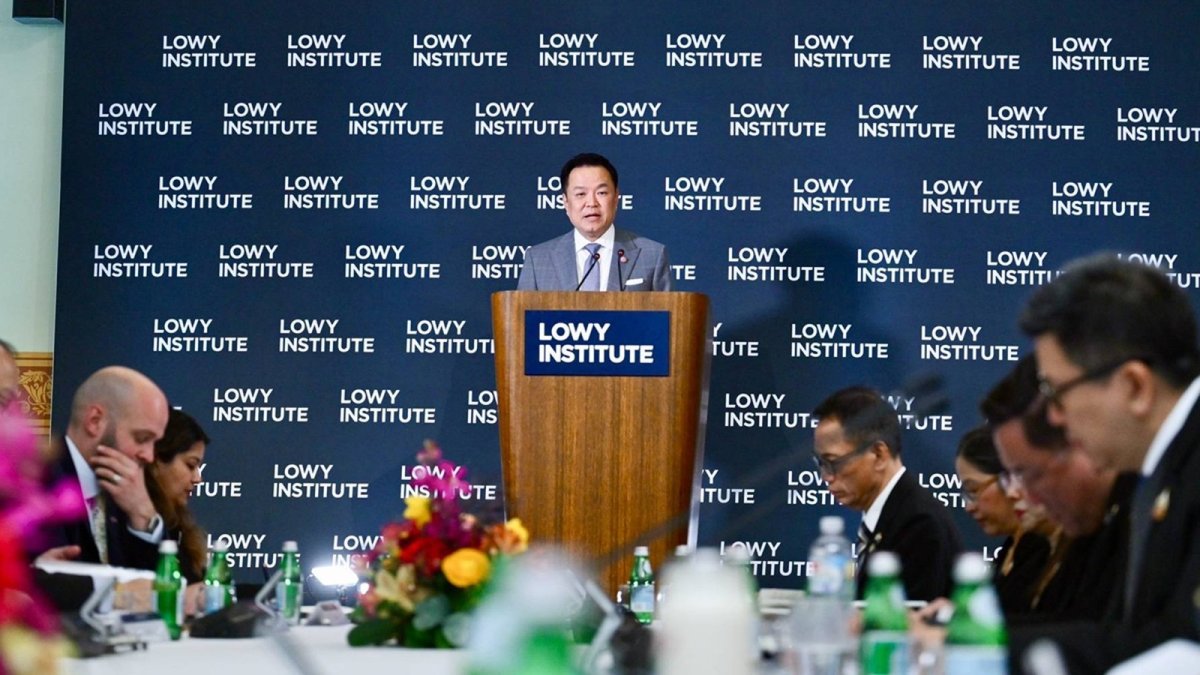
Anutin in Sydney: Thailand Charts a Course of Strategic Autonomy Amid Global Power Rivalry
Prime Minister Anutin Charnvirakul delivered a defining statement of Thailand's foreign policy on Tuesday, telling an audience at the Lowy Institute in Sydney that the kingdom will not be forced to pick a side in the intensifying rivalry between global superpowers. His remarks, which frame Bangkok's approach as one of "strategic autonomy," come at a time when Southeast Asian nations are increasingly feeling the pressure of a fragmented international order.
"Not choosing sides does not mean having no choices," Anutin told the Australian think tank, articulating a vision where Thailand maintains its independence by cultivating a diverse network of partnerships. The speech marks one of the most detailed public explanations of the current administration's geopolitical philosophy, directly addressing the anxieties of regional allies who worry about the stability of a rules-based order in the Indo-Pacific.
The prime minister's visit to Australia, which includes a scheduled meeting with his counterpart Anthony Albanese in Canberra, is being closely watched in Bangkok and across ASEAN. For Thai readers, the message is clear: in a world where Washington and Beijing demand loyalty, Thailand intends to keep its options open, prioritizing national interest over alignment with any single bloc.
Strategic Autonomy: A Policy of Choice, Not Isolation
Anutin was careful to define what strategic autonomy does not mean. He explicitly rejected the notion that Thailand's stance equates to isolationism or neutrality on every issue. Instead, he framed it as a proactive strategy to build resilience against external pressure. "Strategic autonomy meant maintaining the ability to make independent decisions and work with a range of partners based on national interests," he explained to the Sydney audience.
This nuanced position is critical for Thai domestic consumption. The government in Bangkok is balancing deep economic ties with China, its largest trading partner, against a long-standing security alliance with the United States. By diversifying partnerships, Anutin argues, Thailand becomes less vulnerable to coercion. "Countries should diversify their partnerships so they have more options and are less vulnerable to pressure to align with another country's interests," he said, a direct rebuttal to the binary choice that some global powers are attempting to impose on the region.
The prime minister's framing suggests a sophisticated understanding of middle-power politics. He posited that while Thailand and Australia cannot dictate the global balance of power, they possess significant agency in shaping regional norms. "Thailand and Australia may not be countries that determine the balance of power in the world, but we can help shape how power is used in our region," Anutin stated, positioning both nations as influential conveners and standard-setters in the Indo-Pacific.
ASEAN as the Strategic Anchor for Southeast Asia
A central pillar of Anutin's address was the reaffirmation of ASEAN's centrality in Thai foreign policy. He described the regional bloc as a "strategic anchor" that has fundamentally transformed Southeast Asia from a zone of historical division and mistrust into a hub for dialogue and integration. This narrative resonates deeply in Bangkok, where the Ministry of Foreign Affairs has long championed ASEAN as the cornerstone of its diplomatic engagement.
However, Anutin acknowledged that the bloc faces significant headwinds. He called for ASEAN to strengthen its internal unity and centrality, warning that the institution must develop a greater capacity to set its own agenda. "Regional institutions will become increasingly important as reaching consensus at the global level becomes more difficult," he said, signaling that Bangkok views ASEAN as a vital buffer against the paralysis of larger multilateral bodies like the United Nations Security Council.
For Thai readers, this is a familiar yet urgent message. As the ASEAN Chair rotates among member states, Thailand has consistently pushed for a more cohesive regional response to challenges ranging from the South China Sea disputes to the crisis in Myanmar. Anutin's insistence on ASEAN's proactive role suggests that Bangkok will continue to resist any attempt by external powers to divide the bloc or dilute its decision-making autonomy.
Myanmar and Cambodia: A Delicate Balancing Act
On the thorny issue of Myanmar, Anutin reiterated Thailand's support for the ASEAN Five-Point Consensus, the bloc's stalled peace plan, while defending Bangkok's controversial policy of "calibrated re-engagement." This approach, which has drawn criticism from Western nations and some regional peers, involves maintaining dialogue channels with the military junta in Naypyidaw. Anutin argued that this engagement is necessary to encourage "concrete progress" and keep lines of communication open.
In a notable development, Anutin welcomed the recent decision by Myanmar's military authorities to allow the International Committee of the Red Cross (ICRC) to meet detained former leader Aung San Suu Kyi. "Thailand had consistently pushed for such access," he said, framing this as a small but significant victory for diplomatic persistence. The Thai government's position on Myanmar remains a sensitive topic domestically, with human rights groups urging a tougher stance, but Anutin's comments suggest a pragmatic continuation of the current policy.
Regarding Cambodia, the prime minister struck a conciliatory tone, affirming Thailand's commitment to resolving disputes peacefully through bilateral mechanisms. This is a reference to ongoing maritime boundary negotiations and other bilateral issues that have occasionally strained relations between Phnom Penh and Bangkok. Anutin emphasized that maintaining ASEAN unity remains paramount, even as the two neighbors work through their differences behind closed doors.
Deepening Australia Ties: From Trade to Transnational Crime
The centerpiece of Anutin's visit is the scheduled signing of a joint statement with Prime Minister Albanese on cooperation against transnational crime. This agreement, to be formalized in Canberra, underscores a growing security partnership between the two middle powers. Anutin specifically cited efforts to combat cybercrime and transnational crime as prime examples of "minilateral arrangements" that can deliver concrete results without the complexity of larger multilateral forums.
Economically, the relationship is already substantial. Thailand and Australia have enjoyed a free trade agreement since 2005, and bilateral trade reached approximately A$32 billion in 2025. Anutin called for building on this foundation by linking Australian strengths in critical minerals, energy, education, and technology with Thailand's capabilities in advanced manufacturing, food production, and regional connectivity. He identified specific sectors for future cooperation, including batteries, next-generation vehicles, clean energy, and responsible artificial intelligence.
This economic agenda is particularly relevant for Thai businesses looking to diversify their supply chains. By deepening ties with Australia, Bangkok aims to reduce its "excessive dependence on any single market or supply source," a clear nod to the risks of over-reliance on any one economic partner. The focus on critical minerals and green technology also aligns with Thailand's domestic push toward a more sustainable, innovation-driven economy.
OECD Aspirations and the Future of the International Order
Anutin also used the Sydney platform to thank Australia for its support of Thailand's bid to join the Organisation for Economic Co-operation and Development (OECD). He argued that the accession process would help raise Thailand's regulatory standards and support innovation-driven growth. For Thai policymakers, OECD membership is seen as a marker of international credibility and a catalyst for domestic reforms, signaling to investors that Bangkok is committed to global best practices.
Looking ahead, Anutin acknowledged that the international system cannot simply revert to its previous form. He called for new partnerships that preserve strategic choices while strengthening economic resilience and regional stability. This forward-looking perspective is designed to reassure both domestic audiences and international partners that Thailand is not merely reacting to global shifts but is actively seeking to shape its own destiny within them.
For the broader Southeast Asian region, Anutin's message is a reminder that middle powers can carve out meaningful space for themselves in a competitive world. By championing strategic autonomy, Thailand is offering a model of engagement that prioritizes national interest and regional stability over bloc loyalty. As the prime minister returns to Bangkok, the challenge will be translating this eloquent vision into concrete policies that navigate the treacherous currents of great-power politics without sacrificing Thailand's sovereignty or its economic vitality.
By Ann Srisawat, Staff Writer
This article was produced with AI-assisted research and editorial support. Sources: Khaosod English, Global1 News reporting.
What's Your Reaction?
 Like
0
Like
0
 Dislike
0
Dislike
0
 Love
0
Love
0
 Funny
0
Funny
0
 Wow
0
Wow
0
 Sad
0
Sad
0
 Angry
0
Angry
0

Southeast Asia Correspondent at Global1.News. Based in Bangkok, covering Thai and Southeast Asian politics, economy, technology, and culture. Deep regional perspective on one of the world's most dynamic regions.














Comments (0)