
Egypt calls for end to Israeli violations, rejects forced displacement of Palestinians
Egypt’s Prime Minister Mostafa Madbouly used his address to the 81st United Nations General Assembly in New York to reiterate Cairo’s unwavering stance on the Palestinian question.
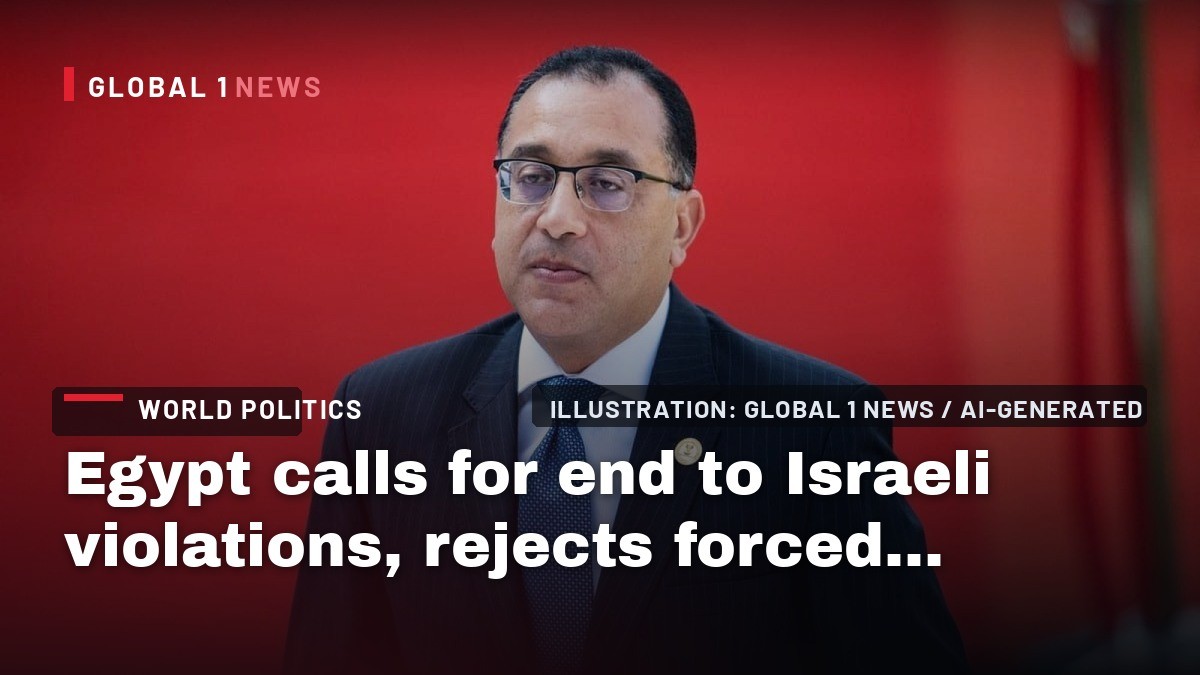
Egypt’s Prime Minister Mostafa Madbouly used his address to the 81st United Nations General Assembly in New York to reiterate Cairo’s unwavering stance on the Palestinian question. He called for an immediate end to Israeli violations against Palestinians, warned against any forced displacement of the population from the Gaza Strip or the occupied West Bank, including East Jerusalem, and underscored the necessity of a fully implemented ceasefire. By framing the conflict in terms of both humanitarian need and international law, Madbouly placed the human cost of the occupation at the centre of regional stability.
Demand for a Complete Ceasefire and Withdrawal
Madbouly’s speech made clear that a partial pause in hostilities would not suffice. He insisted that the Gaza ceasefire must be “fully implemented,” and that Israeli violations must be halted alongside the completion of a withdrawal. The emphasis on “full” implementation signals Egypt’s frustration with intermittent truces that have left civilians exposed to renewed violence.
By linking the ceasefire to a broader withdrawal, Madbouly highlighted the interdependence of humanitarian relief and political resolution. Without a complete pull‑back of forces, the prospects for sustained humanitarian access remain precarious, and the risk of renewed displacement persists. This stance reflects Egypt’s broader diplomatic strategy of tying immediate relief measures to longer‑term political outcomes.
Humanitarian Access and Early Reconstruction
In addition to demanding an end to hostilities, Madbouly called for “sustained humanitarian access” to Gaza. He urged the international community to protect civilians and reject collective punishment, invoking the principles of international humanitarian law. The call for “the start of early recovery and reconstruction” points to the urgent need to rebuild homes, infrastructure, and livelihoods that have been devastated by years of conflict.
Madbouly’s appeal underscores the human cost of the war: families living in rubble, children without safe water, and a health system on the brink of collapse. By insisting on early reconstruction, Egypt signals that humanitarian aid must move beyond emergency relief to lay the foundations for a durable return to normalcy, a step that can only be achieved if the underlying occupation is addressed.
Reaffirmation of Palestinian Statehood
Madbouly reiterated Egypt’s support for an independent, sovereign, and geographically contiguous Palestinian state based on the June 4, 1967 lines, with East Jerusalem as its capital. This reference to the pre‑1967 borders reaffirms the long‑standing Arab League consensus that any lasting peace must be built on a just and comprehensive solution that respects Palestinian self‑determination.
By anchoring the call for statehood in the 1967 lines, Madbouly underscored the legal basis for Palestinian claims under international law. The emphasis on East Jerusalem as the capital reflects the city’s symbolic and practical importance for Palestinians, and signals that any settlement that ignores this reality would be incomplete and unsustainable.
Regional Security Linked to Palestinian Rights
Madbouly warned that regional stability cannot be achieved while Palestinian suffering continues. He argued that “peace cannot be built on uprooting a people from their land,” suggesting that any security framework that tolerates the occupation is fundamentally flawed. The Prime Minister linked the plight of Palestinians to broader regional security concerns, noting that no state can secure itself at the expense of its neighbours.
This perspective positions the Palestinian issue not as a peripheral humanitarian concern but as a core element of Middle East stability. By framing the occupation as a source of insecurity, Egypt calls on the international community to view the resolution of Palestinian rights as integral to preventing broader destabilisation, including potential spill‑over into neighbouring states.
Water Security as an Existential Issue
Beyond the immediate conflict, Madbouly highlighted Egypt’s “existential” water security concerns, warning against unilateral actions on shared water resources. He stressed the need for binding agreements under international law to manage the Nile and other trans‑boundary waters, insisting that development by one party must not come at the expense of harm to others.
This appeal connects environmental sustainability with the broader legal framework governing the region. By reserving Egypt’s rights under international law to protect its water security, Madbouly signalled that any unilateral exploitation of shared resources could exacerbate tensions, further destabilising an already volatile region.
Calls for UN Reform and Non‑Proliferation
Madbouly used his platform to demand comprehensive reform of the United Nations Security Council, citing Africa’s under‑representation. He argued that a more inclusive Security Council would better reflect the realities of the Global South and improve the legitimacy of decisions affecting the Middle East.
In addition, he called for a Middle East free of nuclear weapons and other weapons of mass destruction. This stance aligns with broader regional non‑proliferation efforts and underscores Egypt’s commitment to a security architecture that prioritises human safety over armament races.
Solidarity with Sudan and Broader Regional Outlook
Concluding his address, Madbouly reaffirmed Cairo’s support for Sudan’s unity and state institutions amid ongoing conflict. This solidarity reflects Egypt’s broader vision of a stable, cooperative neighbourhood where disputes are resolved through dialogue rather than force.
By linking the Palestinian cause with wider regional challenges—water security, UN reform, non‑proliferation, and Sudan’s stability—Madbouly painted a comprehensive picture of the interconnected threats facing the Middle East. His appeal to the international community was clear: lasting peace and security can only be achieved by addressing the root causes of suffering, respecting international law, and ensuring that the rights of all peoples, especially the displaced Palestinians, are upheld.
This article was produced with AI-assisted research and editorial support. Reporting is based on the source material cited below. Sources: Middle East Monitor; middleeastmonitor.com; Global1.News (26 September 2026).
By Fatima Al-Rashid, Staff Writer
What's Your Reaction?
 Like
0
Like
0
 Dislike
0
Dislike
0
 Love
0
Love
0
 Funny
0
Funny
0
 Wow
0
Wow
0
 Sad
0
Sad
0
 Angry
0
Angry
0
Gulf/MENA Correspondent at Global1.News. Based in Doha, covering Gulf politics, energy markets, diplomacy, and development across the Middle East and North Africa. Tracks the economic transformation of the Gulf states.















Comments (0)