
Bank of England raises interest rates to 4%, the first increase for more than three years
The Bank of England has lifted its base rate to 4 per cent, ending a three‑year hiatus on monetary tightening. Why the Bank felt compelled to act now Oil has lingered above the £100‑a‑barrel mark since hopes of a diplomatic settlement to reopen the Strait of Hormuz evaporated.
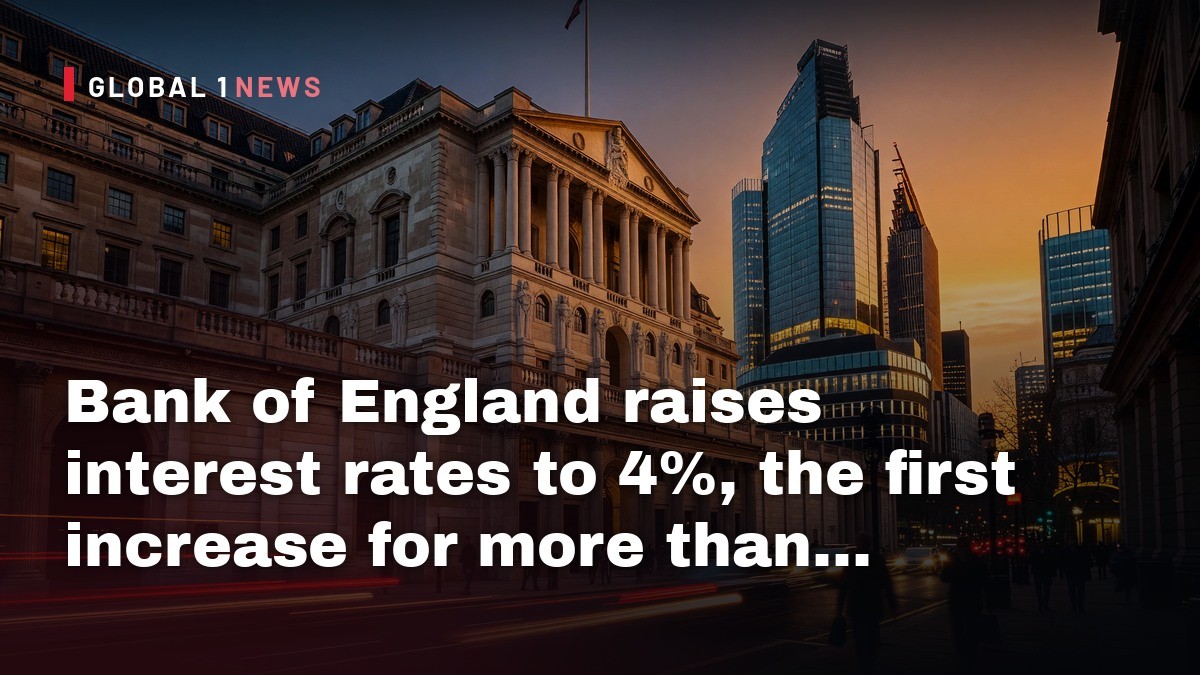
The Bank of England has lifted its base rate to 4 per cent, ending a three‑year hiatus on monetary tightening. The move, backed by eight of the nine members of the Monetary Policy Committee (MPC), reflects growing anxiety that the Iran war‑driven surge in oil prices could reignite inflationary pressures even as the cost‑of‑living crisis tightens household budgets.
Why the Bank felt compelled to act now
Oil has lingered above the £100‑a‑barrel mark since hopes of a diplomatic settlement to reopen the Strait of Hormuz evaporated. The resulting pass‑through to business and consumer costs was a key factor in the MPC’s decision to raise the base rate from 3.75 per cent to 4 per cent. Governor Andrew Bailey warned that, without a de‑escalation in the Middle East, the Bank “does not see the argument for a further increase in rates” as a one‑off event.
The Bank’s own forecasts underscore the risk: it now expects UK inflation to climb to 4.9 per cent in the middle of next year, up from the 3.2 per cent projected in July. September’s consumer price index already showed inflation at 3.5 per cent, suggesting the upward trajectory is already underway.
The split within the MPC
While the decision to raise rates was unanimous, the minutes reveal a stark divide over the magnitude of future hikes. Catherine Mann, the dissenting member, argued for a half‑point increase, contending that a more dramatic move was needed to restore the Bank’s credibility in fighting inflation. By contrast, Alan Taylor described the 0.25 percentage‑point rise as a “risk‑management ‘one‑for‑now’ insurance hike”, signalling a more cautious stance.
Bailey’s comments tempered expectations of a prolonged tightening cycle, insisting that today’s increase “shouldn’t be seen as the first in an inevitable long sequence”. Yet he cautioned that, without a resolution to the Iran conflict, “it does not seem likely to be the last increase”. The next decision, slated for 17 December, will therefore hinge on how quickly oil prices stabilise and whether the geopolitical risk premium recedes.
Impact on households and the cost‑of‑living squeeze
The rate rise will be felt most acutely by mortgage borrowers, who now face higher borrowing costs at a time when the Office for Budget Responsibility predicts real post‑tax incomes will fall this year and next. John Healey’s recent budget attempted to cushion the shock, extending the fuel‑duty freeze, maintaining the VAT cut on electricity bills and promising a £100 energy payment to twenty million households.
Nevertheless, the Bank’s projections for the energy cap suggest that the average household’s annual bill could jump from the equivalent of £1,723 to £2,150 in January, with a further rise expected in April. Food price inflation is also flagged as a risk, potentially reaching 4.75 per cent by mid‑2027. These pressures could erode the “breathing space” the government hopes to provide.
Business reaction and the looming pass‑through
Initial surveys indicate that many firms have so far managed to absorb higher oil and gas costs, often through hedging strategies. However, the MPC warned that this resilience may be short‑lived, and that businesses will soon have to pass on energy price shocks to consumers. The Bank is also watching wage dynamics, noting that workers may seek “bumper pay rises” to offset the higher cost of living, which could add further upward pressure on prices.
In the Bank’s view, the combination of rising energy bills, higher food costs and potential wage growth creates a “significant amount of inflationary pressure in the pipeline”. Bailey stressed that the recent dip in oil prices, while welcome, would need to be sustained before the Bank could consider easing the tightening stance.
Geopolitical undercurrents and market sentiment
The oil price swing has been linked to political developments beyond the UK. After the Democrats secured victories in the US Congress, oil prices fell below £100 a barrel, a move some investors interpreted as limiting former President Donald Trump’s ability to prolong the Iran conflict. Vice‑president‑designate JD Vance explicitly blamed the war for the inflationary surge, underscoring how geopolitical risk is now a core component of the UK’s inflation outlook.
Market participants had been pricing in a series of rate hikes, but the Bank’s nuanced language – acknowledging the risk of further increases while denying an inevitable sequence – may temper expectations. Still, the “significant amount of inflationary pressure” cited by Bailey suggests that markets will remain vigilant to any fresh escalation in the Middle East.
The government’s fiscal response and its limits
Healey’s budget aimed to offset the immediate pain of higher energy costs, but the Bank estimates that the package will shave only a quarter of a percentage point off inflation by mid‑2027. The extension of the fuel‑duty freeze and the VAT relief on electricity bills provide short‑term relief, yet the projected rise in the energy cap and food price inflation indicate that the fiscal cushion may be thin.
With real incomes projected to fall, the combined effect of higher borrowing costs, rising household energy bills and potential wage‑price spirals could deepen the cost‑of‑living crisis. The Bank’s warning that “unless the conflict in the Middle East is resolved, neither does it seem likely to be the last increase” places the onus on diplomatic progress to prevent a protracted squeeze on households.
Looking ahead: what the next decision could mean
The upcoming 17 December meeting will be a litmus test for the Bank’s assessment of both domestic price dynamics and the geopolitical environment. If oil prices remain below the £100 threshold and the Iran conflict shows signs of de‑escalation, the MPC may opt for a more measured approach, perhaps holding rates steady or delivering a modest hike.
Conversely, any resurgence in oil prices or a hardening of the Middle East stalemate could prompt a further increase, potentially aligning with Catherine Mann’s call for a half‑point move. Such a step would deepen the burden on borrowers and could force the government to expand its fiscal support, stretching public finances at a time when the Office for Budget Responsibility already warns of gloomy living‑standard forecasts.
In short, the Bank’s 4 per cent rate is a provisional pause rather than a decisive end‑point. The interplay between geopolitics, energy markets and domestic fiscal policy will shape the trajectory of UK inflation and, ultimately, the financial wellbeing of millions of households.
This article was produced with AI-assisted research and editorial support. Reporting is based on the source material cited below. Sources: The Guardian UK; theguardian.com; Global1.News (05 November 2026).
By Erica Thornton, Staff Writer
What's Your Reaction?
 Like
0
 Dislike
0
 Love
0
 Funny
0
 Wow
0
 Sad
0
 Angry
0

US Politics and Policy Correspondent at Global1.News. Based in Washington DC, covering American politics, policy, elections, and the courts. Knows how the system works and tells you what it actually means.














Comments (0)