
Kremlin Hopes Trump Will Continue ‘Peacemaking’ Efforts in Ukraine as Democrats Win Control of Congress
The Kremlin has publicly expressed hope that President Donald Trump will persist in his “peacemaking” role in Ukraine, even as the United States undergoes a dramatic political shift.
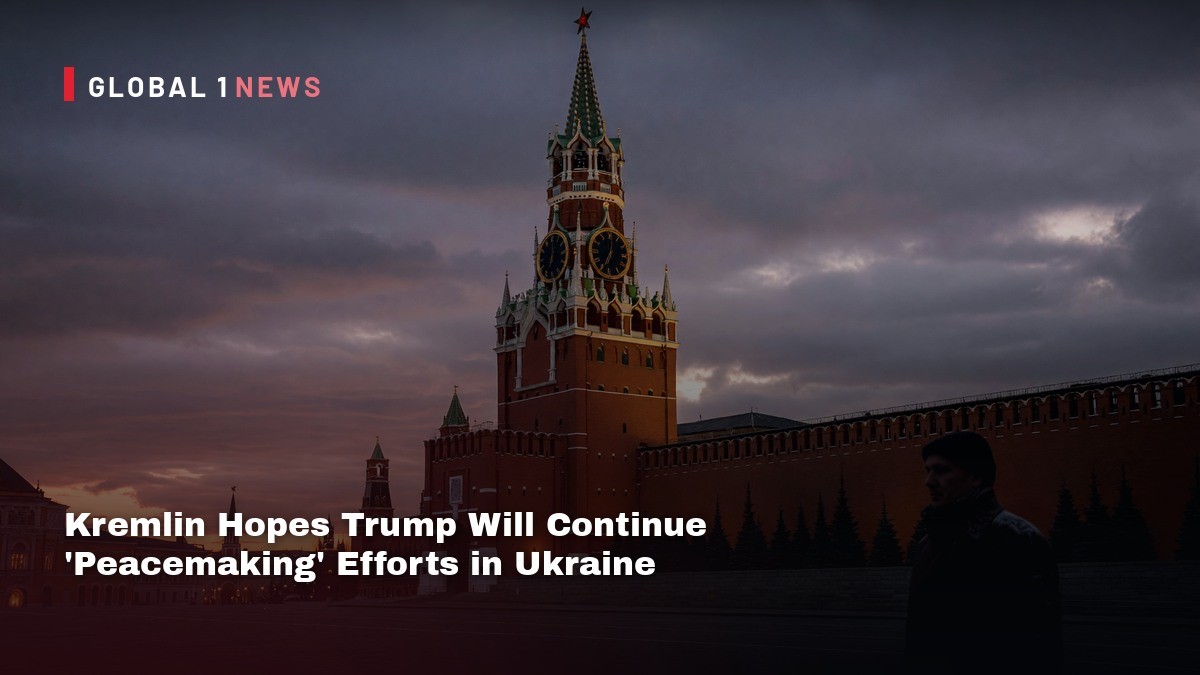
The Kremlin has publicly expressed hope that President Donald Trump will persist in his “peacemaking” role in Ukraine, even as the United States undergoes a dramatic political shift. In a statement to state media, Kremlin spokesman Dmitry Peskov said Moscow “sincerely counts on” Trump to continue his diplomatic efforts, underscoring the Russian leadership’s reliance on a personal relationship with the American president rather than on institutional channels that may soon be dominated by Democrats.
Official Kremlin Messaging on Trump’s Role
Peskov’s remarks were unequivocal: “President Trump will continue his term, and we sincerely count on him continuing his peacemaking efforts.” The spokesman framed the question of a Democratic‑controlled Congress as “America’s internal matter,” thereby sidestepping any direct criticism of the incoming U.S. legislature while reaffirming Russia’s expectation that the current U.S. administration will remain the primary conduit for any negotiated settlement.
He also highlighted forthcoming diplomatic initiatives, noting “another round of trilateral negotiations” and praising “Melania Trump’s successful peacemaking and humanitarian efforts.” By attaching the First Lady’s name to the peace process, the Kremlin seeks to personalize the diplomatic track and to bind the United States’ peace push to the Trump family’s brand, a tactic that may complicate future U.S. policy shifts.
U.S. Political Landscape After the Midterms
The midterm elections delivered a “devastating rebuke” to Trump’s policies, according to the source article, with Democrats capturing majorities in both the Senate and the House. The piece cites voter backlash against “costly tariffs, mass deportations and the highly unpopular war against Iran” as key drivers of the Republican defeat. While the Kremlin’s official comment downplays the impact of this shift, the political reality suggests an upcoming wave of congressional scrutiny over foreign‑policy initiatives, including any U.S.‑led attempts to mediate the Ukraine conflict.
Analysts note that the new Democratic majority is likely to pursue “war powers resolutions” aimed at ending the Middle East conflict, and by extension, to exert pressure on the administration’s broader foreign‑policy agenda. The article does not specify the exact nature of these resolutions, but the implication is that a more assertive Congress could constrain Trump’s latitude in negotiating with Moscow and Kyiv.
Current Diplomatic Track: Abu Dhabi and Trilateral Talks
In the immediate term, the United States is preparing a diplomatic mission to Abu Dhabi. White House special envoy Steve Witkoff and Jared Kushner, the president’s son‑in‑law, are slated to travel there “next week to mediate a new round of peace negotiations between Russian and Ukrainian delegations.” This deployment signals that, despite domestic setbacks, the Trump administration remains committed to a negotiated settlement before the end of the year—a timeline echoed by both U.S. and Russian officials.
The source material stresses that “Ukraine and Russia remain far apart on key issues,” particularly regarding territorial concessions and post‑war security guarantees. This divergence underscores the fragility of any prospective deal and suggests that the upcoming Abu Dhabi talks will be a test of whether personal diplomatic channels can bridge the substantive gaps that have stalled previous negotiations.
Trump’s Public Stance on the Conflict
President Trump has repeatedly framed himself as a peace‑broker, claiming from the outset of his presidency that he would end the war “on day one.” Yet the article notes that he has “struggled to broker a peace deal” and has increasingly criticized Ukrainian President Volodymyr Zelensky while asserting that President Vladimir Putin is “interested in signing an agreement.” This dual narrative serves two purposes: it positions Trump as the indispensable mediator and it casts the Ukrainian leadership as an obstacle, thereby aligning Moscow’s diplomatic overtures with U.S. presidential rhetoric.
From an analytical perspective, this rhetoric may be designed to pressure Kyiv into concessions by suggesting that the United States will not press harder without Russian cooperation. It also reinforces the Kremlin’s narrative that the United States, rather than Europe, is the primary external actor capable of influencing the outcome of the war.
Prospects for a Trump‑Putin‑Xi Summit
The source mentions a possible trilateral summit later in the month, involving Trump, Putin, and Chinese President Xi Jinping. While preparations are “still under discussion,” the very consideration of such a meeting signals Moscow’s willingness to involve China in the diplomatic equation, potentially leveraging Beijing’s strategic partnership with Russia to bolster its negotiating position.
Should the summit materialize, it would mark a rare convergence of three major powers in a direct dialogue over the Ukraine war. The Kremlin’s openness to this format suggests an attempt to broaden the diplomatic arena beyond the traditional U.S.–European track, thereby diluting Western influence and creating a multilateral pressure environment that could favor Russian demands.
Implications for Russian Domestic Politics
The Kremlin’s public reliance on Trump underscores a broader domestic narrative: that Russia’s path to peace is contingent on the goodwill of a single foreign leader. By emphasizing “Melania Trump’s successful peacemaking” and the president’s personal commitment, Russian officials are signaling to the Russian public that the prospect of an end to the war hinges on external actors rather than on internal military or diplomatic initiatives.
This framing serves a dual purpose. First, it deflects responsibility for the war’s continuation onto the United States, reinforcing the Kremlin’s long‑standing portrayal of the conflict as a Western‑driven aggression. Second, it prepares the domestic audience for a potential stalemate, should the incoming Democratic Congress impede Trump’s efforts, thereby allowing the Russian leadership to claim that any lack of progress is due to foreign political turbulence rather than to Russian intransigence.
Strategic Outlook: Kremlin Calculus Amid U.S. Transition
In sum, the Kremlin’s statements reveal a calculated bet on personal diplomacy over institutional channels. By publicly “counting on” Trump and downplaying the significance of the Democratic victory, Moscow seeks to preserve a diplomatic foothold that could be eroded if a new U.S. congressional agenda prioritizes a harder line on Russia.
Analysts infer that Russia will continue to press for a negotiated settlement that includes favorable territorial and security terms, while simultaneously leveraging the Trump‑centric diplomatic process to sow division within the Western alliance. The upcoming Abu Dhabi talks, the potential Trump‑Putin‑Xi summit, and the broader U.S. political transition will together shape the trajectory of the Ukraine war in the months ahead, with the Kremlin poised to exploit any fissures that emerge from the American political realignment.
This article was produced with AI-assisted research and editorial support. Reporting is based on the source material cited below. Sources: The Moscow Times; themoscowtimes.com; Global1.News (05 November 2026).
By Irina Volkov, Staff Writer
What's Your Reaction?
 Like
0
 Dislike
0
 Love
0
 Funny
0
 Wow
0
 Sad
0
 Angry
0
Russia/Eastern Europe Correspondent at Global1.News. Covering Russian politics, energy, security, and the shifting dynamics of the post-Soviet space. Provides clear-eyed analysis on one of the world's most opaque regions.










Comments (0)