
Ecuador’s Noboa Seeks Strategic Depth in Beijing as China Marks a Decade of Partnership
Daniel Noboa's first state visit to China marked a decade of the China-Ecuador strategic partnership, with Xi Jinping urging deeper alignment and Belt and Road cooperation. New agreements span green industries, trade and the digital economy as bilateral trade hit $9.83 billion in H1 2026.
Ecuador’s Noboa Seeks Strategic Depth in Beijing as China Marks a Decade of Partnership
In a recent CGTN report, President Xi Jinping was shown telling Ecuadorian President Daniel Noboa that China has always viewed its relations with Ecuador from a "strategic and long-term perspective," regardless of how the international situation may change. That framing, captured at the Great Hall of the People on Tuesday, August 18, was not diplomatic boilerplate. It was the central message of Noboa’s first state visit to China—an eight-day tour running from Sunday, August 16 through August 23, before continuing to Singapore and Vietnam until August 28. The visit marks the 10th anniversary of the China-Ecuador comprehensive strategic partnership at a moment when Quito is visibly recalibrating between Washington and Beijing, and the economic dividends of the China-Ecuador Free Trade Agreement (FTA) are becoming impossible to ignore.
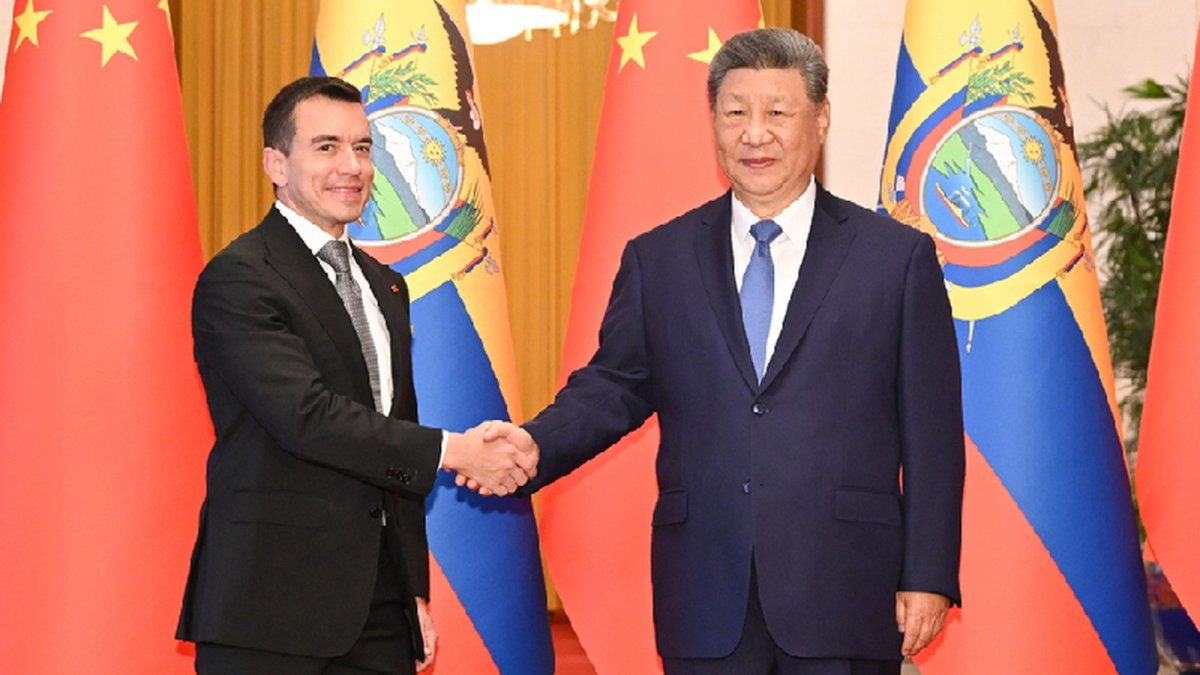 The optics of the visit were meticulously staged. A welcome ceremony and an evening banquet were held for Noboa, who also met separately with Premier Li Qiang and Zhao Leji, China’s top legislator. This was Noboa’s second trip to China as president—his first was in June 2025, when he and Xi witnessed the signing of a cooperation plan under the Belt and Road Initiative (BRI), which Ecuador joined in 2018. This time the stakes were higher: an explicit effort to deepen strategic alignment, with Xi urging both sides to strengthen the alignment of development strategies and implement the cooperation plan to jointly build the Belt and Road.
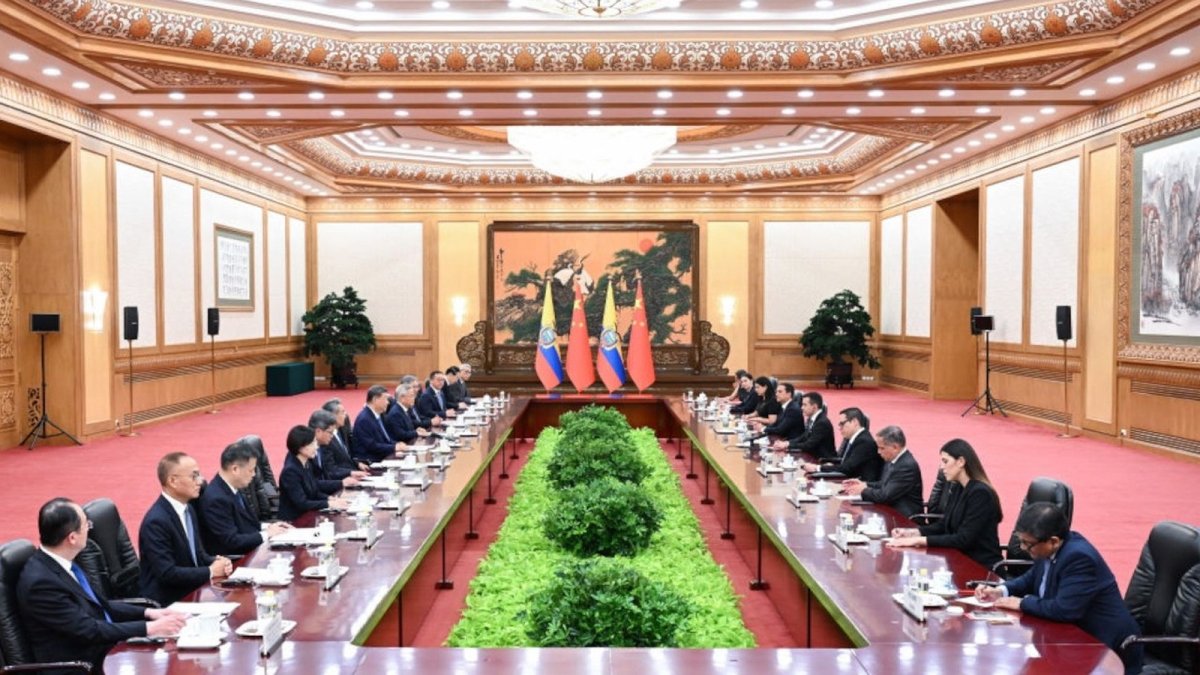
The optics of the visit were meticulously staged. A welcome ceremony and an evening banquet were held for Noboa, who also met separately with Premier Li Qiang and Zhao Leji, China’s top legislator. This was Noboa’s second trip to China as president—his first was in June 2025, when he and Xi witnessed the signing of a cooperation plan under the Belt and Road Initiative (BRI), which Ecuador joined in 2018. This time the stakes were higher: an explicit effort to deepen strategic alignment, with Xi urging both sides to strengthen the alignment of development strategies and implement the cooperation plan to jointly build the Belt and Road.
A Decade of Strategic Partnership: From 2016 to 2026
The 10th anniversary of the comprehensive strategic partnership, established during Xi’s state visit to Quito in November 2016, provides the historical anchor for this week’s talks. Over the past decade, the relationship has evolved from a commodity-driven exchange into a multifaceted economic and political alignment. Xi’s remarks during the talks underscored this evolution, calling for the implementation of cooperation projects in energy, minerals, infrastructure construction, and finance, while actively exploring new frontiers in the digital economy, green development, new energy, and artificial intelligence. For Beijing, the anniversary is not merely ceremonial. It is a strategic opportunity to consolidate political mutual trust and mutual support on core interests and major concerns. Xi was explicit in his support for Ecuador’s sovereign path, stating that China respects and supports Ecuador in exploring a development path suited to its national conditions. This language is carefully calibrated to resonate with Latin American audiences who are wary of external interference, and it dovetails with Xi’s broader message on the region: that the status of Latin America and the Caribbean as a zone of peace should not be shaken, and that the right of these countries to independently choose their cooperation partners should not be interfered with.The FTA Dividend: Trade Numbers That Speak for Themselves
The economic underpinning of this visit is the China-Ecuador Free Trade Agreement, which took effect on May 1, 2024. The numbers are striking. In the first half of 2026, bilateral trade value reached 9.831 billion US dollars, a 20.1 percent year-on-year increase. China has remained the largest destination for Ecuador’s non-oil exports, and the composition of that trade is shifting dramatically. Ecuador’s shrimp exports reached 7.47 billion US dollars in 2025, up 23.2 percent year-on-year, surpassing petroleum as the country’s top export category. China accounts for roughly half of Ecuador’s shrimp export volume. Ahead of the visit, Quito sought the lifting of export suspensions affecting a number of its shrimp processors—a reminder that friction points remain despite the FTA’s success. Xi addressed this directly, noting that bilateral relations have benefited from the FTA and the potential of China’s huge market, and urged both sides to continue tapping the FTA’s potential so that benefits reach more enterprises and consumers. For Noboa, who is navigating a complex domestic economic landscape, expanding exports to China is not just a trade policy; it is a political imperative.Noboa’s Balancing Act: Washington, Beijing, and the Art of the Pivot
Noboa’s visit to Beijing must be read against the backdrop of his government’s deepening security cooperation with Washington over the past 18 months. Ecuador has been courting U.S. military and intelligence support to combat drug trafficking and organized crime, a domestic crisis that has defined his presidency. Yet Quito is simultaneously courting Chinese trade and investment. This is not a contradiction; it is a strategy of diversification—maximizing leverage by maintaining strong ties with both superpowers, a classic playbook for middle powers in the Global South. His remarks in Beijing reflected this delicate calculus. Noboa hailed Xi as a great leader and said Ecuador is willing to always be a good friend of China on the other side of the Pacific. He expressed readiness to deepen political mutual trust, support China in safeguarding its sovereignty and territorial integrity, and respect China’s position on the Taiwan question. These are not throwaway lines. By explicitly aligning with Beijing on Taiwan, Noboa is signaling that his security cooperation with Washington does not extend to challenging China’s core interests. It is a calculated move designed to reassure Beijing that Ecuador’s strategic partnership is not a zero-sum game.
Xi’s Vision for Latin America: A Zone of Peace, Not a Battleground
Xi’s remarks on Latin America and the Caribbean were among the most significant of the visit. He stressed that China has always maintained that the status of the region as a zone of peace should not be shaken, that the course of development and revitalization of Latin American and Caribbean countries should not be disrupted, and that the right of these countries to independently choose their cooperation partners should not be interfered with. This is a direct rebuttal to U.S. influence in the region, framed not as an aggressive challenge but as a defense of sovereign choice. For Beijing, the message is clear: China is not asking Ecuador to choose sides, but it is offering an alternative model of cooperation that does not come with the political conditionalities often attached to Western aid and investment. This resonates deeply in a region that has historically been treated as a U.S. backyard. By supporting Latin American countries in upholding independence and self-reliance, Xi is positioning China as a partner in the region’s quest for strategic autonomy. The signed agreements—spanning green industries, economic and trade cooperation, the digital economy, and people’s livelihoods—are the tangible expression of this vision. Reports indicate that the package includes 43 million US dollars in direct aid for priority social development projects, a relatively modest sum but one that signals Beijing’s willingness to engage on soft-power fronts like healthcare, poverty alleviation, and disaster prevention.Beyond the Bilateral: Implications for ASEAN, the EU, and the Global South
The implications of this visit extend far beyond the Andes. For ASEAN nations watching closely, the China-Ecuador relationship offers a template for how Beijing engages with resource-rich, strategically located middle powers. The emphasis on the digital economy, green development, and new energy aligns with policy priorities Beijing has pursued through successive five-year plans, reflecting China’s push to export its technological standards and infrastructure models. For the European Union, which has been seeking to deepen its own trade ties with Latin America, the China-Ecuador FTA serves as a reminder that Beijing is moving faster and with fewer bureaucratic hurdles. For the broader Global South, the visit reinforces a narrative of multipolarity: Noboa’s ability to secure Chinese investment and trade access while maintaining security ties with Washington shows that smaller nations are no longer forced into binary choices. The second-order effects are significant: as China deepens its footprint in Latin America, the United States will be compelled to respond, potentially escalating competition in its traditional sphere of influence. Yet, Xi’s framing of the region as a "zone of peace" suggests that Beijing is content to let its economic weight do the talking, rather than engaging in overt geopolitical confrontation.The Road Ahead: From Banquets to Implementation
As Noboa’s tour continues to Singapore and Vietnam, the real test will be implementation. The cooperation documents signed in Beijing—covering green industries, digital economy, and livelihoods—are ambitious, but their success will depend on the ability of both governments to translate them into concrete projects. For Ecuador, the immediate priority is expanding shrimp exports and securing the lifting of suspensions on its processors. For China, the focus is on deepening access to Ecuador’s mineral wealth and renewable energy potential, while ensuring that the Belt and Road cooperation plan yields visible results. The 10th anniversary is not an endpoint; it is a launching pad. Xi’s call to “continuously bring bilateral relations to a new level” signals Beijing’s intent to deepen engagement with Ecuador, and by extension, with Latin America as a whole. Noboa has positioned himself as a pragmatic leader willing to navigate a multipolar world. Whether this visit marks a genuine strategic realignment or merely a tactical recalibration remains to be seen. But one thing is certain: the era of Latin America as a passive observer in great-power competition is over. The region is now an active participant, and Ecuador is leading the charge. By Prof. Marcus Chen, Staff WriterThis article was produced with AI-assisted research and editorial support. Reporting is based on sources cited in the article.
What's Your Reaction?
 Like
0
Like
0
 Dislike
0
Dislike
0
 Love
0
Love
0
 Funny
0
Funny
0
 Wow
0
Wow
0
 Sad
0
Sad
0
 Angry
0
Angry
0

Marcus Chen
World Politics Analyst at Global1.News. Based in Beijing, covering US-China relations, global trade, and geopolitical strategy. Brings deep analytical perspective to the power dynamics shaping international affairs.













Comments (0)