
Ecuador Charges Ex-Minister in Presidential Candidate's Assassination Case
Ecuador charges ex-interior minister Jose Serrano and six others, including Los Lobos leader Pipo Chavarria, over 2023 assassination of presidential candidate Fernando Villavicencio; five are fugitives.
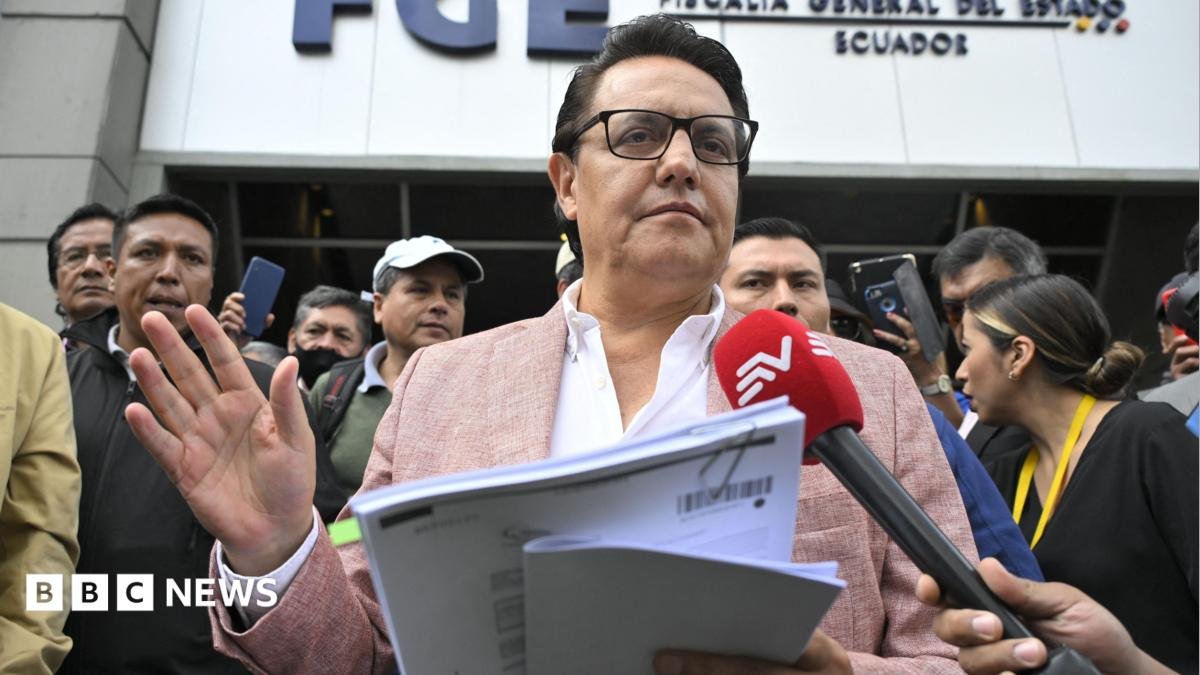
Ecuadorian prosecutors have charged a former interior minister and six others in connection with the assassination of presidential candidate Fernando Villavicencio, a killing that shook the nation eleven days before a general election. The charges, announced Saturday by the Attorney General's Office, implicate José Serrano, who led Ecuador's interior ministry during Rafael Correa's government, as an alleged intellectual author of the plot. Also named is Wilmer "Pipo" Chavarria, the suspected leader of the Los Lobos cartel, who was captured in Spain in 2025 after faking his own death. The case exposes the convergence of organized crime and state power that Villavicencio, a former investigative journalist, spent his career denouncing.
Quito, Ecuador — The seven accused are alleged to have played an indirect role in the murder of Villavicencio, who was gunned down in August 2023 after leaving a campaign rally in the capital, days before the presidential vote. The Attorney General's Office has requested Interpol red notices for the capture and extradition of the five suspects considered fugitives. Pre-trial hearings are taking place, and a judge will decide whether prosecutors have a case that can proceed to a full trial. Lead prosecutor Ana Hidalgo is heading the investigation, according to officials.
The Charges
The Attorney General's Office named seven people on Saturday, according to the BBC, including José Serrano, who allegedly acted as the intellectual author and mastermind of the assassination, according to prosecutors. Serrano, who served as interior minister during the government of former president Rafael Correa (2007-2017), allegedly had access to sensitive information about Villavicencio's security arrangements and allegedly contributed financially to the plot. He is currently located in the United States. These remain allegations at the pre-trial stage, and no determination of guilt has been made by any court.
The other accused include Xavier Jordán, a businessman located in the US; former assemblyman Ronny Aleaga, currently in Venezuela; senior Los Lobos member Luis Arboleda; and Ángel Esteban Aguilar, alias "Lobo Menor," who was arrested in Mexico City in March this year and returned to Ecuador after an Interpol red notice was issued over the murder of Villavicencio. Chavarria remains in Spanish custody, with an extradition request from Ecuador pending. Five of the seven are considered fugitives, the Attorney General's Office said, and it has asked Interpol to issue red notices for their capture and extradition.
A Killing That Shook an Election
Villavicencio was 59 when he was killed, a candidate for the Build Ecuador movement and a former investigative journalist and legislator who had built a reputation for exposing corruption, especially during the government of former president Rafael Correa, who held power from 2007 to 2017. He was one of the few candidates in the 2023 race who openly alleged links between organized crime and government officials, a stance that earned him enemies. He had received a number of death threats in the months before the attack and had been given a security detail, yet he continued to appear at public campaign events, refusing to be silenced.
The attack came as Villavicencio left a campaign rally in Quito. The alleged gunman was shot dead at the scene, according to reports. Six other men linked to the plot were later found murdered in prison while awaiting trial, raising alarms about the reach of criminal organizations inside Ecuador's penal system. The assassination, coming so close to the election, plunged the country into uncertainty and underscored the growing power of drug cartels that had transformed Ecuador from a relatively peaceful nation into one of the most violent in Latin America.
The Hunt Across Borders
The international dimension of the case shows how far the alleged conspirators went to evade justice. Chavarria, known as "Pipo," was captured in Spain in 2025 after having faked his own death, a dramatic attempt to escape prosecution that ultimately failed. He remains in Spanish custody with an extradition request pending from Ecuadorian authorities. His capture was a major breakthrough in a case that now stretches across Europe and the Americas.
Serrano and Jordán are located in the United States, while Aleaga is in Venezuela, according to the Attorney General's Office. Aguilar, also known as Lobo Menor, was arrested in Mexico City in March this year and returned to Ecuador after a red notice was issued over the killing. His criminal history adds a further layer to the case: he was sentenced to 20 years in prison in 2013 for the murder of Serrano's brother but fled after being granted parole. The cooperation of foreign governments will be essential to bring the fugitives before an Ecuadorean judge.
The Wolves of Ecuador
Los Lobos, or "The Wolves," sits at the center of the alleged conspiracy. InSight Crime, a think tank that tracks organized crime in Latin America, describes the gang as Ecuador's second-largest criminal organization, with roughly 8,000 members. The group began as a splinter of the Los Choneros cartel, breaking away around 2020, and has since grown into one of the most powerful forces in the country's drug trade. It is said to have deep connections to the Jalisco New Generation Cartel, known as CJNG, one of Mexico's most violent and expansive criminal networks.
Ecuador's geography helps explain the stakes. Sandwiched between Colombia and Peru, the world's largest producers of cocaine, the country has become a key transit point for the illicit drug as it moves toward North American and European markets. Cartels like Los Lobos use corruption and violence to control supply routes, and their expansion has fueled a surge in violence that made Ecuador one of the most dangerous countries in the region. The alleged involvement of a former interior minister in a political assassination points to the depth of that infiltration and raises questions about how far cartel influence extends within the Ecuadorean state.
A Case That Tests the System
This is not the first round of accountability in the Villavicencio case. In 2024, five people linked to Los Lobos were convicted and jailed over the killing, according to the BBC, with prosecutors saying they orchestrated the hit. Those convictions were a significant step, but the new charges reach higher, implicating figures with ties to state power and the upper ranks of the criminal underworld. The pre-trial hearings now underway will determine whether the case moves to a full trial, a decision that will test the capacity of Ecuador's judicial system to handle crimes that straddle the line between organized crime and the state.
President Daniel Noboa, who won the 2023 election in the aftermath of Villavicencio's assassination, has pursued a hardline security strategy, declaring an internal armed conflict against criminal gangs, deploying the military to the streets, and building new maximum-security prisons. Those measures have produced some results, including the capture of prominent gang leaders. Yet the Villavicencio case, with its alleged links between a former minister and a criminal gang, points to corruption that reaches beyond what military patrols can address, and questions remain about whether the political networks that enable cartels will face the same scrutiny as the gangs themselves.
What This Means for the Region
The charges resonate far beyond Ecuador. Across Latin America, the murder of politicians, journalists, and activists by organized crime has become a recurring crisis, from Mexico to Colombia to Brazil. The alleged alliance between a former interior minister and a cartel leader, if proven, would confirm the worst fears of those who study the region's criminal economies: that the line between the state and the cartels has become dangerously blurred. Villavicencio's family and allies have long pressed for accountability, warning that the case touches on alleged ties between organized crime and state officials.
What readers should watch now is whether the pre-trial hearings lead to a full trial and whether the fugitives are successfully extradited. The United States, Spain, Venezuela, and Mexico are all key players in that process, and their cooperation will determine whether justice can be achieved. The case has already exposed the international reach of Ecuador's criminal networks, but it also represents a test of whether a Latin American state can hold powerful figures accountable, even when those figures are accused of conspiring with the very forces the state claims to be fighting. For a region where impunity has long been the default, the outcome will be watched closely.
By Elena Vasquez, Staff Writer
This article was produced with AI-assisted research and editorial support. Sources: BBC News, InSight Crime, Infobae, El Universo.
What's Your Reaction?
 Like
0
Like
0
 Dislike
0
Dislike
0
 Love
0
Love
0
 Funny
0
Funny
0
 Wow
0
Wow
0
 Sad
0
Sad
0
 Angry
0
Angry
0

Latin America Correspondent at Global1.News. Based in Mexico City, covering politics, economics, energy, and culture across the region. Brings an on-the-ground perspective to stories spanning from the Rio Grande to Patagonia.












Comments (0)