
China injects 360 billion yuan into state banks and insurers to steady financial system
Beijing has unveiled a 360 billion yuan ($53.6bn; £39.7bn) capital injection into eight of the country's largest state-owned banks and insurance companies, a decisive move to reinforce the financial system as the world's second-largest economy contends with slowing growth, the fallout of the Iran war, and...
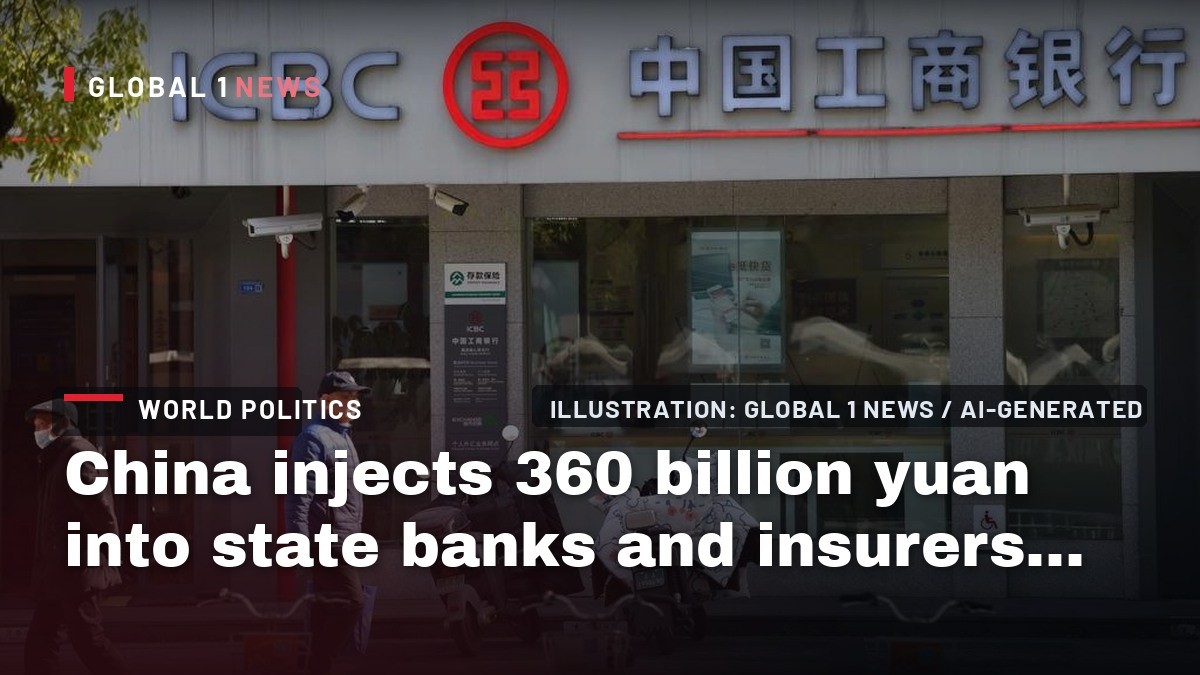
Beijing has unveiled a 360 billion yuan ($53.6bn; £39.7bn) capital injection into eight of the country's largest state-owned banks and insurance companies, a decisive move to reinforce the financial system as the world's second-largest economy contends with slowing growth, the fallout of the Iran war, and an intensifying technological rivalry with Washington. The cash infusion, led by the Ministry of Finance and announced by state news agency Xinhua on Sunday, is the latest pillar of Beijing's strategy to channel resources into the real economy while insulating key institutions from external shocks.
China injects 360bn yuan into banks, insurers to boost economy
Beijing, China — September 7, 2026
A Capital Infusion with Strategic Weight
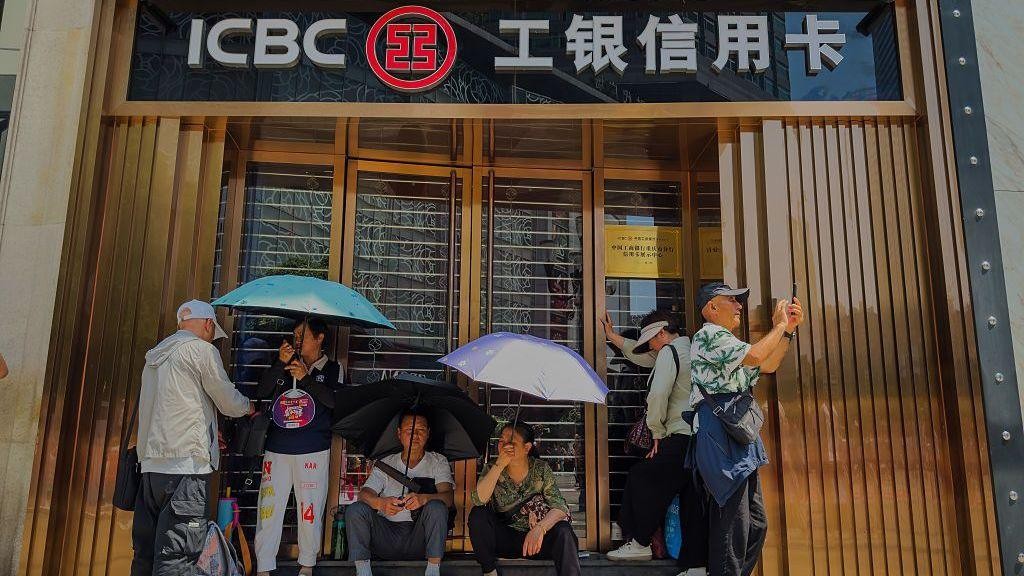
The recapitalization package, confirmed by Xinhua on Sunday, targets three of the nation's premier commercial lenders and five major insurance groups, including Industrial and Commercial Bank of China (ICBC), Agricultural Bank of China (ABC), and China Export & Credit Insurance Corporation (Sinosure). According to the official statement, the move "will help further enhance their sound operating capabilities, risk resistance capabilities, and ability to serve the real economy."
The scale of the operation — equivalent to roughly $53.6 billion — signals that Beijing is not merely tinkering at the margins. It is a deliberate, centrally coordinated effort to fortify the balance sheets of institutions that sit at the very heart of China's financial architecture. For context, ICBC and ABC are consistently ranked among the largest banks globally by assets, making their stability a matter of systemic importance not just for China, but for global financial markets.
Why Now? The Macroeconomic Imperative
The timing of the injection is no accident. Official GDP figures released in July revealed that China's economy expanded by just 4.3% in the second quarter of 2026, a sharp deceleration from the 5% growth recorded in the first three months of the year. This quarterly slowdown, driven by weak domestic demand and the inflationary shock of rising oil prices linked to the Iran war, has placed Beijing's annual growth ambitions under significant strain.
In March, the government lowered its full-year growth target to a range of 4.5% to 5% — the lowest official economic expansion goal since 1991. With the second quarter coming in below that band's midpoint, the pressure on policymakers to act has intensified considerably. The capital injection is therefore best understood as a preemptive measure, designed to ensure that state-owned financial institutions have the capacity to sustain credit flows to businesses and households even as global conditions deteriorate.
Financial Stability as National Security
For President Xi Jinping, the health of the financial sector has long been framed as a pillar of national security. This latest move is consistent with that doctrine, reflecting a view that economic resilience is inseparable from geopolitical strength. In the face of US-led sanctions pressure and export controls on advanced technology, Beijing cannot afford a domestic credit crunch or a banking crisis that would divert attention and resources from its strategic priorities.
The injection also serves a domestic political purpose. By reinforcing the capital positions of major lenders, the leadership is signaling to provincial governments, state-owned enterprises, and private investors that the central government stands ready to backstop the system. This assurance is critical for maintaining confidence in a period when property market weakness and local government debt concerns continue to weigh on sentiment.
Reading Beijing's Calculus on the Iran War and US Rivalry
The strategic calculus behind the recapitalization extends well beyond domestic bookkeeping. Beijing is closely monitoring the economic dislocations caused by the Iran war, particularly its effect on global energy prices and supply chains. As a major oil importer, China is vulnerable to price spikes that can fuel imported inflation and squeeze corporate margins. By strengthening the capital buffers of its financial institutions, Beijing is effectively building a firewall against these external shocks.
Simultaneously, the move is a direct response to the ongoing trade and technology rivalry with the United States. Washington's efforts to restrict Chinese access to advanced semiconductors and other critical technologies have underscored the need for a self-reliant financial system capable of funding domestic innovation. A well-capitalized banking sector is a prerequisite for the state-directed credit allocation that Beijing relies upon to support strategic industries, from artificial intelligence to electric vehicles and renewable energy.
What the Global Times and State Media Are Saying
State-affiliated media have framed the injection in explicitly defensive terms. The Global Times, a tabloid known for its nationalist perspective, argued that the package "will give banks and financial institutions more resources to channel into credit for the real economy, while strengthening their ability to withstand external shocks at a time of global financial uncertainty."
This framing is telling. It acknowledges, perhaps inadvertently, that the global financial environment has become markedly more uncertain — a reality shaped by the confluence of the Iran war, elevated interest rates in Western economies, and the fragmentation of global trade into rival blocs. The language of "external shocks" is a tacit admission that Beijing sees the current period as one of heightened vulnerability, requiring a more robust defensive posture.
Second-Order Effects for Global Markets and the Renminbi
For international investors, the recapitalization carries several implications. First, it reduces the probability of a sudden, disorderly deleveraging in China's banking sector, which would have severe spillover effects on global credit markets. Second, by supporting credit expansion, the move may provide a modest tailwind for Chinese commodity imports and industrial activity, with potential knock-on effects for global growth forecasts.
However, the injection also raises questions about moral hazard and the long-term efficiency of state-directed credit. Critics may argue that propping up banks with public funds, rather than addressing underlying structural weaknesses such as overcapacity in certain manufacturing sectors, merely postpones necessary adjustments. The renminbi's trajectory will be closely watched; a more stable financial system could support the currency, but persistent monetary easing and credit expansion could exert downward pressure over time.
Demographics and the Long Game
Beyond the immediate cyclical concerns, the recapitalization must be viewed against the backdrop of China's profound demographic challenges. A shrinking workforce and an aging population are reshaping the economy's potential growth rate, making it harder to achieve the kind of rapid expansion seen in previous decades. Beijing's broader aim is to transition from an investment-led, export-oriented model to one driven more by domestic consumption and high-value services.
This structural transformation requires a financial system that can price risk accurately and allocate capital efficiently. Whether state-owned banks, with their policy obligations and political mandates, can fully play that role remains an open question. The capital injection buys time, but it does not by itself resolve the deeper challenge of raising productivity growth in an era of demographic decline.
Outlook: A Calculated Bet on Stability
In the near term, the 360 billion yuan injection is a calculated bet that reinforcing the financial system's foundations will help China navigate a turbulent period. The Ministry of Finance's leadership of the operation underscores the fiscal commitment behind the move, while the involvement of institutions like Sinosure highlights the importance of trade credit insurance in an environment of rising geopolitical risk.
Yet the ultimate test will be whether this capital translates into productive investment and sustainable growth, rather than merely forestalling a crisis. With the annual growth target already at a three-decade low, and external headwinds showing no signs of abating, Beijing's room for maneuver is narrowing. The recapitalization is a necessary step, but it is unlikely to be the last intervention required to keep the world's second-largest economy on an even keel.
This article was produced with AI-assisted research and editorial support. Sources: BBC News (Peter Hoskins, Business reporter), Xinhua, Global Times.
By Prof. Marcus Chen, Staff Writer
What's Your Reaction?
 Like
0
Like
0
 Dislike
0
Dislike
0
 Love
0
Love
0
 Funny
0
Funny
0
 Wow
0
Wow
0
 Sad
0
Sad
0
 Angry
0
Angry
0

World Politics Analyst at Global1.News. Based in Beijing, covering US-China relations, global trade, and geopolitical strategy. Brings deep analytical perspective to the power dynamics shaping international affairs.











Comments (0)