
China AI Misinformation Crisis: Fake Disaster Videos
The same generative artificial intelligence technologies that China has prioritised as a pillar of national industrial strategy are now being weaponised by anonymous creators who fabricate disaster footage at machine speed, exploiting the gap between the country's rapid AI capability expansion and its lagging content verification infrastructure.
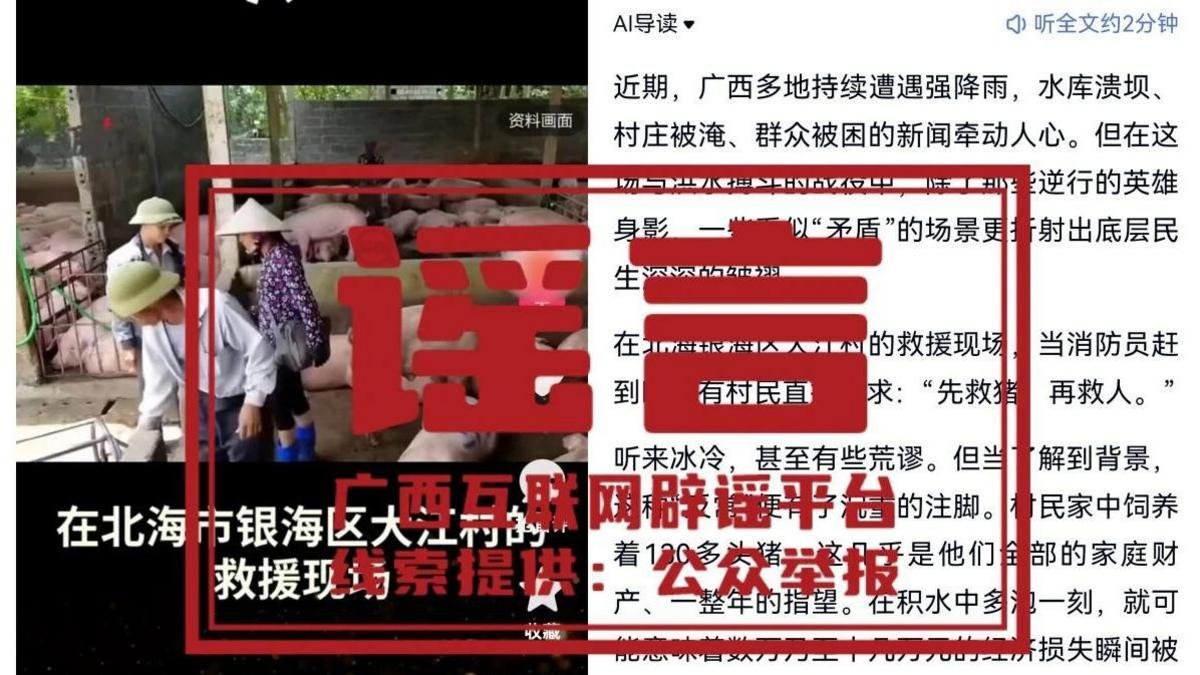
China's AI Ambition Collides With Digital Deception as Natural Disasters Fuel Misinformation Crisis
As Typhoon Noul lashes China's southern provinces, Beijing faces a challenge that extends beyond storm surges and floodwaters: a deluge of AI-generated disinformation that threatens to undermine public trust during an already volatile emergency. The same generative artificial intelligence technologies that China has prioritised as a pillar of national industrial strategy are now being weaponised by anonymous creators who fabricate disaster footage at machine speed, exploiting the gap between the country's rapid AI capability expansion and its lagging content verification infrastructure. The convergence of extreme weather, digital manipulation, and governance gaps presents an acute test for both domestic crisis management and China's global ambitions to lead in AI standard-setting.
Beijing, China — Article continues...
AI-Generated Fabrications During Typhoon Season
The past several months have witnessed a surge in AI-manufactured disaster content across Chinese social media platforms. These include synthetic images depicting corpses floating in floodwaters, fabricated scenes of severe inundation in areas that remained dry, and misleading portrayals of emergency response operations. In several instances, false videos claiming widespread power outages triggered panic buying of emergency supplies among residents, complicating evacuation logistics for local authorities. Huang Zhihua, Deputy Chief in charge of online public security for Zhejiang Police Department, told state media that content creators deliberately exploit disaster news to accumulate followers, recognising that sensational material attracts greater engagement and view counts.
Documented Incidents and Enforcement Responses
Specific cases illustrate the pattern. In early July, flooding in Hengzhou, Guangxi caused hundreds of snakes to escape from a breeding farm. This genuine incident was followed by fabricated images purporting to show crocodiles being released into rivers. Authorities have responded with arrests and administrative penalties in recent weeks, ranging from detention pending criminal prosecution to fines for those responsible for creating and distributing bogus reports. On 23 July, the Cyberspace Administration of China announced a nationwide crackdown on false internet content related to floods and disasters, instructing local branches to target fabricated data, malicious editing, staged scenes, and misattributed historical events, while calling on social media platforms to strengthen content review protocols.
Academic Analysis of the Generation-Detection Asymmetry
Chinese academics have provided pointed analysis of the structural imbalance driving this crisis. Professor Chen Bin, writing in the newspaper of the Communist Party's Central Party School, observed that AI dramatically lowers the technical barriers to producing false information, eliminating the need for sophisticated skills in photo manipulation or video editing. Professor Xu Xiaoke from Beijing Normal University characterised the situation as a persistent cat-and-mouse contest: detection technology consistently lags behind generation capabilities, and this asymmetry is unlikely to resolve quickly. Professor Gao Fuping from the East China University of Political Science and Law identified three tiers of motivation among perpetrators — those creating content for amusement, those seeking traffic for personal gain, and those deliberately aiming to provoke panic or social unrest — each requiring a different enforcement approach.
Trust Deficit From Official Information Management
The credibility gap that AI-generated content exploits has been widened by previous official information-management decisions. In early July, journalists were instructed to describe a major breach in the Liulan Dam near Nanning as an "opening" or "gap" rather than using more precise language, even as downstream flooding caused at least 26 fatalities. In 2021, local officials in Henan province were arrested for concealing or underreporting 139 deaths during catastrophic flooding. These episodes have created a documented trust vacuum, making citizens more susceptible to believing fabricated content when official channels are perceived as incomplete. Residents who have encountered prior understatements become predisposed to treat any bulletin with caution, lowering the threshold at which viral videos gain traction during crucial evacuation windows.
China's AI Industrial Policy and Governance Gap
Beijing has positioned artificial intelligence as the central driver of technological modernisation since the 2017 national strategy declared AI would serve as the main driving force behind the country's progress. State-controlled Xinhua reports that China now hosts over 6,000 AI companies, with substantial capital flowing into large-scale training clusters and application deployment through mechanisms steered by MIIT, NDRC, and MOFCOM under frameworks such as the Dual Circulation strategy. These ministries coordinate subsidies, data infrastructure, and enterprise standards to accelerate generative capabilities. Yet the same industrial policies that prioritise output growth and capability expansion have not been matched by synchronised investment in real-time content verification infrastructure. Public security agencies are left to address harms after circulation, operating with detection tools that Professor Xu describes as perpetually behind generation capability.
The sequencing reflects a deliberate strategic choice: accelerate first, regulate later. In contrast, the United States and the European Union have begun embedding detection and watermarking requirements earlier in regulatory pipelines, coupling export controls with mandatory transparency rules for frontier models. Beijing's model, while generating industrial scale, accepts temporary governance gaps that adversaries and malicious actors can exploit during crisis periods.
International Implications for AI Governance Leadership
China's difficulties in containing AI-driven misinformation during natural disasters carry direct consequences for its diplomatic positioning. Beijing has sought to present itself as a responsible AI power capable of setting global standards, advancing initiatives such as the Global AI Governance Initiative and related United Nations engagements that emphasise responsible development and risk mitigation. Yet persistent domestic verification gaps supply counter-narratives that highlight enforcement shortfalls. Partners evaluating technology partnerships — particularly in the Global South where Chinese digital infrastructure investments are concentrated — weigh not only generative capacity but also demonstrated ability to manage second-order harms during emergencies. Foreign Ministry channels promoting Chinese regulatory templates as alternatives to Western frameworks face recurring domestic incidents that undermine credibility with target audiences.
The Legal and Regulatory Framework Gap
Professor Chen Bin warned that AI technology continues to evolve far faster than legal frameworks, a challenge that transcends national boundaries. Shanghai and Washington-based lawyer Peter Pang observes that legal professionals worldwide are witnessing an explosion in AI-related cases for which precedent remains thin. China's existing legal framework provides for penalties ranging from administrative fines to up to seven years of imprisonment for serious misinformation-related offences. However, the application of these laws to AI-generated content raises novel questions of intent, attribution, and platform liability that existing statutes were not designed to address. The Cyberspace Administration's late-July directive represents an attempt to close this gap through administrative guidance, but the enforcement machinery remains heavily dependent on provincial-level implementation, which varies in capacity and rigour.
Strategic Implications for Digital Governance
The crisis unfolding during Typhoon Noul's aftermath tests the coherence of China's digital governance model at a moment of heightened tension between technological ambition and social stability imperatives. While the state mobilises resources to combat AI misinformation through enforcement, platform content review, and public education — as Professor Gao advocates through combining law enforcement with publicised punishments — the underlying structural drivers remain: an AI industrial policy that prioritises generation speed over detection capability, official information management practices that erode public trust, and a legal framework still adapting to the speed of synthetic content creation. The outcome will carry lessons not only for China but for every nation seeking to harness advanced AI while managing its capacity for harm.
The immediate priority remains protecting populations affected by Typhoon Noul from both floodwaters and fabricated content. But the longer-term challenge — ensuring that detection and governance mechanisms keep pace with the generative technologies China is racing to develop — will determine whether the country can maintain domestic stability while projecting AI leadership abroad.
By Prof. Marcus Chen, Staff Writer
This article was produced with AI-assisted research and editorial support. Reporting is based on sources cited in the article.
What's Your Reaction?
 Like
0
Like
0
 Dislike
0
Dislike
0
 Love
0
Love
0
 Funny
0
Funny
0
 Wow
0
Wow
0
 Sad
0
Sad
0
 Angry
0
Angry
0

World Politics Analyst at Global1.News. Based in Beijing, covering US-China relations, global trade, and geopolitical strategy. Brings deep analytical perspective to the power dynamics shaping international affairs.















Comments (0)