
Macau jails pro-democracy campaigner in city's first national security case
The sentencing of former legislator Au Kam San to twelve years and six months in prison marks the first national‑security conviction in Macau since the region’s handover to China in 1999.
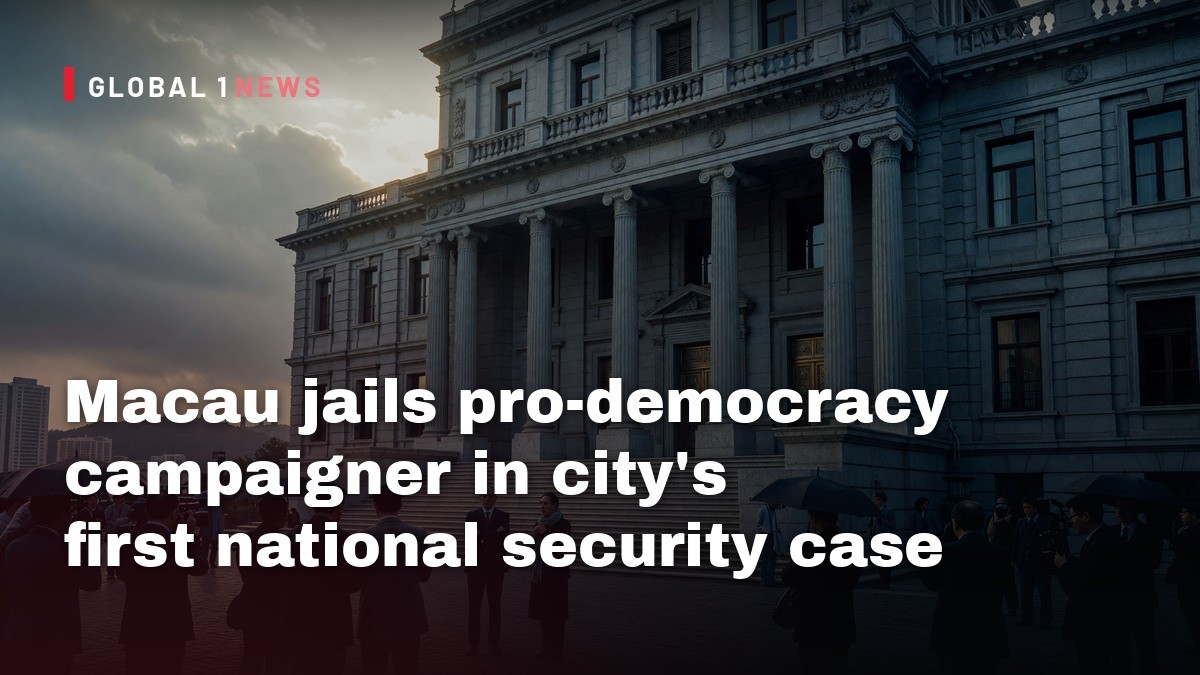
The sentencing of former legislator Au Kam San to twelve years and six months in prison marks the first national‑security conviction in Macau since the region’s handover to China in 1999. The case, concluded behind closed doors, underscores a tightening of Beijing’s security framework across its Special Administrative Regions and raises questions about the future of limited political dissent in the city‑state.
Background to the case
Au Kam San, now 69, was a primary‑school teacher before entering politics. He was elected to Macau’s Legislative Assembly in September 2001 and served for two decades as one of a small cohort of pro‑democracy lawmakers in a body otherwise dominated by pro‑Beijing figures. During his tenure, Au helped organise annual vigils commemorating the 1989 Tiananmen Square crackdown, a practice that had been tolerated in Macau and Hong Kong until recent security crackdowns.
In July 2025, Au was arrested and later charged with multiple offences, including three counts of subverting state power, three counts of endangering national security through contacts with foreign organisations, and one count of breaching confidentiality. After a three‑day trial that concluded in September, a judge ordered the proceedings to be held behind closed doors, citing the need to avoid prejudice to national‑security interests.
The legal framework
Macau’s national‑security law, enacted in 2009, criminalises treason, secession and subversion against the Chinese Communist Party. The legislation was broadened in 2023 to cover non‑violent acts of secession, and further amended in 2026 to permit closed‑door trials. These revisions align Macau’s security regime more closely with the sweeping national‑security measures imposed on Hong Kong after 2020.
The prosecutors argued that Au had “assisted and collaborated with external hostile organisations” by gathering and disseminating information they described as “manifestly filled with political claims of a subversive nature against the state.” They claimed these activities occurred over a long period, although the authorities have not disclosed the specific evidence presented at trial.
Details of the conviction
Au was found guilty of four of the seven charges brought against him. The court sentenced him to twelve years and six months, reflecting the seriousness with which Macau’s authorities view subversion cases. The sentencing follows a pattern of increasingly severe penalties for political activism in the region, mirroring a recent ten‑year sentence handed to Hong Kong activist Joshua Wong.
Family members reported that Au was not permitted to choose his own legal counsel; instead, a court‑appointed lawyer represented him. His wife, Virginia Cheang, described the ruling as “groundless persecution designed to humiliate Au” and expressed doubts that the authorities would allow regular correspondence or visits, noting her fear of “greater disappointment.”
Implications for Macau’s political landscape
The conviction sends a clear signal to the remaining pro‑democracy legislators in Macau. With only a handful of such voices historically present in the Legislative Assembly, the removal of Au—who had been a prominent figure for two decades—further narrows the space for dissent. The case also demonstrates the practical impact of the 2026 amendment allowing closed‑door trials, which limits public scrutiny and reduces transparency in politically sensitive prosecutions.
Given that the vigils Au helped organise have effectively been banned since the national‑security law’s expansion, the sentencing may deter future public commemorations or other forms of symbolic protest. The broader trend suggests a convergence of Macau’s security policies with those of Hong Kong, where similar restrictions have been in place since 2020.
Regional context and comparisons
The timing of Au’s sentencing, coming a day after Joshua Wong’s ten‑year sentence in Hong Kong, highlights a coordinated tightening of security enforcement across China’s Special Administrative Regions. Both cases involve former legislators or prominent activists charged with subversion and related offences, reflecting a consistent legal approach to curbing dissent.
While Hong Kong’s crackdown began in earnest after the 2020 national‑security law, Macau’s legal amendments in 2023 and 2026 illustrate a gradual alignment with mainland policies. The expansion of the law’s scope to include non‑violent acts and the allowance for closed‑door proceedings represent incremental steps that collectively reshape the legal environment for political expression.
Reactions from families and civil society
Virginia Cheang’s open letter, published after the verdict, underscores the personal toll of the case. She appealed for permission to write to and visit Au, acknowledging the slim prospects of a favorable response. Her statement that she “dare not hope for more” reflects a broader sense of resignation among families of political prisoners, who often face opaque judicial processes and limited avenues for appeal.
Human‑rights observers have noted the lack of public disclosure regarding the evidence and procedural details of the trial. The absence of transparent information fuels concerns about due‑process standards and the potential for politically motivated prosecutions. Although the source material does not include statements from NGOs, the pattern of closed‑door trials and assigned counsel aligns with broader critiques of the security law’s implementation.
Future outlook for dissent in Macau
Au’s imprisonment is likely to have a chilling effect on remaining pro‑democracy actors in Macau. The combination of lengthy sentences, restricted legal representation, and closed‑door hearings creates a deterrent environment that may discourage public advocacy and limit the formation of opposition networks.
Nevertheless, the historical memory of the Tiananmen vigils and the legacy of former legislators like Au may continue to inspire underground or low‑profile forms of dissent. The extent to which Macau’s authorities will enforce the national‑security law in future cases remains uncertain, but the precedent set by this first conviction suggests a trajectory toward stricter enforcement and reduced tolerance for political opposition.
This article was produced with AI-assisted research and editorial support. Reporting is based on the source material cited below. Sources: BBC News Asia; bbc.co.uk; Global1.News (09 November 2026).
By Kenji Tanaka, Staff Writer
What's Your Reaction?
 Like
0
 Dislike
0
 Love
0
 Funny
0
 Wow
0
 Sad
0
 Angry
0

Japan Correspondent at Global1.News. Tokyo-based voice covering Japanese politics, technology, economy, and culture. Tracks the intersection of tradition and innovation in one of the world's most dynamic societies.












Comments (0)