
Ceuta Crisis: Italy Suspends Schengen With Spain After 60,000 Migrants Overwhelm Enclave
Italy suspended Schengen with Spain for one month after 60,000 migrants overwhelmed Ceuta, leaving 57 dead and 7,000 minors among the arrivals. Madrid fired back with Frontex data showing Italy leads EU entries. Europe's open-border consensus is fracturing.
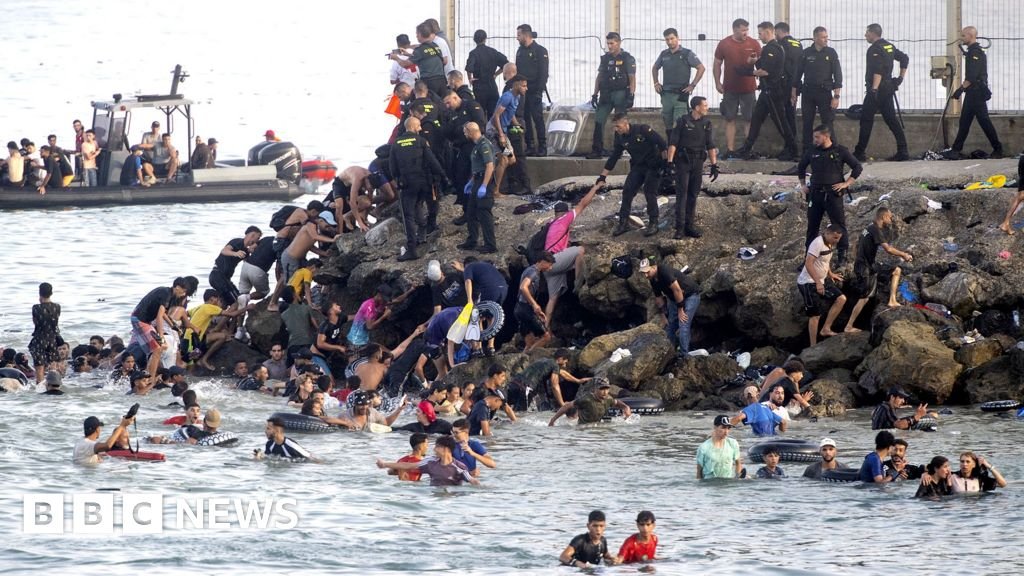
A 70% Population Shock in 48 Hours
About 60,000 migrants crossed into the Spanish North African enclave of Ceuta from Morocco starting in the early hours of Thursday July 30 — a surge that has left at least 57 dead, forced Spain to deploy armed forces, and shattered Europe's migration consensus. The toll was revised upward from 34 on Friday evening, with more casualties feared on the Moroccan side. Some drowned; others were crushed in a stampede at a breakwater near a border checkpoint.
Ceuta's population is roughly 83,600, and regional president Juan Jesús Vivas said the arrivals amounted to around 70 percent of the city's entire population. Spain's Interior Ministry offered a more conservative estimate of 50,000 arrivals since early Thursday. At least 7,000 of those who crossed are minors. By Friday evening, more than 48,000 had voluntarily returned to Morocco — but the political damage was done.
Ceuta has seen surges before; a 2021 influx sent police and military scrambling. Residents say this felt different. Carmen Gonzalez Bermudez: "thousands and thousands of people in swimming costumes and all wet, just coming from the sea." Víctor Ortiz Sotomayor: "packed with immigrants, in every square and street, mainly looking for food." His fear was raw: "We haven't gone outside because we're scared."
'People Are Dying Here' — The Human Toll
The testimony is gutting. One man returning to Morocco told Reuters: "It's not good at all, and it's not fun either. I mean, people are dying here. I beg you, please, if you haven't come yet, don't come. Don't do it." This was no hopeful migration — it was a desperate surge driven by criminal networks.
At least 57 are confirmed dead — the toll climbed through Friday — and officials have not ruled out more bodies on the Moroccan side. Migrants rounding the breakwater near the border checkpoint were caught between the sea and the sheer volume of people behind them.
Then there are the minors: at least 7,000 children and teenagers crossed in a single day. That is not a migration policy issue — it is a child-safety emergency that will test every asylum system Spain and the EU have. Residents described police present but passive; one said officers were "in the streets but they weren't doing nothing."
Why Now? A Court Ruling, Mafias, and Madrid's Fury
Prime Minister Pedro Sánchez, visiting Ceuta on Friday, blamed criminal networks for deliberately misreading a Supreme Court ruling that migrants stopped at sea while trying to reach Ceuta or Melilla cannot be summarily returned to Morocco. "What has emerged from our talks with Moroccan authorities is that trafficking mafias took a self-serving interpretation of a Supreme Court ruling," he said — one that "spread like wildfire." He called the surge a "violation of Spain's territorial integrity."
The timing is not accidental. Morocco, Ceuta's hinterland, is gripped by high unemployment and saw Gen Z-led anti-government protests last year. The ruling gave smugglers a story to sell — get in the water, and Spain cannot push you back — and thousands believed it.
Spain's response has been military. Armed forces have been deployed to bolster security in Ceuta and Melilla, the EU's other North African enclave, where 300 to 400 crossings were also reported overnight. But this is containment, not a solution.
Italy Draws the Line: Schengen Suspended
Italy's Prime Minister Giorgia Meloni called the images "shocking," writing that such "uncontrolled immigration" was a security threat to Europe. On Friday, she acted: Italy suspended the Schengen open-borders agreement with Spain for one month, starting Saturday.
Foreign Minister Antonio Tajani was explicit: "The temporary suspension of Schengen with Spain is a necessary decision to protect the security of our citizens and defend Europe's borders." Italy's interior ministry closed maritime and air entry points to arrivals from Spain. Checks will be "targeted," applying only to non-EU citizens; Spanish and European citizens traveling to Italy will not be impacted. Tajani called the measure "provided for by the treaties and, today, rendered unavoidable."
This is a political declaration as much as a border measure. Italy is saying Spain's failure to hold its external border is Europe's problem, and Rome will not wait for Brussels to fix it. The one-month limit does not reduce the significance. It is a warning shot.
Madrid Fires Back: 'Respect for Data Is Not Optional'
Spain did not take the blow quietly. Foreign Minister José Manuel Albares called Italy's remarks "improper" for "a partner and friendly country from which we expect European solidarity and not partisan demagoguery," and summoned the Italian ambassador to Madrid. On X, he insisted the integrity of the Schengen area was "guaranteed" and noted "practically the entirety of those who entered Ceuta have already returned to Morocco."
Sánchez went further, deploying statistics as a weapon. "Solidarity and empathy are optional. Respect for European treaties and data is not," he wrote. Frontex data from 2021 to 2026 shows Italy with the largest number of arrivals: 478,600. The Western Balkans route saw 340,600; Greece 259,800. Spain? 234,760. "This is not the time to divide. It is the time to continue building a strong and united EU."
The numbers are the point. If Italy — the EU's top arrival country over the past five years — gets to lecture Spain about border security, then Schengen has already broken.
Europe's Right Flank Sees Its Opening
Spain fights on multiple fronts. Czech Prime Minister Andrej Babiš went further than Meloni, calling for a temporary suspension of Spain's Schengen membership. Denmark's Mette Frederiksen, who spoke with Meloni, said "the EU must immediately take all necessary measures and consider all options, including a suspension of Schengen cooperation." Her reasoning was blunt: "Uncontrolled immigration is a threat to Europe. And to Denmark." No repeat of 2015, she said.
Germany moves too. Interior Minister Alexander Dobrindt said Berlin intends to reinforce and extend checks beyond September — checks first introduced September 16, 2024 at borders with Denmark, France, Belgium, Luxembourg and the Netherlands, extended three times, most recently until mid-September 2026. Chancellor Friedrich Merz: "We expect Morocco to take back the illegal migrants without delay"; "the protection of the EU's external borders is decisive for the fight against illegal migration."
Finland's Interior Minister Mari Rantanen backed Meloni outright, saying Spain failed to protect its border. The pattern is unmistakable: northern and eastern members are tired of the southern flank's failures.
Brussels and Washington: Words, Not Solutions
Commission President Ursula von der Leyen called the images "unacceptable": "We cannot allow anyone to come to our Union without abiding by our rules. Dangerous crossings must stop immediately. Smuggling networks must be dismantled. And returns must be swift, as our rules allow." Commissioner Magnus Brunner is ready to travel; Dubravka Suica is in contact with Morocco. The EU Pact on Migration and Asylum, in effect since June 12, 2026, faces its first test.
Washington weighed in. President Donald Trump called the situation "a catastrophe," blaming "weak law, bad management." The State Department said it stood with "the people of Spain, and all Europeans, against this egregious violation of their sovereignty and human rights," linking the crisis to Sánchez's earlier amnesty for irregular migrants — though new arrivals after it took effect are not eligible.
Britain watches nervously. Prime Minister Andy Burnham said his government had offered support to Spain — "obviously that's a matter for the Spanish government first and foremost, but it is a cause for concern." Reform UK's Nigel Farage called it "a battle for the future of our civilization," warning that "before long many will be crossing the English Channel to enter Britain illegally."
A Schengen Fracture That Won't Heal Quickly
The data shows this was no surprise. UN figures put 2,826 crossings into Ceuta up to July 15 this year, with another 181 via Melilla — compared with 994 for all of 2025, 476 in 2024, and 467 in 2023. Frontex's 2025 data showed the Western Mediterranean route was smaller than Italy's routes but the only major route with a year-on-year increase. The warnings were there. Europe ignored them.
Geographically, this is the EU's most exposed flank. Ceuta sits roughly 17 kilometers — 11 miles — from mainland Spain across the Strait of Gibraltar, one of the EU's only land borders with Africa. Ferry travel to the mainland requires ID checks. When 60,000 people arrive in 48 hours, containment is a fantasy.
The Schengen Area spans 29 European countries with abolished common-border controls. Italy's suspension, Denmark's saber-rattling, and Germany's extended checks are the first cracks in a system already under stress. Sánchez, Meloni, Frederiksen, Merz — all have answers; none has a solution. Sixty thousand crossed. Fifty-seven died. The future of Europe's open borders just became the price of their desperation.
By Jessica Ali, Staff Writer
This article was produced with AI-assisted research and editorial support. Reporting is based on sources cited in the article.
What's Your Reaction?
 Like
0
Like
0
 Dislike
0
Dislike
0
 Love
0
Love
0
 Funny
0
Funny
0
 Wow
0
Wow
0
 Sad
0
Sad
0
 Angry
0
Angry
0

Editor-in-Chief at Global1.News. Atlanta-based journalist who cuts through the BS and tells it like it is. Lead anchor, host, and the voice you hear when the spin stops and the truth starts.











Comments (0)