
Le Clos Makes History as SA Swimming Dominates Glasgow
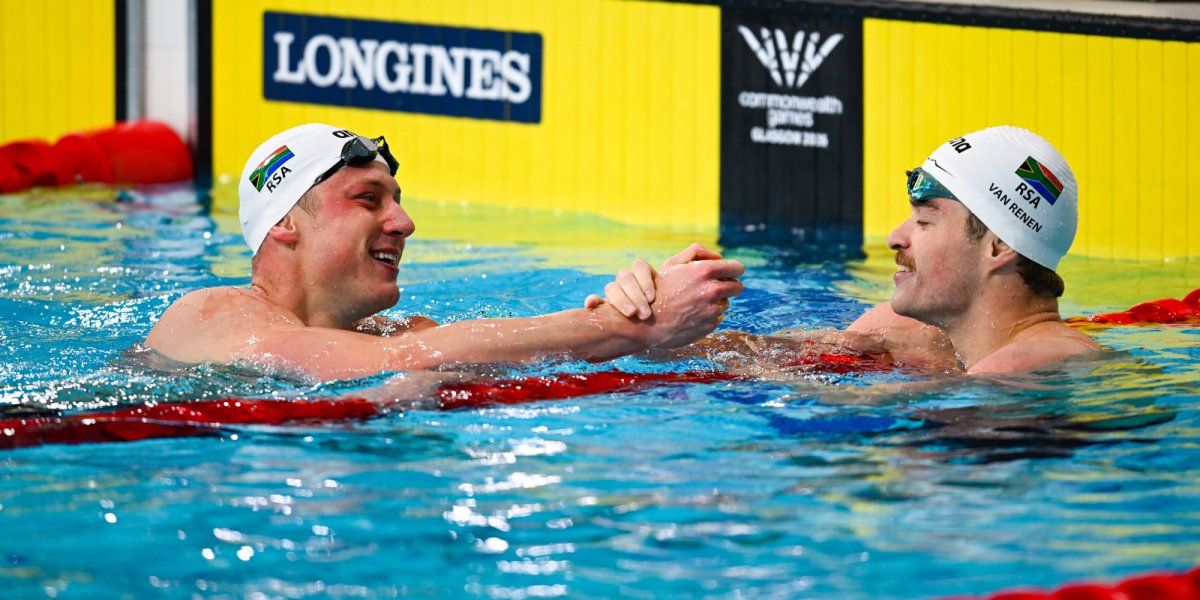
Le Clos Makes History as SA Swimming Dominates Glasgow Glasgow's Tollcross International Swimming Centre delivered a night South African sport will talk about for decades on Wednesday, July 29, when Chad le Clos became the most decorated athlete in Commonwealth Games history and Pieter Coetzé completed a golden backstroke sweep.
Le Clos Makes History as SA Swimming Dominates Glasgow
Glasgow's Tollcross International Swimming Centre delivered a night South African sport will talk about for decades on Wednesday, July 29, when Chad le Clos became the most decorated athlete in Commonwealth Games history and Pieter Coetzé completed a golden backstroke sweep. When the final relay touched home, Team South Africa had finished second in the swimming medal table with six golds among 22 medals — a display of depth, character and national pride that reached far beyond the pool deck.
Tags: Chad le Clos, Commonwealth Games, Glasgow 2026, Pieter Coetzé, Team SA swimming, backstroke, Lara van Niekerk, South Africa swimming, para swimming, Tollcross
A Night for the Ages at Tollcross
History has a habit of arriving quietly, and it slipped in with the final swim of the night. Le Clos, 34, swam the butterfly leg as South Africa claimed bronze in the men's 4x100m medley relay in 3:31.13, behind Australia and England, with Coetze, Michael Houlie and Ruard van Renen alongside him. That bronze was the 21st Commonwealth Games medal of his career — one clear of Australia's Emma McKeon — and it made the Durban-born veteran the most successful athlete the Games have ever produced, in any sport.
The achievement capped a remarkable six days at the Tollcross International Swimming Centre, where South Africa's swimmers and para swimmers rewrote expectations. Australia ran away with the overall programme — a record 37 golds among 76 medals, surpassing their own Gold Coast 2018 haul — but directly behind them sat the green and gold, ahead of Scotland and England. For a nation that finished ninth overall with seven golds and 27 medals at Birmingham 2022, this was a leap that signals a resurgent swimming culture.
Coetzé Completes the Backstroke Sweep
If Le Clos provided the emotional peak, Pieter Coetzé provided the pure speed. The 22-year-old, based in the United States, stormed to gold in the men's 100m backstroke in a Games and African record of 51.77 seconds — the second-fastest time in history, just 0.17 seconds outside Thomas Ceccon's world record. The victory completed a clean sweep of the 50m, 100m and 200m backstroke titles, a treble only Australia's Mitch Larkin had previously managed at a Commonwealth Games, at Gold Coast in 2018.
Coetzé's Glasgow story began on day one, when he broke the Games record in the 50m backstroke heats with 24.45 seconds, erasing Liam Tancock's mark from Delhi 2010. He followed with a Games-record 1:54.22 in the 200m backstroke, and on the final night he led off the medley relay in 51.71 seconds — yet another Games record. Add the mixed 4x100m freestyle relay silver and the men's 4x100m freestyle relay bronze, and the tally reads six medals in one Games.
Van Renen joined him on the podium in the 100m backstroke, taking bronze in 53.31 seconds behind England's Oliver Morgan. After the race, Coetzé allowed himself a moment of satisfaction. "I'm just relieved, I think, mostly," he said. "I'm very proud of myself and happy to get the job done. It was something I was focused on and believed I could do, so to pull it off is a great feeling."
Le Clos: From Delhi 2010 to the Record Books
To understand what Wednesday night meant, you have to understand the journey. Le Clos arrived at Delhi 2010 as an 18-year-old with the world at his feet, leaving with five medals. Glasgow 2014 brought seven more, Gold Coast 2018 added five, and Birmingham 2022 contributed one. His career tally now stands at seven golds, five silvers and nine bronzes across five Games — and that is before you mention the Olympic chapter that made him a household name.
In 2012, a 20-year-old Le Clos stunned the sporting world by pipping Michael Phelps by 0.05 seconds to win Olympic gold in the 200m butterfly at London 2012 — against an American icon who had not lost the event since 2001. He won more medals in Rio in 2016, competed in Tokyo and Paris, and has made clear he hopes to qualify for a fifth Olympics in Los Angeles in 2028.
The numbers tell a story of consistency; the words tell one of gratitude. "Looking back on the whole Commonwealth Games journey, from India through to now, I never thought I'd be standing here," Le Clos said. "To stand alone in history is unbelievable. Four years ago, I needed one more medal, then Emma came past me, and suddenly I needed three more. We just took it one day at a time."
The Depth Behind the Glory
What made Glasgow special was that the headlines did not belong to two men alone. Christian Sadie delivered a commanding gold in the men's 50m freestyle S7 with a new Games record of 28.06 seconds, announcing South Africa's para swimmers on the biggest stage. Danicka Vyncke, a Tuks swimmer and 2024 Paralympian, took silver in the women's S13 50m freestyle and could barely process it — "I simply can't believe it" — while Nathan Hendricks added men's S13 50m freestyle silver.
Kaylene Corbett went one better than her Birmingham 2022 bronze with silver in the women's 200m breaststroke in 2:24.46, behind Scotland's Angharad Evans, with Aimee Canny fifth and Rebecca Meder eighth. The women's 4x100m medley relay of Olivia Nel, Canny, Erin Gallagher and Meder powered to bronze in 3:58.58 — a new African record — pipping Canada on the final stroke behind Australia and Scotland.

And then there was Lara van Niekerk. The 23-year-old retained her women's 50m breaststroke crown in 30.43 seconds, four years after winning gold at Birmingham, and the tears flowed freely as she searched the stands for her parents. The road since 2022 has been brutal — health issues, setbacks, challenges that would have broken lesser athletes. Her comeback, and her stated targets of the 2027 World Championships and the Los Angeles Olympics in 2028, where 50m events join the programme for the first time, make her one of the most compelling stories in SA sport.
Team Culture: Doing It for Chad
Ask the swimmers what drove them and they will not point to medals tables. They will point to each other. When the mixed 4x100m freestyle relay team took silver — Coetze and Houlie building a commanding halfway lead by swimming the first two legs while rival nations deployed their women, Gallagher and Canny holding on until Australia swept past in the final 100 metres — the motivation was personal. "We did it for Chad," Gallagher said afterwards. "We wanted to get that 20th medal for him."
That medal tied Le Clos with McKeon at 20. The 21st came 24 hours later, and Le Clos was quick to share the credit. "The way the boys and girls swam... they swam their hearts out. They kept saying 'we're doing this for Chad' before they walked down and it just means the world to me." It is a team culture that echoes the Springboks' celebrated Bomb Squad ethos — collective effort, individual excellence, and a refusal to let a teammate walk alone.

What It Means for SA Swimming — and What to Watch For
For South African sport, Glasgow 2026 is more than a feel-good fortnight. It is proof that the country's swimming pipeline runs deep. Twenty-five swimmers represented South Africa in the swimming and para swimming programme, and the medal haul — six golds among 22 in the pool alone — suggests a system producing athletes across disciplines, not just a golden generation in isolation.
The transformation conversation that runs through every South African sport applies here too. Swimming has historically been a sport of barriers in this country — access, facilities, coaching — and the depth on display in Glasgow, from the university ranks to the para programme, is a reminder of how much talent exists when pathways open. The momentum must now translate into grassroots investment.
The road ahead is clear. The 2027 World Championships offer the next benchmark, with Coetzé, Van Niekerk, Houlie and Chris Smith among those eyeing the world stage. Then comes Los Angeles 2028, where the introduction of 50m events to the Olympic programme hands Van Niekerk and Coetzé a golden opportunity to convert Commonwealth dominance into Olympic medals. Le Clos, already an Olympic champion, has said he wants to be there for a fifth Games.
South African sport has been starved of unambiguous good news lately. Glasgow reminded everyone what it looks like: a 34-year-old champion rewriting the record books, a 22-year-old touching the second-fastest backstroke in history, a relay team swimming its hearts out for a teammate, and a flag flying second on the swimming medal table. It was a night to be proud of — and a warning that SA swimming is back.
By Dante Williams, Staff Writer
This article was produced with AI-assisted research and editorial support. Reporting is based on sources cited in the article.
What's Your Reaction?
 Like
0
Like
0
 Dislike
0
Dislike
0
 Love
0
Love
0
 Funny
0
Funny
0
 Wow
0
Wow
0
 Sad
0
Sad
0
 Angry
0
Angry
0

Breaking News and Investigations Correspondent at Global1.News. Based in London, covering global breaking news, security, and investigative stories. Known for digging deeper and connecting the dots across continents.











Comments (0)