
Prime Minister Carney Withdraws Support for FIFA Leadership
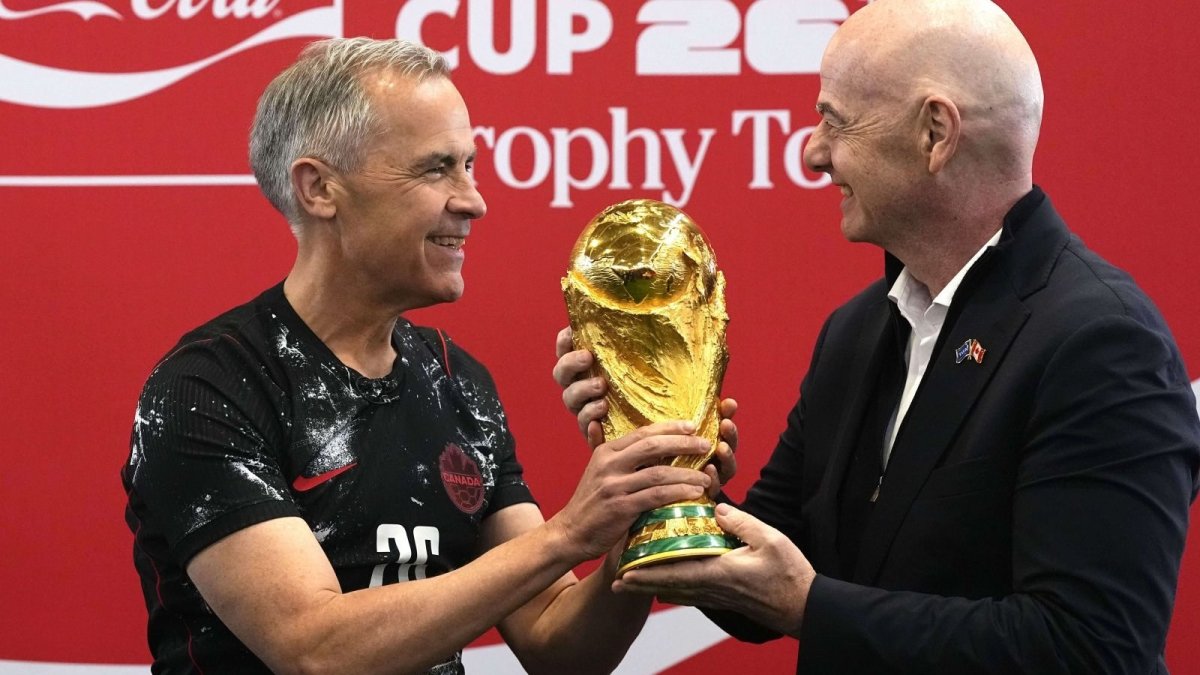
Prime Minister Mark Carney has stated he no longer has confidence in FIFA President Gianni Infantino. The announcement comes as the 2026 FIFA World Cup continues across Canada, the United States and Mexico. Carney’s remarks follow the collapse of a plan to create a private company to manage World Cup commercial rights. The proposal drew widespread opposition from soccer federations around the world.
Prime Minister Carney Withdraws Support for FIFA Leadership
Prime Minister Mark Carney has stated he no longer has confidence in FIFA President Gianni Infantino. The announcement comes as the 2026 FIFA World Cup continues across Canada, the United States and Mexico.
Carney’s remarks follow the collapse of a plan to create a private company to manage World Cup commercial rights. The proposal drew widespread opposition from soccer federations around the world.
Tags: Mark Carney, Gianni Infantino, FIFA, 2026 World Cup, Canada Soccer, Victor Montagliani, CONCACAF, UEFA
The Abandoned FIFA Forward Enterprise Plan
The plan, known as the FIFA Forward Enterprise, would have created a $20 billion company to run the World Cup. Private investors, including the Kushner family, were to be involved.
Infantino did not consult senior FIFA officials before advancing the idea. Carney described the failure to seek input as a fatal mistake for an organisation with global responsibilities.
The proposal was abandoned after strong resistance emerged from multiple confederations. FIFA later acknowledged that the process should have been handled differently.
Prime Minister Mark Carney’s shift in stance follows weeks of public appearances alongside FIFA leadership throughout the summer tournament matches hosted partly on Canadian soil. His assessment highlights how the absence of early dialogue with senior figures inside the governing body turned a commercial proposal into a broader crisis of trust, one that exposed the challenges of balancing investor interests with the sport’s worldwide obligations.
The episode underscores Carney’s view that decisions affecting football’s global structure demand wider input than might be expected even in routine corporate settings. By drawing parallels to everyday business practices, the prime minister framed the episode as a cautionary example for any entity entrusted with an event that spans multiple nations and confederations, including Canada’s own role in the current tournament.
International Pressure and Boycott Threats
UEFA’s 55 member associations threatened to boycott the World Cup if the plan proceeded. The Confederation of North, Central America and Caribbean Association Football and the Asian Football Confederation also voiced opposition.
British Prime Minister Andy Burnham added his voice to the pressure last Sunday, declaring that he did not believe Infantino was the right person to lead world football. “I do not believe he, FIFA president Gianni Infantino, is the right man to lead football forward on the world stage,” Burnham said. Multiple reports indicated Infantino offered Morocco the chance to host the 2030 World Cup final in exchange for support, though FIFA denied any such promise.
Reports emerged that Infantino had floated the idea of Morocco hosting the 2030 final as a means of securing backing, a claim FIFA immediately labelled false and misleading while insisting any future hosting decision would follow established procedures. The swift denial did little to quiet speculation, as confederations across Europe, North America and Asia had already signalled unified resistance to the commercial plan.
Inside FIFA headquarters, Arsène Wenger and Mattias Grafström publicly stepped back from the proposal on Tuesday, while senior adviser Carlos Cordeiro resigned the previous week. Chief operating officer Kevin Lamour described staff as deceived by the lack of openness, prompting the organisation to issue an apology letter to the FIFA Council and member associations that acknowledged the process should have been handled differently and pledged future improvements. FIFA has since said it reaffirmed full support for Infantino's presidency, with Secretary General Grafstrom and members of the management board backing the embattled president.
Carney’s Direct Criticism of the Process
Carney said the episode showed Infantino could not be trusted to manage an event of this scale. He noted that such decisions cannot be made without proper consultation, even in smaller organisations.
“I don’t have confidence in Mr. Infantino after this point, given what transpired and given the nature of what transpired,” Carney said. “This is not how you run any business, a small business, let alone something that is a global responsibility like football.”
The prime minister emphasised that football carries a global responsibility and must be governed with greater transparency. His comments align with growing calls for Infantino to step down.
Concerns Over Relationship With Trump
Additional scrutiny has focused on Infantino’s ties to U.S. President Donald Trump. The day before the United States faced Belgium, FIFA lifted the suspension of an American player after receiving a call from Trump, an intervention that drew immediate protest from the Belgian soccer federation.
The Belgian federation said it was “astonished” by the news and appealed the decision, but the appeal was dismissed just hours before kickoff, leaving little time for further recourse. UEFA condemned the sequence as an “incomprehensible and unjustifiable decision,” warning that the integrity of the game is at stake.
The episode added to existing questions about the impartiality of FIFA’s disciplinary processes during a tournament being staged across three host nations, and to broader unease over the president’s closeness to the White House.
Reactions and Analysis
For a prime minister who appeared alongside Infantino at World Cup matches earlier in the summer, Carney’s public break is a notable shift — and a reminder of how quickly the governance crisis has moved from boardroom disputes to the highest levels of international politics. His language was deliberately blunt, and it lands at a delicate moment for the co-hosting arrangement, with Canada still in the midst of its share of the tournament.
The episode also illustrates how the commercial ambitions of a single president can strain the sport’s multilateral foundations. Carney’s framing — that an organisation with a global responsibility cannot be run like a small business — echoes the objections raised by UEFA and confederations across three continents, and gives Canadian officials a clear reference point as they decide how far to push for change within FIFA’s member-driven governance structure.
Canada’s Stake and What Happens Next
Canada Soccer issued a statement on Wednesday confirming it remains aligned with CONCACAF and Carney’s position. The organisation will review the matter at its board meeting next week before charting any further response, placing Canadian officials in a position to weigh their stance ahead of broader international discussions.
Victor Montagliani, the Canadian head of CONCACAF and former president of Canada Soccer, is viewed as a potential successor if Infantino departs. Asked whether he would back Montagliani, Carney said the choice belonged to world soccer’s governing body, not international politicians, while praising the Canadian: “He’s an exceptional individual; he’s a credit to Canada, credit to football. He’s done a very good job in his role at CONCACAF … Loves the game. Loves the game.”
Infantino continues to seek a fourth and final term at the March elections. FIFA, for its part, has said mistakes were acknowledged and that the process should have been handled differently, while seeking to steady the president’s position ahead of a vote that will ultimately rest with the member associations.
For Canadian fans and officials, the stakes extend beyond the boardroom. With the tournament being staged partly on home soil this summer, the federation’s deliberations next week will be watched closely as a signal of where Canada stands in the wider fight over football governance — and whether a Canadian could one day sit at the head of the world game.
By Alex Thompson, Staff Writer
This article was produced with AI-assisted research and editorial support. Reporting is based on sources cited in the article.
What's Your Reaction?
 Like
0
Like
0
 Dislike
0
Dislike
0
 Love
0
Love
0
 Funny
0
Funny
0
 Wow
0
Wow
0
 Sad
0
Sad
0
 Angry
0
Angry
0
Canada Correspondent at Global1.News. Based in Toronto, covering Canadian politics, energy, trade, and US-Canada relations. Provides the Canadian perspective on North American and global affairs.










Comments (0)