
Head-On Collision Between Bus and Lorry in Brazil Kills More Than 20
At least 23 people, including two children, died when a health-authority minibus carrying patients collided head-on with a lorry on Brazil's BR-373 highway in Paraná. Police have opened an investigation into the crash.
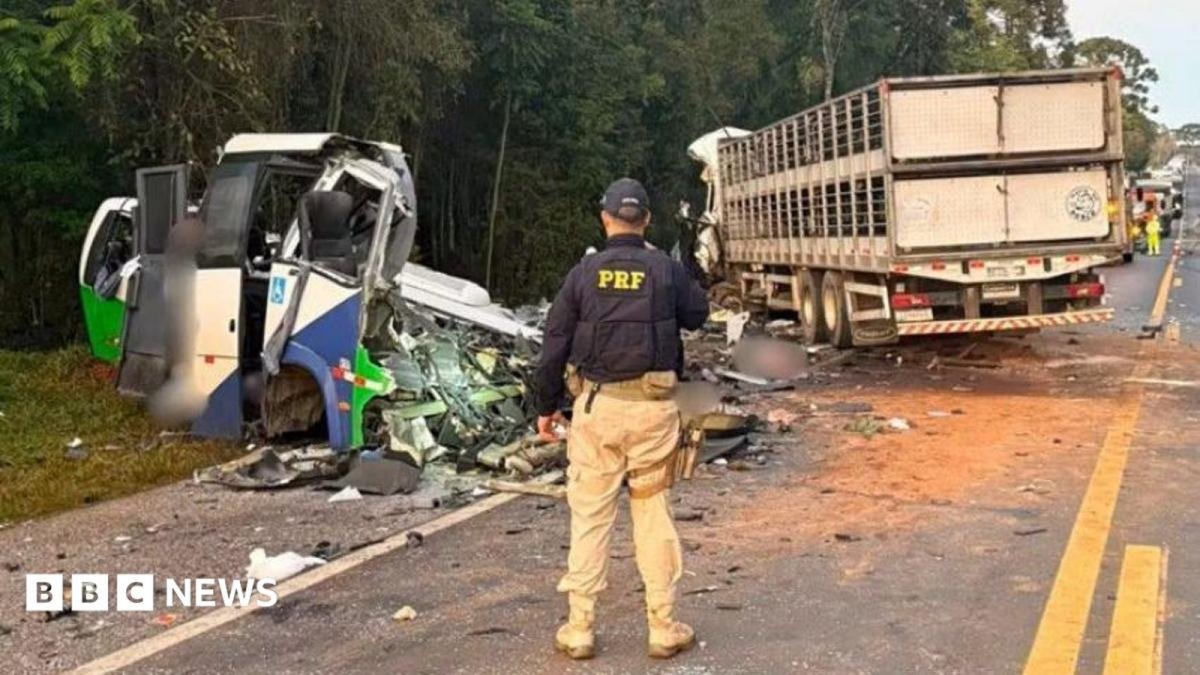
The predawn silence of the BR-373 highway in Paraná state was shattered early Wednesday in a collision that has once again laid bare the brutal arithmetic of Brazil’s roadways. A minibus, reportedly carrying patients and their relatives from the health secretariat of Imbituva toward medical appointments in Ponta Grossa, met a lorry head-on at kilometre 209. Federal highway police confirmed at least 23 people died, including two children, with another five injured. The lorry driver was also among the dead. As investigators sift through twisted metal and unanswered questions, the tragedy underscores a grim reality: for millions of Brazilians, the journey to see a doctor can be as perilous as the illness itself.
Curitiba, Brazil — The crash occurred in the early hours of Wednesday on a stretch of the BR-373, a vital artery cutting through the southern state of Paraná. The highway remained closed for nearly seven hours as forensic teams and officers from Brazil’s federal highway police (PRF) documented the scene. The minibus, according to local media reports, was operated by the health authorities of Imbituva, a municipality roughly 60 kilometres from Ponta Grossa, where the passengers were headed for scheduled health appointments. The exact cause of the head-on collision remains under investigation, authorities said.
A Routine Journey Turned Fatal
The victims were not tourists or long-haul truckers; they were people seeking basic medical care. The minibus was part of a common but often overlooked system in Brazil’s interior, where municipal health departments regularly shuttle patients to larger cities for consultations, exams, and procedures unavailable in their hometowns. For residents of Imbituva, Ponta Grossa is the regional hub for specialised medicine. The trip is a lifeline for those with chronic conditions, cancer treatments, or prenatal care needs.
Among the dead were two children, a detail that has sent waves of grief through the small community. The injured, five in total, were rushed to hospitals in the region, though their conditions were not immediately detailed by police. The lorry driver, whose cargo and route were not specified in initial reports, also perished in the crash. The PRF said the investigation will focus on reconstructing the moments before impact, including speed, road conditions, and potential driver fatigue — all recurring factors in Brazil’s road-death statistics.
The BR-373 and the Perils of Paraná’s Highways
The BR-373 is a critical corridor in Paraná, connecting agricultural heartlands to processing centres and ports. It is a road used by heavy lorries hauling grain, timber, and fuel, often sharing lanes with smaller vehicles like the ill-fated minibus. At kilometre 209, the highway passes through rolling hills and curves that demand vigilance, especially in the dark hours before dawn. Local residents have long complained about the road’s maintenance and the aggressive driving of some lorry operators, though no official data was immediately available to link those concerns to Wednesday’s crash.
The closure of the highway for nearly seven hours caused significant disruption, forcing detours and delaying freight shipments. For the families of the victims, however, the delay was a cruel prelude to the worst kind of news. The PRF’s forensic team worked methodically, photographing skid marks, measuring debris fields, and interviewing any witnesses who may have seen the vehicles in the moments before the collision. The investigation, police said, will take time, and the results may not be known for weeks.
A National Crisis in Numbers
Wednesday’s tragedy is not an isolated incident but a symptom of a persistent public health and safety emergency. According to a World Bank study cited by authorities, more than 34,000 people died in road traffic accidents in Brazil in 2023. The majority of those deaths were motorcyclists, a group particularly vulnerable on highways not designed for their safety. The study also highlighted that excessive speed, driving under the influence of alcohol, and mobile phone use while driving are among the leading causes of these fatal crashes.
These numbers place Brazil among the deadliest countries in the world for road travel, a distinction that carries enormous social and economic costs. Each death represents a family shattered, a community diminished, and a loss of productive years that disproportionately affects working-age Brazilians. The World Bank’s research suggests that many of these deaths are preventable with stricter enforcement, better road design, and public awareness campaigns. Yet, despite decades of advocacy, the toll remains stubbornly high.
February’s Pilgrim Bus and a Pattern of Tragedy
Wednesday’s crash follows another deadly incident in February, when a bus carrying pilgrims to a religious festival overturned in the north-eastern state of Ceará, killing 15 people on board. That accident, like the one in Paraná, involved a vehicle filled with passengers who were not merely travelling for leisure but for purpose — in that case, faith. The recurrence of such tragedies has prompted renewed calls for stricter safety regulations for passenger transport, particularly for smaller operators that may lack the resources of major bus companies.
In the case of the Imbituva minibus, questions are already emerging about the vehicle’s maintenance history, the driver’s hours behind the wheel, and whether the health secretariat had adequate protocols for such trips. Municipal health departments across Brazil often operate on tight budgets, and the vehicles used for patient transport are sometimes older models, retrofitted for medical purposes but not always subject to the same rigorous inspections as commercial fleets. The PRF’s investigation will likely examine these factors, though officials have not yet commented on the vehicle’s condition.
The Health Care Divide and the Road to Treatment
The tragedy also highlights a deeper structural issue: the centralisation of health care in Brazil. While the country’s universal health system (SUS) is a constitutional right, the reality is that specialised services are concentrated in larger cities. For residents of small municipalities like Imbituva, accessing a cardiologist, oncologist, or even a simple imaging exam often requires a road trip. This reliance on long-distance travel for health care is a daily reality for millions, and it carries inherent risks that are rarely factored into health policy discussions.
When a minibus full of patients crashes, the loss is not just personal but systemic. It reveals the fragility of a system that depends on safe roads to deliver its services. The five injured survivors now face their own medical journeys, this time as victims of the very system meant to help them. Their recovery, both physical and psychological, will be long. For the families of the 23 dead, the pain is immeasurable, and the search for answers has only just begun.
An Investigation and a Community in Mourning
The federal highway police have opened a formal investigation, and the results will be crucial in determining whether any charges are filed. In similar cases, outcomes have ranged from criminal negligence charges against drivers to civil suits against transport operators. The lorry driver’s death complicates the inquiry, as investigators will need to piece together his actions without his testimony. Data from the lorry’s tachograph, if present, and any onboard cameras could provide critical evidence.
In Imbituva, the mood is one of shock and sorrow. Local officials are expected to provide support to the victims’ families. The crash has also reignited debates about the safety of patient transport in Paraná, with some local leaders calling for an audit of all vehicles used by municipal health departments. Whether such measures will follow is uncertain, but the pressure on authorities to act is mounting.
As the sun rose over the BR-373 on Wednesday, the highway reopened to traffic, but the scars of the collision remain. For the families who lost loved ones, the road to Ponta Grossa will never be the same. For Brazil, the crash is another stark reminder that the country’s roads are not just conduits of commerce and connection but also sites of recurring, preventable tragedy. The investigation will seek to answer how this happened; the harder question — how to stop it from happening again — remains unresolved.
This article was produced with AI-assisted research and editorial support. Sources: BBC News Latin America.
By Elena Vasquez, Staff Writer
What's Your Reaction?
 Like
0
Like
0
 Dislike
0
Dislike
0
 Love
0
Love
0
 Funny
0
Funny
0
 Wow
0
Wow
0
 Sad
0
Sad
0
 Angry
0
Angry
0

Latin America Correspondent at Global1.News. Based in Mexico City, covering politics, economics, energy, and culture across the region. Brings an on-the-ground perspective to stories spanning from the Rio Grande to Patagonia.














Comments (0)