
New Orleans Police Officer Brandon Coleman Charged With 350 Counts in Overtime Fraud Case
A senior New Orleans police officer faces 350 criminal charges over alleged overtime fraud. Prosecutors say Brandon Coleman collected more than $172,000 in pay he never earned, caught on video at home while clocked in. He posted $17,000 bond; next court date Sept. 9.
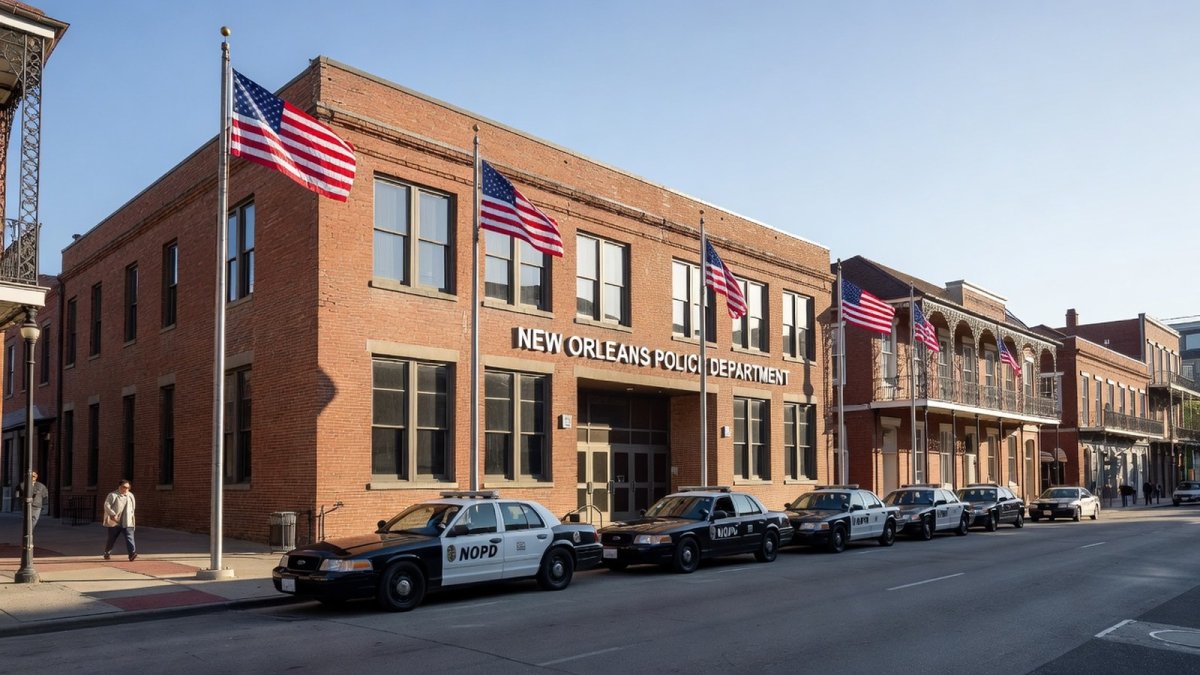
A senior New Orleans Police Department officer turned himself in Friday morning on 350 criminal charges tied to an overtime fraud investigation. Brandon Coleman, 39, faces 325 counts of filing false public records, 23 counts of public payroll fraud, one count of theft and one count of malfeasance in office. The case stems from a joint probe by the Louisiana State Police and the New Orleans Office of Inspector General that began in April 2026 — and prosecutors say the video evidence against him has been building for nearly a year.
The Arrest: 350 Charges and a Pattern of Mismatches
Coleman was booked into the Orleans Justice Center on Friday after investigators with the Louisiana State Police Criminal Investigations Division and the New Orleans Office of Inspector General found repeated discrepancies between his reported overtime work locations and where he actually was, along with gaps between his logged hours and his real hours. The alleged fraudulent payments stretched from December 2024 to December 2025, according to state police.
The probe grew directly out of WVUE FOX 8's "Unchecked Overtime" investigative series, first published in November 2025. FOX 8 cameras repeatedly recorded Coleman at his home while he was clocked in for work. In one example from July 22, his initial timesheet showed a 16-plus-hour shift running from 6:25 a.m. to 11 p.m. — but video showed him entering his unit at 10:08 a.m., hours after he claimed to have started.
Cameras vs. Timesheets: How the Case Was Built
The investigation gained traction precisely because authorities cross-referenced Coleman's self-reported locations against independent video evidence gathered over months. That methodical comparison revealed not isolated mistakes but a pattern of mismatches spanning an entire year of payroll submissions — turning what began as a media exposé into a formal criminal case with hundreds of counts.
The April 2026 launch of the joint investigation marked the shift from journalistic scrutiny to official accountability. By focusing on specific dates where footage contradicted timesheets, investigators built a timeline that aligned with the discrepancies first highlighted in the investigative series. Legal analysts noted that the straightforward nature of the video-and-records comparison could streamline proceedings, potentially encouraging a negotiated resolution over a full trial.
Such evidence collection also underscored how easily the prior self-reported system could be exploited when no real-time verification existed at assignment sites. The resulting charges reflect a deliberate effort to quantify the scale of the alleged fraud through documented gaps rather than assumptions — a case that illustrates how sustained external monitoring can convert public reporting into prosecutable evidence when discrepancies accumulate systematically.
First Court Appearance and Bond Decision
Coleman appeared Friday before Orleans Parish Criminal District Court Judge Juana Lombard. The Louisiana Attorney General's office argued that Coleman collected more than $172,000 he should not have been paid. Judge Lombard found probable cause on all 350 charges, setting the criminal case in motion.
Coleman posted a $17,000 bond and was released from jail. He is scheduled to return to court on September 9, 2026.
Defense Attorney Disputes the Allegations
Defense attorney Bobby Hjortsberg pushed back hard on the charges, arguing the surveillance footage tells an incomplete story. "Brandon works for Mardi Gras. He works citywide. He does all kinds of things. He's not at the station 24 hours a day. No one expects him to be," Hjortsberg said. "And so to say that because he walks out the door at 9 o'clock, that he hasn't been working for several hours before that, either shows that you don't care about the facts or, you know..."
Hjortsberg called Coleman "one of the hardest working NOPD officers on the force" and said the charges are "absolutely baseless," vowing to prove his client was working during the disputed hours with physical evidence. "I promise you, if that day comes, he will walk out the front door with me," he said.
FOX 8 legal analyst Joe Raspanti took a different view, predicting the case is unlikely to reach a jury. "This case has been pretty much laid out by Rob Krieger and the work he did here. I think it's going to be a pretty straightforward prosecution," Raspanti said. "I would be surprised if this thing ever goes to trial... you're going to go in there and try to get the best deal you can for your client because it's laid out already."
The Money: How Overtime Ballooned
The financial figures help explain why the case drew so much scrutiny. In 2024, Coleman received $112,275.12 in overtime pay on top of a roughly $65,000 base salary, for total earnings of $217,776.16 — after logging 146 days of 16-plus-hour shifts, according to Metropolitan Crime Commission data cited in the FOX 8 series. In 2025, his total compensation reached $229,000 against a $68,000 base salary, more than three times his base pay.
Coleman was not alone at the top of the overtime charts. NOPD's highest overtime earner in 2024 was Sgt. Henry Burke, who collected $245,903 — including $121,460 in overtime on an $83,000 base salary. A third officer, Christopher Kalka, became the subject of an internal NOPD investigation in May 2026 after payroll records showed he received more than $156,000 in just over eight months, nearly triple his base salary.
The compensation trajectory reveals how unchecked overtime approvals allowed individual earnings to far exceed base pay structures. When base salaries remained modest relative to overtime windfalls, the incentive structure encouraged logging hours that exceeded reasonable expectations for a single officer's capacity — a pattern that compounded year over year until external investigations intervened.
A Department-Wide Problem: The OIG Audit
The Coleman case did not emerge in isolation. A January 2026 review by the New Orleans Office of Inspector General found that NOPD officers logged more than 260,000 overtime hours totaling roughly $16.4 million between January and July 2025 — in violation of long-standing city policies governing overtime reporting.
The OIG had warned NOPD in April 2026 that its payroll practices left the department vulnerable to exactly this kind of abuse. The aggregate data painted a picture of widespread vulnerability rather than isolated incidents, with lax controls allowing overtime to function as a de facto salary supplement without adequate tracking of actual work performed.
By documenting those violations at a departmental level, the review shifted focus from individual accountability to institutional reforms that addressed root causes like absent biometric verification and supervisor credential misuse. The scale of the hours and costs involved helped explain why the subsequent joint investigation expanded rapidly once initial discrepancies surfaced — and why the persistence of high earners into mid-2026 indicated implementation lagged behind the identified risks.
Coleman is the second NOPD officer arrested as a result of the overtime investigation. Former Sgt. Henry Burke was arrested in February 2026 and fired last month, and a FOX 8 source confirmed Burke's case has been referred to federal prosecutors. Internal investigations into Sgts. Bianca Boone and Rene Benjamin are ongoing.
Reforms and Results: A 45 Percent Drop in Overtime
In response to the revelations, NOPD ordered in November 2025 that all officers working scheduled overtime shifts clock in using biometric time clocks at their specific district or assignment location, replacing the self-reported system that had allowed the alleged fraud to flourish. In May 2026, the department added policies requiring advance written approval for overtime shifts, clearer supervisory audit duties and mandatory spot checks — while eliminating the practice of employees self-approving timesheets using supervisor credentials.
The changes produced measurable results. The Office of Inspector General reported in July 2026 that NOPD overtime spending fell 45 percent during the first six months of 2026, saving the city more than $8.3 million.
NOPD Superintendent Anne Kirkpatrick said the department has fully cooperated with the independent investigation. "Accountability and integrity are fundamental to this department, and we will continue to cooperate as the case moves forward," Kirkpatrick said in a statement.
What's Next: Prosecution and the September Court Date
Louisiana Attorney General Liz Murrill confirmed her office will prosecute the case. "My office will prosecute this case. I appreciate the work of the Louisiana State Police and the New Orleans Office of Inspector General. We will continue holding public officials accountable for abusing the public's trust," Murrill said Friday.
Under Louisiana Revised Statute § 14:138, public payroll fraud is a felony carrying penalties of up to two years in prison, fines up to $1,000 and court-ordered restitution with legal interest to reimburse the government for its losses.
Coleman's September 9 court date will determine how the case proceeds. With Burke's case now before federal prosecutors and Kalka's internal probe still open, the city's overtime enforcement crackdown shows no sign of winding down — even as the reforms credited with saving millions suggest the era of unchecked overtime may finally be over.
Superintendent Kirkpatrick's statement on departmental cooperation reflects an institutional acknowledgment that accountability must extend beyond policy tweaks to include cultural shifts in overtime oversight. As remaining inquiries conclude, the focus will likely remain on whether the documented savings and procedural updates prevent recurrence while restoring public confidence in the department's financial integrity.
By Jessica Ali, Staff Writer
This article was produced with AI-assisted research and editorial support. Sources: WVUE FOX 8, NOLA.com, WWL-TV, Louisiana State Police, New Orleans Office of Inspector General, Louisiana Attorney General's Office, Metropolitan Crime Commission.
What's Your Reaction?
 Like
0
Like
0
 Dislike
0
Dislike
0
 Love
0
Love
0
 Funny
0
Funny
0
 Wow
0
Wow
0
 Sad
0
Sad
0
 Angry
0
Angry
0

Editor-in-Chief at Global1.News. Atlanta-based journalist who cuts through the BS and tells it like it is. Lead anchor, host, and the voice you hear when the spin stops and the truth starts.















Comments (0)